



ORANGE BEACH • BAYFRONT CONDO • BOATING AMENITIES
Bayshore Towers in Orange Beach: What Boaters Should Know About Slips, Docks, and Fit
_(800_x_150_px)_(2).gif)
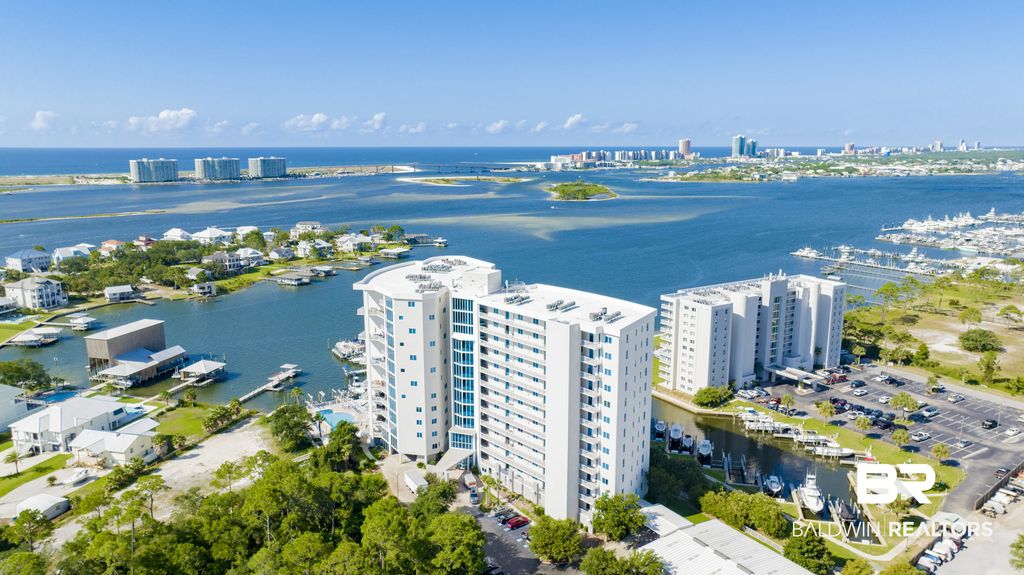
If you’re looking at Bayshore Towers because you want a true “condo + boat” lifestyle, you’re thinking the right way. From the aerial view, you can see an on-site dock system with multiple slips—exactly the kind of setup that makes Orange Beach so special. The key is this: slip access can be excellent here, but the details are always document-driven. I’ll walk you through what I look for and what I verify before my buyers commit.
“A boat slip is only an amenity if it actually fits your boat—and your lifestyle. My job is to make sure the ‘dream’ is true on paper.”— Meredith Folger Amon
I am frequently asked about the marina at Bayshore Towers, and it is one of the property’s most compelling lifestyle features. The condominium offers a private, owner-exclusive marina with deeded boat slips thoughtfully arranged along a central pier with finger docks on both sides.
The layout and spacing are well suited for a range of vessels commonly found along the Orange Beach waterfront, with most slips accommodating boats approximately 25 to 35 feet in length. Select slips—particularly those in more open or end-tie positions—may allow for larger vessels approaching 40 to 45 feet, subject to beam width and association guidelines.
As with most upscale condominium marinas, beam and overall profile are often the defining considerations rather than length alone, with many slips comfortably supporting beams in the 9 to 12 foot range.
Because each slip is individually deeded, I always advise buyers to confirm specific dimensions, lift or wet-slip configuration, and HOA parameters to ensure a seamless fit for their vessel and lifestyle.

Where Bayshore Towers fits in the Orange Beach boating lifestyle
Bayshore Towers appeals to boaters because it’s positioned in a protected waterfront setting with an on-site dock system. That typically means calmer water than open Gulf exposure and a more “grab-and-go” boating routine. If you’re exploring the broader market, start here: Orange Beach. And if boating is your priority, this resource stays bookmarked on my phone: Boater-Friendly Homes on the Gulf Coast.
One of the things I love highlighting about Bayshore Towers is its exceptional setting alongside the Burkardt Estates waterfront neighborhood in Orange Beach. This location places the condominiums in the heart of one of the area’s most established and boat-centric enclaves, where canals, private docks, and protected waterways define the landscape. The proximity to Burkardt Estates creates a uniquely boater-friendly environment, offering calm waters, easy maneuverability, and direct access to Terry Cove and the Intracoastal Waterway without the challenges of heavy open-water exposure. For boat owners, this means effortless departures, smooth returns, and a true “lock-and-leave” coastal lifestyle—where your residence and your vessel are seamlessly connected in a setting designed around life on the water.
Boating amenities you’ll typically want to confirm
Bayshore Towers’ dock system is the headline feature for boaters. What matters in practice is how slip access is structured and what the association allows. Here’s what I confirm early:
- Slip access type: deeded, assigned, leased/rented, or first-come/first-served
- Slip identification: the exact slip number tied to the unit (if applicable)
- Utilities: water and shore power availability at the slip
- Rules: boat length/beam limits, lift rules, vendor rules, storm protocols
- Costs: slip fees, dock maintenance, reserves, and special assessment history
Are the slips deeded, assigned, or first-come/first-served?
I want to be very clear here: I do not “assume” slip type based on a photo, a listing line, or a casual comment. Different condo communities—even within Orange Beach—handle slips differently. Bayshore Towers buyers should verify this through the association documents and/or management.
The only safe way to confirm slip rights is to match the condo unit to the slip number (if a slip is tied to the unit), then verify dimensions, fees, insurance requirements, and rules in the association documents and/or with management—before closing.
What size boats can Bayshore Towers slips accommodate?
Slip capacity is not one-size-fits-all. Even in the same dock system, slip lengths, widths, piling placement, and maneuver room can vary. That’s why I avoid promising exact dimensions without measured confirmation.
What I look for instead of “marketing length”
- Measured slip length (not just “up to X feet” language)
- Beam clearance between pilings and finger piers
- Turning radius in the basin (windy-day reality)
- Docking approach (angle + room to correct)
If your boat is close to a “round number” (like ~30’ LOA), day-to-day comfort can depend on swim platforms, bow pulpit, and how you rig lines and fenders. A boat that is technically “within the limit” can still feel tight if the slip is snug or the pilings are positioned in a way that reduces usable space.
What types of boats tend to work best for condo slip life
In general, the easiest ownership experience comes from boats that are comfortable in protected-water docking and don’t require a ton of “margin math” every time you come home. Buyers with these setups tend to be happiest:
- Center consoles and dual consoles that dock easily and don’t push max length/beam
- Bay boats for shallow-water versatility and simple handling
- Moderate-beam cruisers that leave clearance for pilings, fenders, and crosswind correction
Boats that can be more challenging—depending on the specific slip—are wide-beam vessels, tall profile boats in tight fairways, and anything pushing the slip’s maximum practical length once platforms/pulpits are considered.
“Beam is the silent deal-breaker. Length is what people sometimes brag about—beam is what you dock with.”— Meredith Folger Amon
Water and power: don’t assume they’re at “your” slip
One of the biggest quality-of-life factors is whether your slip has the utilities you actually use. If you rinse down, charge batteries, run a fridge, or need shore power, confirm what’s available at your slip, not just “on the dock.”
- Is there shore power at the slip? (and what amperage?)
- Is water available at the slip or via shared spigots?
- Are utilities included, separately billed, or metered?
Boat lifts: capacity matters as much as length
If a slip includes a lift (or allows one), I confirm the rated lift capacity, cradle/bunks, and the boat’s true wet weight (fuel, water, gear, batteries). “Largest of boats” language is marketing. I still verify capacity and configuration in writing.
- Is the lift included, separately owned, or association-owned?
- What is the rated capacity and is it documented?
- Any restrictions on lift modifications or approved vendors?
- What are the storm protocols for lifts and boats?
Docking and maneuverability: what I evaluate in the real world
Docking comfort is a combination of space, wind exposure, and how the fairways are laid out. From the aerial perspective, Bayshore Towers shows a basin with multiple rows of slips. The “feel” of docking depends on the specific slip location and how much turning room you have when the wind is not cooperating.
- Fairway width (room to swing, pause, and correct)
- Wind funneling (buildings and openings can create gust patterns)
- Current influence (varies by tide and channel flow)
- Piling placement (changes your usable footprint)
Restrictions to ask about (so you don’t get surprised later)
Every association is different, so I treat restrictions as “must-read,” not “maybe.” Here are the rules that matter most for boaters:
- Boat size limits (length and beam) and how they are measured
- Use rules (liveaboard, commercial use, chartering)
- Slip rentals (can you rent a slip? to whom? board approval?)
- Hurricane protocol (mandatory haul-out, lift-down rules, liability)
- Maintenance obligations (who maintains what: dock, pilings, utilities?)

What I tell buyers: the questions that protect you
- Is slip access deeded, assigned, rented, or first-come—and where is that stated?
- What is the exact slip number associated with the unit (if any)?
- What are the measured slip dimensions and piling-to-piling clearance?
- Are water and power at the slip? Who pays?
- Is a lift included/allowed? What’s the capacity and configuration?
- What are the fees (HOA + slip fees + dock reserves)? Any recent or planned assessments?
- What insurance is required for slip users (liability limits, additional insured, etc.)?
- What are the storm rules—and who is responsible if something goes wrong?
Advantages and disadvantages (the honest version)
Advantages
- Convenience: on-site slips can make boating part of daily life
- Protected-water routine: typically easier than open Gulf exposure
- Lifestyle + resale appeal: verified slip rights can be a major buyer draw
Disadvantages / trade-offs
- Document complexity: slip rights must be verified (no guessing)
- Rules and restrictions: storm protocols, size limits, rental limitations
- Cost variability: HOA, slip fees, dock maintenance, and assessments can change
If you want help evaluating Bayshore Towers—or comparing it to other boater-friendly options in Orange Beach—I’ll walk you through the slip verification process step-by-step. The goal is simple: you should know exactly what you’re buying, how it works, and whether it truly fits your boat.
 , #searchthegulf #meredithamon #becausewelivehere,
.gif) ,
, Ask A Question or Sign Up To See New Real Estate Listings Before Your Competition
When it comes to finding the home of your dreams in a fast-paced market, knowing about new listings as soon as they are available is part of our competitive advantage.Sign up to see new listings in an area or specific community. Contact Meredith with any questions you may have.