
Built for the Coast
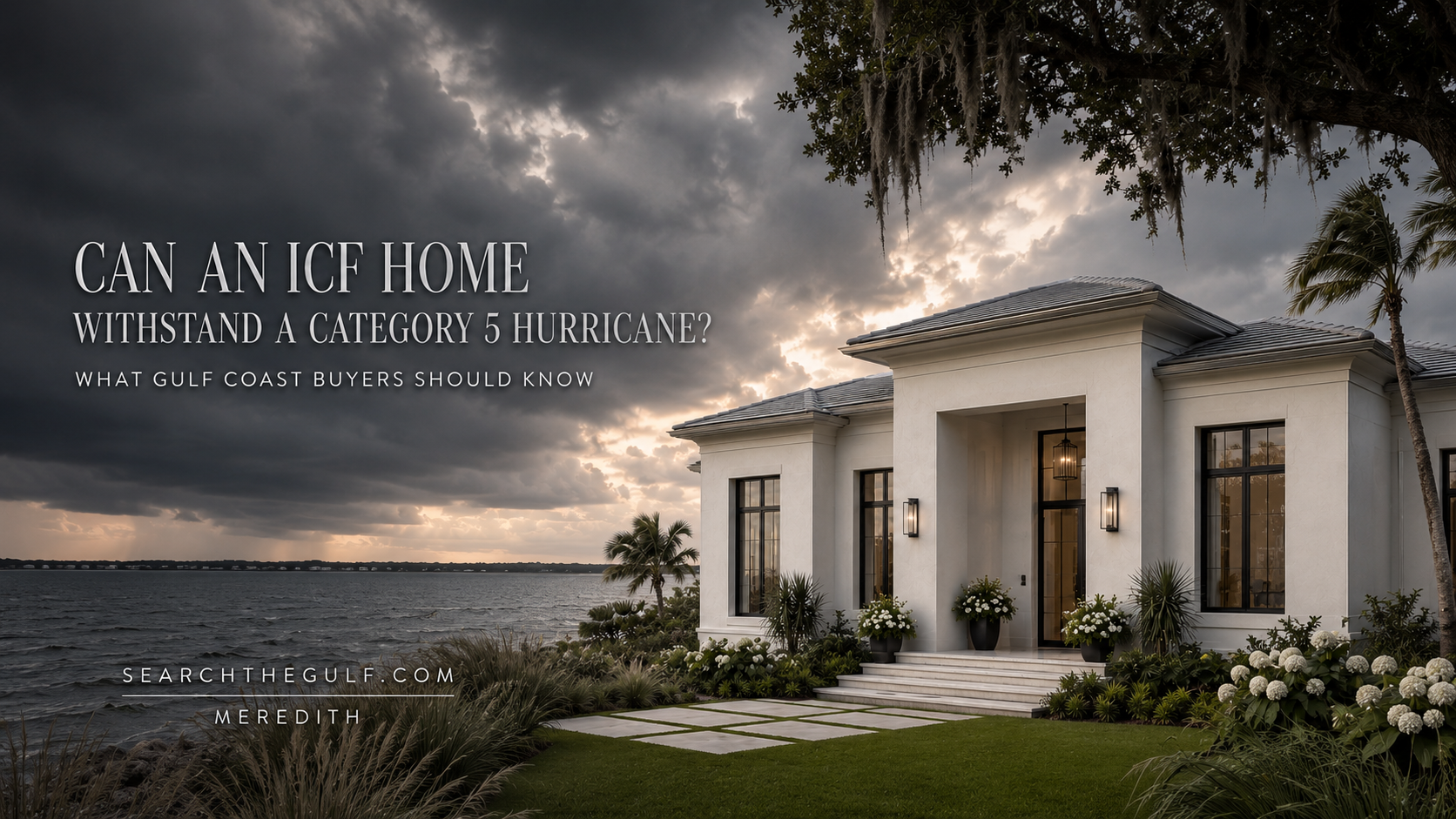
Can an ICF Home Withstand a Category 5 Hurricane?
The careful answer every Gulf Coast buyer, homeowner and custom-home builder should understand
By Meredith Folger Amon | Gulf Coast Real Estate Advisor
When buyers begin researching insulated concrete form construction, one question almost always rises to the top:
“Can an ICF home withstand a Category 5 hurricane?”
The honest answer is that a properly engineered ICF home can offer exceptional resistance to hurricane-force winds and wind-borne debris—but an ICF wall system alone does not make a house invincible.
I would never describe any residence as “hurricane-proof.” A coastal home is a collection of interconnected systems, and a hurricane tests every one of them: the foundation, walls, roof, windows, exterior doors, garage doors, structural connections, penetrations, elevation, drainage and surrounding site.
ICF construction can create remarkably strong exterior walls. Whether the entire home performs successfully during an extreme hurricane depends on how those walls are engineered, reinforced and connected to everything above and below them.
The Short Answer
A site-specific, properly engineered and carefully constructed ICF home can provide exceptional resistance to extreme hurricane winds. However, the ICF walls alone cannot guarantee the performance of the entire residence.
The Foundation of the Conversation
What Is an ICF Home?
Insulated concrete forms, commonly called ICFs, are hollow foam forms assembled to create the exterior walls of a home. Reinforcing steel is placed within the forms, and concrete is poured into the center.
A Completed ICF Wall Generally Includes
- A reinforced-concrete structural core
- Continuous foam insulation on both sides
- Interior and exterior finish systems
- Engineered reinforcement around openings and structural transitions
The U.S. Department of Energy describes ICF construction as rigid foam forms filled with reinforced concrete, combining insulation, thermal mass, air sealing and structural strength. The department also notes that ICF walls can provide resistance to strong winds and storms when properly designed and constructed. Learn more about insulated concrete forms from the U.S. Department of Energy.
That reinforced core is one reason ICF construction is so appealing for new homes on Ono Island, in Orange Beach and throughout the Alabama and Florida Gulf Coast.
But the word reinforced matters. The concrete mix, thickness of the core, reinforcing-steel size, spacing, lap lengths, placement and connections must follow the structural plans.
“ICF is a construction method—not a universal engineering specification.”
An Important Distinction
Hurricane Category and Design Wind Speed Are Not the Same
This is where the conversation becomes more technical—and much more important.
The Saffir-Simpson Hurricane Wind Scale classifies a hurricane according to its maximum sustained wind speed. A Category 5 hurricane has maximum sustained winds of 157 mph or higher. Category 5 has no upper boundary. Review the National Hurricane Center’s Saffir-Simpson Hurricane Wind Scale.
A home’s structural design is not based simply on a hurricane-category label. Engineers evaluate site-specific wind criteria, building geometry and the pressures expected at different parts of the structure.
| Measurement | What It Describes | How It Is Used |
|---|---|---|
| Hurricane category | Maximum sustained surface wind | Classifies the hurricane on the Saffir-Simpson scale |
| Design wind speed | A code-based engineering value commonly expressed as a three-second gust | Helps engineers calculate structural wind loads and pressures |
| Design pressure | Positive and negative pressure acting on a particular component | Used to select and install windows, doors, roofing and other components |
ASCE design-wind data is expressed as a three-second gust at a specified height and exposure—not as the sustained wind measurement used to classify hurricanes. The ASCE Hazard Tool explains these site-specific design parameters.
A Category 5 hurricane is a storm classification. A design wind speed is an engineering input. They are related, but they are not interchangeable.
What Does “Designed for 180 MPH Winds” Really Mean?
Whenever buyers encounter a wind-speed claim, I encourage them to ask:
“Is that rating for one product, one wall assembly or the complete residence?”
A statement such as “designed for 180 mph winds” could refer to a mapped ultimate design wind speed, a particular wall-system test, a window’s design pressure, a laboratory impact test or an engineer’s complete structural design.
Wind pressure changes with exposure, elevation, building shape, roof geometry and the component’s location on the structure. Corners and edges of a roof, for example, can experience different forces than the center of the roof.
A large window facing open water may require a different pressure rating from a smaller opening on a more protected side of the residence. I would want to see the sealed structural plans, applicable product approvals, design pressures and inspection records—not simply a wind-speed claim printed in a brochure.
The Complete Building System
Wall-System Testing Is Not Whole-House Performance
ICF walls can be extraordinarily strong. Reinforced concrete may resist wind pressure and flying debris that could severely damage lighter wall assemblies.
However, a laboratory test of an ICF wall does not necessarily include every part of the completed home.
A Wall-System Test May Not Account For
| Roof framing and sheathing | Windows and exterior doors |
| Roof-to-wall connections | Garage doors and sliding glass doors |
| Wall-to-foundation anchorage | Soffits, vents and penetrations |
| Attached porches and carports | Construction quality in the field |
The test result may demonstrate what a particular wall assembly can resist under controlled conditions. It does not guarantee that a particular house will survive a particular hurricane.
Strength Through Connection
The Continuous Load Path: Connecting the Roof to the Ground
During a major hurricane, wind can push against a home, pull outward on the walls and create tremendous uplift at the roof.
A continuous load path provides a connected route for those forces to travel through the structure and into the foundation and ground.
- The roof covering is attached to the roof deck.
- The roof deck is attached to the framing.
- The roof framing is connected to the walls.
- Upper-story walls are connected to lower-story walls.
- The walls are anchored to the foundation.
- The foundation transfers the forces into the ground.
The connection between a roof and an ICF wall requires careful coordination. Embedded straps, anchor bolts, reinforcing steel and other specified connectors must be installed in the correct locations and at the proper spacing.
This is also why ICF construction and FORTIFIED Gold are not the same thing. An ICF home may pursue a FORTIFIED designation, but ICF walls alone do not create one. FORTIFIED Gold requires an engineered continuous load path, including roof-to-wall, story-to-story and wall-to-foundation connections. Review the official FORTIFIED Gold overview.
I explain this further in my guides to continuous load paths on Ono Island and why hurricane straps and clips matter.
Protecting the Building Envelope
Windows, Doors and Garage Doors Can Become the Weakest Links
An ICF wall may remain intact while a vulnerable opening fails. Windows, entry doors, sliding doors and garage doors must be selected for the pressures calculated at their specific locations.
Garage doors deserve special attention because they create such a large opening in the building envelope. FEMA explains that garage-door failure can breach the envelope, increase internal pressure and contribute to additional structural damage. Read FEMA’s coastal-construction guidance.
Once wind enters through a failed opening, pressure can build inside the house while uplift continues outside. The home is then being pushed and pulled from multiple directions.
Questions I Recommend Asking
- What positive and negative design pressures are required for each opening?
- Are the windows and doors impact-resistant or protected by an approved shutter system?
- Are the frame, glass, anchors and installation method included in the product approval?
- Are the sliding-door systems properly rated for their size and location?
- Is the garage door rated for wind pressure and debris impact where required?
- Is photographic or inspection documentation available?
Learn more in my Gulf Coast guide to impact windows and doors.
Small Penetrations Can Create Large Vulnerabilities
Every opening placed through an ICF wall interrupts the reinforced-concrete assembly. These openings may include plumbing, electrical conduit, HVAC lines, vents, outdoor faucets, generator connections, gas lines and low-voltage wiring.
Penetrations should be coordinated before the concrete pour whenever possible. They also require proper structural detailing, flashing, sealing and waterproofing.
Large openings deserve particular attention. Wide sliding doors, garage openings and groups of windows may require additional reinforcing steel, engineered lintels or concrete beams to transfer loads safely around the opening.
The Homesite Matters
Site Exposure Changes the Forces on the Home
Two identical homes can experience different wind pressures because they occupy different sites. A home facing open water may have less protection from surrounding structures and vegetation.
Site Evaluation May Consider
- Open-water exposure and distance across the water
- Building height and elevation
- Nearby structures and surrounding terrain
- Roof geometry and large overhangs
- Attached porches, carports and outdoor rooms
- Trees and potential debris sources
- The home’s position and orientation on the lot
On Ono Island, a residence overlooking Old River, Bayou St. John or the Intracoastal Waterway may have a different exposure profile from one on an interior street.
A spectacular open-water view is one of the great privileges of coastal living. It is also a reason the structural engineer must evaluate the actual homesite rather than rely on a generic plan prepared for another location.
More Than Wind Pressure
Wind-Borne Debris Changes the Equation
Hurricane winds do not arrive alone. They may carry roof materials, lumber, signs, landscape objects and pieces of nearby structures.
A reinforced-concrete wall may perform extremely well against debris, but the home still has potentially vulnerable windows, glass doors, garage-door windows, roof coverings, soffits, vents and equipment enclosures.
Impact-rated glass is not simply stronger glass. It is part of a tested assembly that includes the glass, interlayer, frame, anchors and installation requirements. Substituting fasteners, changing spacing or modifying the opening may affect the assembly’s performance.
Wind Is Only Part of the Storm
What About Storm Surge and Flooding?
The Saffir-Simpson scale addresses wind speed. It does not classify a hurricane according to storm surge, rainfall, flooding or tornadoes.
An ICF home designed for severe wind is not automatically protected from storm surge, wave action, scour, erosion, floating debris, foundation undermining or saltwater intrusion.
A resilient coastal home must address both wind and water.
This may require a site-specific foundation, geotechnical testing, flood-zone review, proper elevation, compliant enclosures, protected mechanical equipment and thoughtful drainage planning.
ICF walls can be part of this strategy, but concrete does not erase flood risk. Buyers considering land should begin with thoughtful Ono Island and Orange Beach homesite due diligence.
Plans Must Become Reality
The Workmanship Question
A beautifully engineered set of plans only succeeds when it is followed in the field. Many of the most important structural details become hidden once concrete is poured and finishes are installed.
Construction Documentation May Include
- Reinforcing-steel placement photographs
- Concrete-strength and placement records
- Connector and anchor documentation
- Roof-deck fastening photographs
- Window, door and garage-door product approvals
- Inspection reports and engineering letters
- FORTIFIED evaluator documentation, when applicable
Along the coast, exposed metal connectors should also be selected and maintained with corrosion in mind. I discuss these concerns in my Ono Island salt-air corrosion guide.
So, Can an ICF Home Withstand a Category 5 Hurricane?
A site-specific, properly engineered and carefully constructed ICF home can provide exceptional resistance to extreme hurricane winds. However, the ICF walls alone cannot guarantee that the entire house will withstand every Category 5 hurricane or every hazard accompanying it.
Category 5 includes every hurricane with sustained winds of at least 157 mph, with no maximum limit. Each storm has its own size, duration, gusts, direction, debris field, surge, waves and rainfall.
No responsible builder, engineer or real estate advisor should promise that a home is “hurricane-proof.” More accurate and meaningful descriptions include:
- Engineered for the homesite’s applicable wind loads
- Constructed with reinforced ICF exterior walls
- Designed with a continuous load path
- Equipped with pressure- and impact-rated openings where required
- Built to FORTIFIED standards and independently designated, if applicable
- Constructed to reduce vulnerability to severe coastal wind events
A Practical Resource
My ICF Buyer and Builder Checklist
Before relying on a claim about hurricane performance, I recommend asking for the following:
| ✓ Sealed structural plans | ✓ Site-specific wind criteria |
| ✓ Wind-exposure classification | ✓ Foundation engineering |
| ✓ ICF wall specifications | ✓ Reinforcing-steel schedule |
| ✓ Concrete-core thickness | ✓ Concrete-strength specification |
| ✓ Roof-to-wall details | ✓ Wall-to-foundation details |
| ✓ Opening design pressures | ✓ Impact-rating documentation |
| ✓ Garage-door approval | ✓ Roof-system approval |
| ✓ Construction inspection records | ✓ Concealed-connection photographs |
| ✓ FORTIFIED documentation | ✓ Elevation certificate |
“The most resilient coastal homes are not created by one extraordinary product. They are created through thoughtful design, compatible systems, precise installation and careful documentation.”
Meredith Folger Amon
Search. Research. Build With Confidence.
Exploring an ICF Home or Gulf Coast Homesite?
I help buyers evaluate homes, homesites, construction features and waterfront opportunities throughout Ono Island, Orange Beach and the surrounding Gulf Coast.
Search Gulf Coast Real EstateVisit SearchTheGulf.com, the Gulf Coast’s premier website for searching all real estate listings along the coast.
Explore Ono Island real estate or browse my Gulf Coast homebuilding resources.
Information is deemed accurate but is subject to errors and omissions. Building codes, engineering requirements, flood criteria, product approvals and association guidelines may change. Buyers, property owners and builders should confirm requirements with licensed engineers, qualified contractors, local building officials, insurance professionals and the Ono Island POA/ACC, when applicable. This article is educational and is not structural, engineering, legal, insurance or construction advice.
 #searchthegulf #meredithamon #becausewelivehere
 Ono Island Homes & Land for Sale – Luxury Waterfront Real Estate in Orange Beach Alabama





.gif)

Ono Harbour at Sunset | My Sanctuary on Ono Island
Ono Harbour · Ono Island
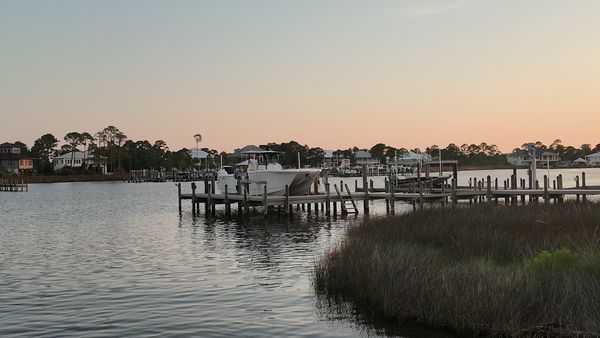
Ono Harbour at Sunset
Salt air. Marsh grass. Pretty boats on still water. Soft peach light over the harbour—my sanctuary on Ono Island, so close to Orange Beach.
Ono Harbour Homes Walking the Dock
A Favorite Corner of the Island
Ono Harbour is one of my…
2026 MBGFC Labor Day Invitational | Orange Beach | Search The Gulf

Cotton Bayou Marina Boats | Orange Beach Near Terry Cove
Ask A Question or Sign Up To See New Real Estate Listings Before Your Competition
When it comes to finding the home of your dreams in a fast-paced market, knowing about new listings as soon as they are available is part of our competitive advantage.Sign up to see new listings in an area or specific community. Contact Meredith with any questions you may have.