
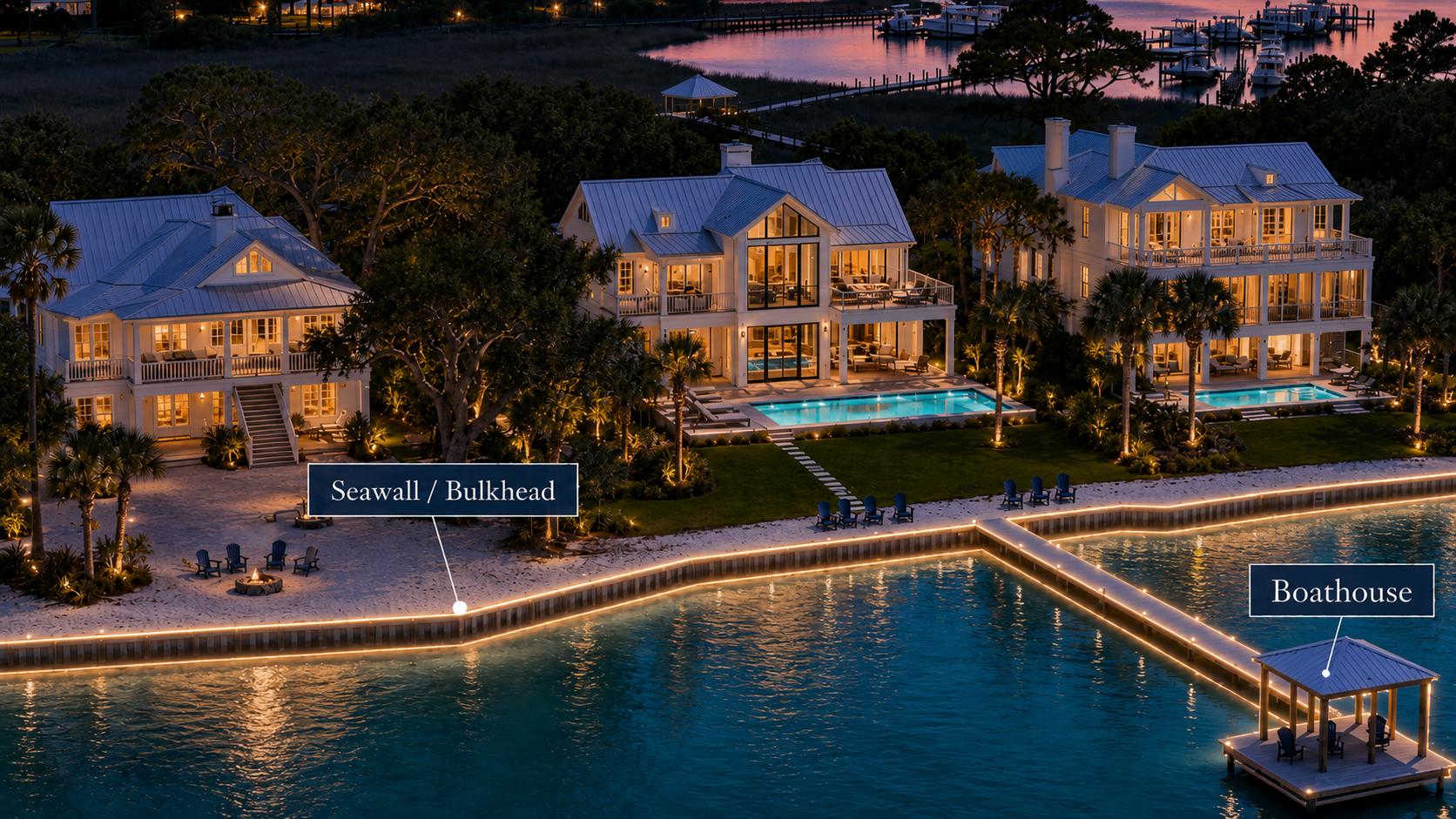

Living on the water in Orange Beach and on Ono Island is an extraordinary lifestyle. The views, boating access and connection to the Gulf Coast are difficult to replicate anywhere else. Waterfront ownership also comes with responsibilities that may not be obvious when someone first falls in love with a property.
One of the most important—and frequently most expensive—components of a waterfront property is its shoreline protection.
A seawall or bulkhead is not simply a decorative border between the yard and the water. It may retain soil, support the usable portion of the lot, protect landscaping, reduce erosion and serve as the foundation for access to a dock or boat lift. Its condition can affect the property’s use, maintenance budget and long-term value.
“When I look at a waterfront property, I do not stop at the house. I want to understand the shoreline, the wall, the water depth, the dock, the neighboring structures and what may—or may not—be permitted in the future.”
This guide focuses on Alabama waterfront property, particularly Orange Beach and Ono Island. Regulations can change, and every site is different, so owners should confirm current requirements with the applicable agencies, licensed professionals, municipality and property owners association before beginning work.
Is It a Seawall or a Bulkhead?
Bulkhead
A bulkhead is primarily a retaining structure. It holds soil in place and helps maintain the edge of a waterfront lot.
Seawall
A seawall is generally engineered to withstand more direct wave action, surge and erosion forces. Its profile or shape may be designed to resist or redirect wave energy.
Many residential structures around protected bays, canals and bayous are technically bulkheads, even though owners commonly call them seawalls. In higher-energy locations, the engineering requirements can be substantially different. The design should reflect shoreline slope, fetch, wave patterns, water depth, soil conditions and the energy level of the site.
What Does a Bulkhead Actually Protect?
- Retains soil behind the shoreline
- Reduces ordinary erosion
- Preserves usable yard area
- Helps control localized washout
- Creates a defined transition between land and water
- Works with docks, walkways and boat access
- Supports drainage and grading when properly engineered
It is important to understand what a bulkhead does not guarantee. An ordinary residential bulkhead should not be treated as a floodwall protecting the home from hurricane storm surge. It can be overtopped, undermined, displaced or damaged by forces beyond its design. Home elevation, foundation design, flood-zone requirements and appropriate insurance remain essential.
How Seawalls and Bulkheads Are Built
Although the visible wall receives most of the attention, much of the structural system may be buried behind it. A typical anchored bulkhead can include:
- Vertical piles or interlocking sheet piling driven into the underlying soil
- Horizontal structural members, often called walers
- Tie rods connected to buried anchors or “deadmen”
- A structural cap at the top of the wall
- Filter fabric or geotextile behind the wall
- Properly compacted backfill
- Drainage provisions to relieve pressure behind the structure
- Riprap or another form of toe protection where scour is a concern
The wall must resist pressure from the retained soil as well as water, waves, boat wakes, changing tides, drainage and storm conditions. Soil conditions, anchoring, structural loading and material selection all matter.
Common material options
| Material | Potential Advantages | Important Considerations |
|---|---|---|
| Pressure-treated timber | Familiar, workable and often suitable for lower-energy environments. | Service life depends on treatment quality, exposure, fasteners, marine organisms and decay. |
| Vinyl or composite sheet piling | Clean appearance and does not rust. | Still requires proper embedment, anchoring, impact resistance and a complete structural design. |
| Steel sheet piling | Substantial strength for deeper walls, difficult soils or heavier loading. | Corrosion protection and long-term saltwater maintenance must be considered. |
| Concrete | Can provide strength and durability. | May require heavier equipment, specialized engineering and greater installation cost. |
| Riprap, revetments or hybrid systems | Can dissipate energy and support a more natural shoreline transition. | Requires site-specific design, adequate space and environmental review. |
Hard Bulkhead or Living Shoreline?
A vertical wall can preserve a defined property edge, but it may also reflect wave energy instead of gradually absorbing it. That reflected energy can contribute to scour at the base of the wall or erosion along adjacent shoreline areas.
Living shorelines use combinations of native marsh vegetation, sand, oyster-friendly materials, stone sills and other nature-based features. They can absorb wave energy, provide habitat and maintain a more natural connection between the upland and water.
They are not appropriate for every property. A narrow canal with substantial boat traffic, a steep bank or a high-energy shoreline may require a different solution. The best approach may be a hybrid design that combines structural protection with native vegetation or offshore energy reduction.
Wakes, Wake Zones and Why Location Matters
Boat wakes can place repetitive stress on a shoreline wall. A property along a narrow canal may experience frequent smaller wakes, while a home facing a wider bay or heavily traveled waterway may be exposed to larger wakes, wind waves and longer fetch.
Alabama boating rules prohibit hazardous wash or wake in certain situations, and vessel operators must observe established speed zones. Orange Beach also maintains local no-wake and idle-speed areas.
My practical recommendation
A calm showing-day does not always represent normal conditions. When practical, I recommend evaluating a waterfront property at different times, including weekends and boating season.
- Is the property inside or immediately outside a no-wake area?
- Does the shoreline face a navigation channel?
- How close do boats normally pass?
- Do neighboring walls show scour, leaning or erosion?
- Is there adequate water depth without excessive prop wash near the wall?
- Does the dock create a sheltered area where floating debris collects?
- Is the wall designed for the energy exposure of the location?
Warning Signs a Bulkhead May Need Attention
- A wall leaning toward the water
- Bulging or bowing panels
- Separated sheet-pile joints
- Rot or splitting in timber components
- Corroded tie rods, bolts or fasteners
- Cracked or displaced concrete caps
- Voids or sinkholes behind the wall
- Soil washing through or beneath the wall
- Depressions in the yard near the shoreline
- Failed drainage outlets
- Scour at the base
- Riprap that has shifted or disappeared
- Dock piles pulling away from the structure
- Prior repairs without permits or engineering records
A cosmetic patch may hide soil loss without addressing its cause. When I see a depression behind a wall, I do not assume that adding dirt is the complete repair. The drainage, toe, joints, anchors and backfill should be evaluated.
Hurricane-Season Preventive Maintenance
The best time to inspect waterfront improvements is before a named storm is approaching. I recommend an annual professional review when the structure is older, has visible movement or protects a substantial amount of improved property.
- Photograph the full wall, dock, lift and shoreline.
- Check for movement, cracks, open joints and soil loss.
- Inspect the cap and exposed fasteners.
- Confirm drainage paths are open.
- Examine the toe for scour.
- Repair loose dock boards and railings.
- Remove unsecured furniture, storage boxes and recreational equipment.
- Have electrical service to docks and lifts inspected by a qualified electrician.
- Review the boat and lift manufacturer’s storm procedures.
- Confirm floating structures have properly engineered guides and adequate pile height.
- Keep permits, plans, surveys, invoices and photographs in cloud storage.
After a storm, stay away from any shoreline edge that appears hollow, cracked or undermined. Water can remove soil beneath grass while leaving a deceptively intact surface.
Permits: Address Them Before Construction
Waterfront work can involve several layers of approval. Obtaining one approval does not necessarily satisfy the others.
Potential review authorities
- U.S. Army Corps of Engineers, Mobile District
- Alabama Department of Environmental Management
- Alabama Department of Conservation and Natural Resources, State Lands Division
- City of Orange Beach or another local jurisdiction
- The property owners association or architectural-review authority
- Utility and electrical authorities
- Other resource agencies when wetlands, protected habitat or shellfish areas are present
Section 10 of the Rivers and Harbors Act generally applies to work or structures in, over or under navigable waters. Section 404 of the Clean Water Act can apply when dredged or fill material is placed in waters of the United States, including qualifying wetlands.
The Corps’ Alabama general-permit program covers certain routine projects with minimal impacts, including piers, pile-supported structures, shoreline stabilization, boat slips and dredging. Project-specific verification is commonly required before regulated work begins. Because permit programs and expiration dates change, applicants should verify the rules in effect when they apply.
State-owned submerged lands
In Alabama, submerged property below mean high tide and the bottoms of navigable rivers and creeks can constitute state-owned public trust lands managed by the ADCNR State Lands Division.
A waterfront owner may therefore need a state approval, permit, easement or lease even when the upland property is privately owned. Applicants may be required to establish riparian ownership and locate the boundaries of their riparian-use area.
Riparian setbacks and structure limits
Current permit conditions can include minimum separation from adjacent riparian lines, limits based on the width of the waterway, setbacks from federally maintained navigation channels and restrictions on the number or configuration of boat-berthing areas. These conditions are not substitutes for local or HOA restrictions, which may be more limiting.
Seagrass: Does It Prevent a Dock or Pier?
This is one of the most important questions in waterfront due diligence.
Seagrass is generally addressed in permit documents as submerged aquatic vegetation, or SAV. Its presence does not automatically mean that no dock can ever be built. It can, however, substantially affect the dock’s placement, design, height, width, roof coverage, piling method and the ability to dredge.
The practical answer
Seagrass may not make a dock impossible, but it can make a particular dock design, covered boathouse, lift location or dredging plan unpermittable.
A buyer should never rely solely on a neighboring dock as proof that the same structure can be approved today. That dock may have been permitted under older rules, may occupy a different riparian configuration or may not cross the same environmental resources.
Permit conditions may require an uncovered, narrow and elevated access pier with spacing between deck boards to allow sunlight penetration. Roofed structures, pilings and moored boats may be required to avoid or maintain distance from SAV, submerged grassbeds or emergent wetlands. Dredging through SAV or submerged grassbeds is generally a much more serious limitation.
Wetlands and Shoreline Work
Wetlands can exist along the shoreline, behind the apparent waterline or beneath vegetation that an untrained observer might not recognize as regulated.
For new bulkheads or seawalls, permit conditions may require the wall to be installed along the existing shoreline at or above mean or ordinary high water. Where jurisdictional wetlands are present, the wall may need to remain landward of them and must not isolate wetlands from open-water contact.
Not every low or wet area is automatically a federally regulated wetland, and not every jurisdictional determination is obvious. A qualified wetland consultant and the Corps should be involved when the site presents uncertainty.
Docks, Piers, Boat Lifts and Boathouses

Permits may authorize piers, wharves, open decks, floating structures, mooring pilings, boat lifts and covered, open-sided boat shelters. They do not automatically authorize every use or design.
How large can a boathouse be?
There is no single statewide residential boathouse dimension that applies to every Alabama waterfront lot. The workable size depends on:
- Shoreline width
- Riparian-line setbacks
- Waterway width
- Distance from navigation channels
- Water depth
- SAV and wetlands
- Number and size of boats
- Roof location
- Local zoning
- POA or architectural requirements
- Neighboring permitted structures
- Required navigation clearance
On Ono Island, I encourage owners to treat the POA or architectural-review process as a separate approval track. Federal or state authorization does not replace private-covenant approval, and private approval does not replace governmental permits.
Can a Property Owner Dredge for Better Water Depth?
Possibly, but dredging is not an automatic riparian right and should never be assumed.
Dredging generally must be related to navigation, remain within authorized dimensions and avoid wetlands, SAV, submerged grassbeds and natural shellfish beds. Dredged material typically must be placed and contained in an approved upland area rather than discharged into nearby water or wetlands.
Questions for a shallow-water property
- Was the area previously authorized and dredged?
- What depth and dimensions were permitted?
- Is maintenance dredging currently feasible?
- Have SAV or wetlands developed?
- Where could dredged material be legally placed?
- Is barge or equipment access practical?
- Would the controlling depth of the surrounding waterway make additional dredging useful?
A shallow lot with “potential boating access” is not equivalent to an existing permitted deep-water slip.
Advantages and Disadvantages
Potential advantages
- A defined and usable property edge
- Reduced routine shoreline erosion
- Protection for landscaping and upland improvements
- Easier integration with docks and walkways
- Greater control over drainage and grading
- A familiar solution for canals and constrained shorelines
Potential disadvantages
- Significant construction and replacement expense
- Ongoing inspection and repair
- Hidden tieback and anchor failures
- Scour at the base of a vertical wall
- Reflected wave energy
- Environmental and permitting restrictions
- Potential impacts on neighboring shorelines
- Difficult construction access
A wall can last for many years and still become a major capital item during the next owner’s period of ownership. Age alone is not enough to evaluate it; design, materials, soil, exposure, maintenance and workmanship matter.
What Does a Seawall or Bulkhead Cost?
There is no responsible single cost-per-foot figure for all Gulf Coast properties.
A small repair to a protected canal wall is very different from replacing a long, deep wall exposed to open-bay conditions. A modest repair may be a five-figure project. Full residential replacement can readily become a six-figure capital expense, and complex steel, concrete, deep-embedment or difficult-access projects can cost substantially more.
Important cost drivers
- Linear footage
- Wall height and required embedment
- Soil and geotechnical conditions
- Construction material
- Tieback and anchor design
- Water depth
- Wave and wake exposure
- Demolition and disposal
- Barges, cranes and equipment access
- Drainage repairs
- Backfill and compaction
- Riprap or toe protection
- Engineering and surveys
- Wetland and SAV investigations
- Federal, state, local and HOA approvals
- Restoration of lawns, pools, patios and landscaping
- Dock, boat-lift and electrical work
I prefer obtaining at least two or three detailed proposals based on the same engineered scope. A low estimate that omits anchors, drainage, soil replacement, access or restoration may not be the least expensive project by completion.
Insurance: Is the Seawall Covered?
This is an area where owners should ask very specific questions.
The National Flood Insurance Program’s standard policy generally identifies seawalls, bulkheads, retaining walls, wharves, piers and docks as property not covered. Owners should not assume that an independent shoreline wall or dock is covered by an NFIP policy.
Questions to ask the insurance agent
- Is the dock covered as an “other structure”?
- Is the boat lift covered?
- Is the bulkhead or seawall excluded?
- Is wind coverage separate from flood coverage?
- What is the named-storm or hurricane deductible?
- Are electrical components over water covered?
- Is collapse caused by earth movement, erosion or scour excluded?
- Is debris removal covered?
- Is ordinance-and-law coverage available?
- Is there a separate marine-structure endorsement?
Flood premiums cannot be accurately estimated from the presence of a bulkhead alone. Actual property-specific quotes should be obtained during the buyer’s due-diligence period.
What I Recommend Before Buying Waterfront Property

Before the end of a buyer’s inspection or due-diligence period, I recommend trying to obtain:
- Original wall and dock permits
- Engineering plans and specifications
- Repair invoices
- The property survey
- Riparian-line information
- Wetland or SAV surveys
- Maintenance-dredging records
- Dock and boat-lift permits
- Electrical-permit records
- HOA or architectural approvals
- Insurance declarations and endorsements
- A professional wall inspection
- Estimates for recommended repairs
- Written confirmation regarding proposed additions
I also recommend comparing the physical improvements with the survey and permit documents. A structure shown in an old photograph or MLS listing is not proof that it was permitted.
My Personal Take
Waterfront improvements should be evaluated as part of the property—not as accessories that can be addressed later.
A beautifully renovated house may sit behind a wall that needs major work. Conversely, a well-engineered wall, properly permitted dock and thoughtfully designed boat-access system can add tremendous utility to a waterfront property.
When I help buyers evaluate homes in Orange Beach and on Ono Island, I encourage them to think beyond the current boat and current owner. Will the dock work for the buyer’s boat? Is there adequate depth at normal low water? Is the lift positioned without damaging seagrass? Can the wall accommodate a future pool or outdoor area? Is there room for contractors to reach the shoreline if replacement becomes necessary?
Those questions can be just as important as the number of bedrooms or the interior finishes.
Frequently Asked Questions
Does seagrass automatically prevent a dock?
No. It may still allow a carefully designed, uncovered and elevated access pier, but it can restrict width, height, roof coverage, piling installation, boat placement and dredging. A site-specific survey and agency review are essential.
Can I replace an existing wall in the same location?
Possibly. Replacement of a previously permitted wall may be authorized within defined limits. Local, state, federal and HOA approvals may still be required.
Can I assume an existing dock is permitted?
No. Ask for the permit verification, plans, approvals and any transfer or compliance documentation.
Does a no-wake zone eliminate wake damage?
No. It can reduce wake energy when observed, but wind waves, storm conditions, unauthorized wakes and ordinary vessel movement can still affect the shoreline.
Will flood insurance replace my seawall?
Generally, owners should not expect the standard NFIP policy to cover an independent seawall, bulkhead, pier or dock. Coverage should be verified in writing with the insurance carrier.
Should the wall be inspected before purchasing?
Yes, particularly if there are voids, movement, erosion, older timber, undocumented repairs or substantial upland improvements near the wall.
Helpful Government and Technical Resources
- U.S. Army Corps of Engineers, Mobile District — Regulatory Permit Types
- U.S. Army Corps of Engineers — Alabama General Permits
- City of Orange Beach Building Department
- Alabama Law Enforcement Agency — Boating Rules and Regulations
- FEMA — National Flood Insurance Program Risk Rating
- NOAA — Living Shorelines Guidance
Search Gulf Coast Waterfront Real Estate
Waterfront property is highly site-specific. The shoreline, boating route, water depth, dock configuration, wake exposure and permitting history can be as important as the home itself.
Explore Gulf Coast Real Estate ListingsMeredith Folger Amon
Gulf Coast Real Estate Advisor
Licensed in Alabama and Florida
meredith@searchthegulf.com
This article provides general educational information and is not engineering, environmental, legal, permitting or insurance advice. Permit standards and agency procedures can change. Confirm the requirements in effect at the time of application with the appropriate agencies and licensed professionals.

#searchthegulf #meredithamon #becausewelivehere
Search Coastal Alabama Homes and Real Estate For Sale
- All Listings
- Under $100,000
- $100,000 - $200,000
- $200,000 - $300,000
- $300,000 - $400,000
- $400,000 - $500,000
- $500,000 - $600,000
- $600,000 - $700,000
- $700,000 - $800,000
- $800,000 - $900,000
- $900,000 - $1,000,000
- Over $1,000,000





.gif)

Fort Morgan Sunset: A Peaceful October Evening | Meredith
Through Meredith’s Lens · Fort Morgan, Alabama
An October Sunset at the End of Fort Morgan Road
By Meredith · October 13, 2026
Tonight, I stood at the end of Fort Morgan Road and watched a perfect October sky settle over the Gulf. Pale blue gave way to apricot and rose, with a ribbon of gold…

Long Bayou Preserve Orange Beach: New Site Plan & Update
Ask A Question or Sign Up To See New Real Estate Listings Before Your Competition
When it comes to finding the home of your dreams in a fast-paced market, knowing about new listings as soon as they are available is part of our competitive advantage.Sign up to see new listings in an area or specific community. Contact Meredith with any questions you may have.