
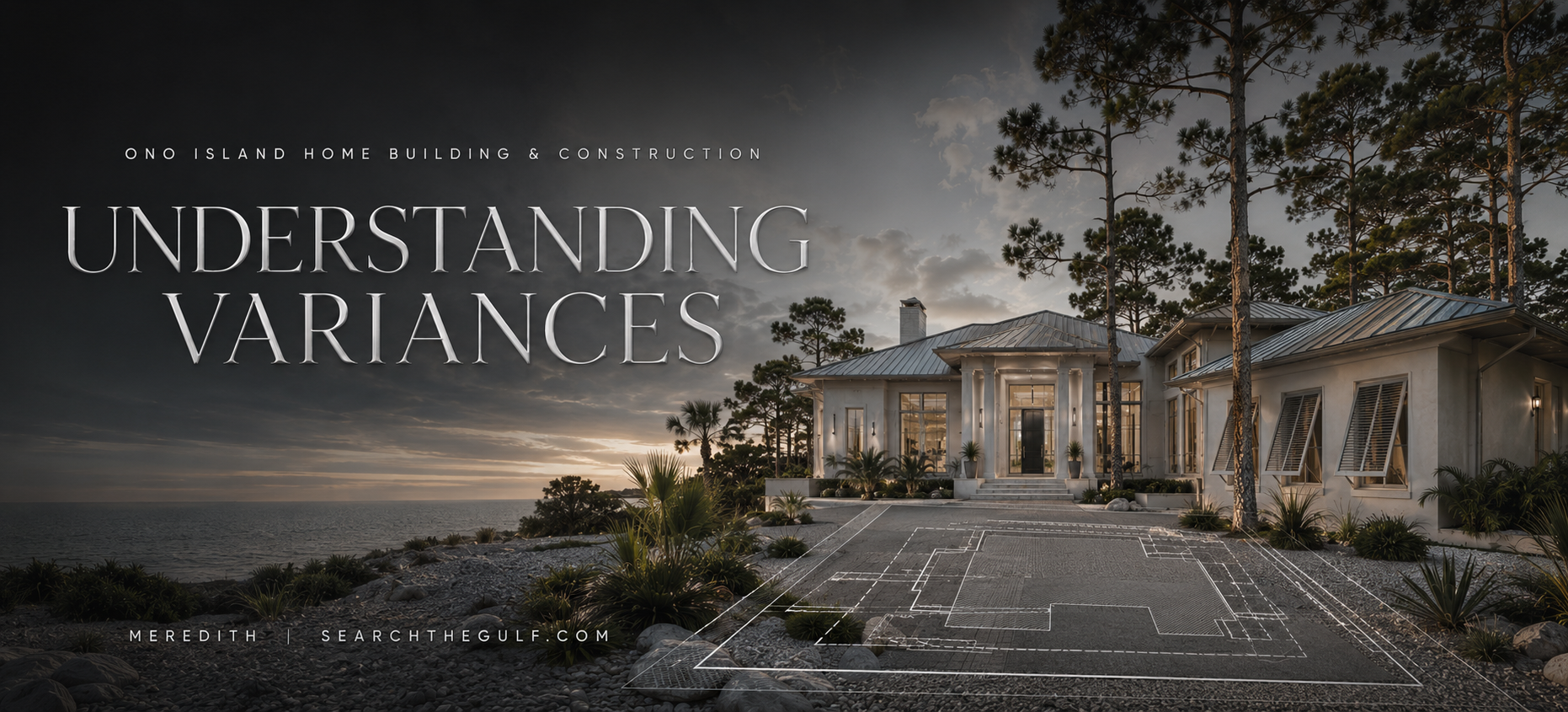
Ono Island Home Building & Construction
Understanding Variances on Ono Island
What happens when the dream home fits the lifestyle—but not quite inside the building envelope?
_(800_x_150_px)_(2).gif)
Building a home on Ono Island often begins with a beautiful vision: the way the house will sit among the pines and palms, the direction the porch will face, where the swimming pool might catch the afternoon sun, or how easily everyone can move from the back door to the boat dock.
Then the survey arrives.
A setback line crosses the preferred pool location. An unusually narrow lot limits the building footprint. A curve in the road creates an unexpected front-yard condition. The shape or elevation of the homesite makes an otherwise sensible design difficult to place.
The Question I Hear
“Meredith, can we ask for a variance?”
The answer may be yes—but a variance is not simply permission to disregard an Ono Island building rule. It is a formal request for limited relief when a property has a special condition that makes literal enforcement of a rule create an undue hardship.
For anyone considering building a home on Ono Island, understanding this distinction early can protect time, money and a great deal of emotional energy.
The Short Answer
A variance may provide limited relief from an ACC rule when a property has an exceptional condition—but it is not a shortcut around the covenants, permitting requirements or the rights of neighboring property owners.
First Things First
What Is an Ono Island Variance?
An Ono Island variance is a property-specific exception considered by the Ono Island Architectural Control Committee, commonly called the ACC.
Under the ACC rules provided to me, the committee may consider a variance when special conditions affecting a particular property would make strict enforcement of a rule create an undue hardship—and when granting the request would not substantially impair another property owner’s enjoyment of their property.
The intention is to preserve the spirit of the island’s architectural standards while allowing the committee to consider genuinely unusual circumstances.
“A variance is intended to address a hardship created by the property—not simply a design preference created by the owner.”
Wanting a larger garage, a wider pool deck or a house positioned closer to the water may be understandable, but preference and convenience alone may not establish the hardship required for approval.
Property-Specific Considerations
What Conditions May Support a Variance?
Condition One
An exceptionally narrow, shallow or unusually shaped lot
Not every Ono Island homesite is a perfect rectangle. Curved roads, canal frontage, pie-shaped parcels and irregular property lines can create surprisingly complicated building envelopes. A design that works beautifully on one lot may be impossible to place on another—even when the properties appear similar from the road.
Condition Two
Exceptional topography or an extraordinary property condition
Elevation changes, drainage patterns, natural features and other physical conditions may affect where a home or improvement can reasonably be located. These conditions should be documented through surveys, engineering information and accurately scaled plans.
Condition Three
Preservation of a property right
Relief may be considered when it is necessary to preserve a property right rather than merely provide additional convenience. This standard can be nuanced, which is why clear documentation and experienced professional guidance matter.
Condition Four
A documented medical need
The rules provide for consideration of a reasonable medical cause supported in writing by a licensed physician when the proposed use and location would substantially assist with a specific medical need of the property owner.
Additional Review
Another cause accepted by the ACC
The committee may review other causes or circumstances individually. This allows unusual facts to be considered, but it does not make approval automatic.
Important Boundaries
What a Variance Cannot Do
The ACC rules state that the variance process does not authorize the committee to approve a use or structure in an area where that use or structure is otherwise restricted.
In practical terms, a variance is not a tool for rewriting the covenants or creating a prohibited use. A request must also avoid:
01. Impairing the supply of light and air to adjacent property
02. Increasing the danger of fire
03. Creating or increasing a safety concern
04. Unreasonably diminishing neighboring property values
05. Impairing the health, safety, comfort or general welfare of Ono Island residents
This is why the relationship between the proposed improvement and neighboring properties matters. The ACC is not looking only at one set of plans. It is also considering how the request may affect the surrounding area.
A Common Misunderstanding
“But My Neighbor Received One”
A variance granted to another property does not automatically establish a precedent for your property. Every lot and every request is considered separately and individually.
Two lots may look similar from the street while having different dimensions, easements, elevations, setbacks, waterfront conditions or neighboring improvements. A previous approval can be interesting background, but it does not guarantee the same result on another homesite.
Projects to Examine Carefully
When Might a Variance Be Needed?
A potential variance question may arise while planning:
◆ A new custom residence
◆ An addition or major alteration
◆ A swimming pool, pool deck or enclosure
◆ A garage or other accessory structure
◆ A pier, boathouse or boat lift
◆ An improvement affected by an unusual lot shape, setback or topographic condition
Before assuming a variance will solve the problem, ask whether the plan can be adjusted to comply.
From Question to Decision
The Ono Island Variance Process
Based on the ACC rules supplied for this guide, the general process includes the following steps.
Step One
Identify the exact relief being requested
Instead of asking broadly for “setback relief,” the plan should show the applicable setback, the proposed location and the exact amount of encroachment being requested. Precision helps the committee and neighboring owners understand the request.
Step Two
Explain the property-specific hardship
The application asks why the property cannot reasonably be used in accordance with the covenants or current ACC rules. The explanation should focus on the physical condition of the property and be supported by objective documentation.
Step Three
Submit a complete application
The supplied variance checklist calls for items that may include:
- A completed Ono Island ACC variance application
- The applicable variance application fee
- An agent authorization form when someone other than the owner applies
- A completed ACC permit application
- A plot plan and current survey
- Dimensions of existing and proposed structures
- Applicable setbacks and distances from property lines
- Required state and federal permits, when applicable
- Approval from another applicable neighborhood association or committee
- Any additional information requested for review
Fee Reminder
The supplied variance checklist identifies a $500 application fee. Because fees, forms and procedures can change, owners should confirm the current amount with the Ono Island POA before submitting an application.
Step Four
Meet the submission deadline
The supplied rules state that a variance application must be submitted at least 15 calendar days before the regularly scheduled ACC meeting. The administrator must determine that the application is complete before it can be scheduled for a hearing.
Step Five
Adjacent property owners receive notice
Once a complete application is scheduled for a public hearing, the rules provide for notice to adjacent property owners by certified mail at least five days before the hearing.
Step Six
The ACC conducts a hearing
The ACC may decide the matter following the hearing. If additional information or review is needed, the rules allow a decision to be deferred for up to 45 days from the hearing date.
Step Seven
Complete the remaining permitting
The variance is only one part of the approval process. Depending on the project, additional approval may be required from the Ono Island ACC, Ono North or Ono Harbour, Baldwin County and applicable state or federal agencies.
Do Not Miss This Distinction
“An Ono Island variance is not a Baldwin County building permit, and ACC approval does not replace state or federal authorization.”
Watch the Calendar
How Long Does an Approved Variance Remain Valid?
The supplied ACC rules state that an approved variance is valid for 180 days after issuance.
If the required permitting is not completed during that period, a new variance may be required. Owners should coordinate the request with their surveyor, designer, engineer, contractor and permitting schedule so the approval window is not lost.
180 days
The stated validity period for an approved variance under the supplied ACC rules
Special Procedures
Two Requests Processed as Variances
The supplied rules identify two situations processed through the variance procedure that do not require the same showing of hardship.
An osprey nest installation
The variance procedure provides notice to adjacent property owners and an opportunity to comment on the proposed location.
A lift-only installation on Bayou St. John or Old River
The rules describe a variance procedure for adding a lift beside an existing boathouse when the location would not otherwise create a setback or property-line encroachment. All other required permitting remains applicable.
Never order marine equipment, drive pilings or begin waterfront construction based solely on a preliminary conversation.
Understanding the Difference
Can an ACC Decision Be Appealed?
The supplied rules provide an appeal process. An appeal of an ACC decision generally must be submitted within 15 calendar days of the committee’s decision. The Board of Directors may affirm, reverse or modify the decision. An appeal fee may apply, and the Board determines whether a hearing is necessary.
Variance
A request for relief from a rule because of a qualifying property-specific condition.
Appeal
A request for review of a decision that has already been made.
Permit
Written authorization for work shown in an approved application.
Before You Fall in Love With the Floor Plan
My Advice Before Buying an Ono Island Homesite
When I help buyers evaluate an Ono Island homesite, I encourage them to investigate the building envelope before becoming emotionally committed to a particular floor plan.
I want to know:
✓ Where are the recorded property lines?
✓ What setbacks apply to this particular unit and lot?
✓ Are easements shown on the survey?
✓ Can the preferred home fit without a variance?
✓ Is there room for the driveway, garage, pool and outdoor living areas?
✓ How will drainage and required elevations affect the design?
✓ Are trees or waterfront conditions limiting the usable area?
✓ Does another neighborhood association have approval authority?
✓ Will a pier, boathouse or lift require additional permits?
✓ Does the purchase contract provide enough time for due diligence?
“The advertised lot dimensions are not the same thing as the buildable area.”
A beautiful homesite can still be an excellent purchase when a variance may be needed, but the uncertainty should be understood before a buyer invests heavily in architectural plans or closes without appropriate professional review.
My preferred approach is to begin with a current boundary and topographic survey, identify the applicable restrictions and ask a qualified designer or builder to prepare a realistic conceptual site plan.
That preliminary work can reveal whether the home fits, whether the plan should be modified or whether a carefully documented variance request may be appropriate.
Preparing the Request
What Can Make a Variance Application Clearer?
No presentation can guarantee approval, but a complete application makes it easier for the committee and neighboring owners to understand the request.
- A current survey drawn to scale
- A site plan with existing and proposed conditions clearly labeled
- Exact dimensions and the precise relief requested
- Photographs showing the property condition
- A concise explanation of the hardship
- Alternative layouts considered and why they may not be workable
- Drainage, engineering or elevation information when relevant
- Details showing how neighboring properties will be protected
- Applicable supporting permits and approvals
- Any additional information requested by the administrator or ACC
A Better Building Sequence
A Variance Should Be Part of the Planning—not an Afterthought
The expensive mistake is designing the entire house first and asking questions later.
Variances involve notice, review and discretion. Approval should never be assumed, and construction should not begin before all required written authorizations are in place.
“Survey the property. Understand the building envelope. Assemble the right professionals. Confirm the rules. Then design the home.”
That sequence may feel less exciting than selecting countertops or sketching a waterside porch, but it is what gives all of those beautiful details a dependable foundation.
Planning to Buy or Build?
Let’s Look Beyond the Lot Lines and Understand What May Truly Be Possible
If you are considering buying land, building a custom home or evaluating an unusual construction concern, I would be happy to help you organize the real estate side of the due-diligence process.
Search Ono Island Real EstateVisit SearchTheGulf.com, the Gulf Coast’s premier website for searching real estate listings throughout the area.
Important Disclaimer
This information is deemed accurate but is subject to errors, omissions and changes. It is based in part on Ono Island ACC materials supplied for review, including rules dated March 2022 and a permit application modified in May 2025. Requirements, fees and procedures may have changed. Property owners, buyers, builders and design professionals must independently confirm current requirements with the Ono Island POA, applicable neighborhood associations, Baldwin County and all governing agencies before purchasing property, finalizing plans or beginning work. This article is general real estate information and is not legal, architectural, engineering, surveying or permitting advice.
#searchthegulf #meredithamon #becausewelivehere
Through Meredith’s Lens · Fort Morgan, Alabama
When it comes to finding the home of your dreams in a fast-paced market, knowing about new listings as soon as they are available is part of our competitive advantage.Sign up to see new listings in an area or specific community. Contact Meredith with any questions you may have.
Ono Island Homes & Land for Sale – Luxury Waterfront Real Estate in Orange Beach Alabama

.gif)


Fort Morgan Sunset: A Peaceful October Evening | Meredith
An October Sunset at the End of Fort Morgan Road
By Meredith · October 13, 2026
Tonight, I stood at the end of Fort Morgan Road and watched a perfect October sky settle over the Gulf. Pale blue gave way to apricot and rose, with a ribbon of gold…

Long Bayou Preserve Orange Beach: New Site Plan & Update
Ask A Question or Sign Up To See New Real Estate Listings Before Your Competition




```