Ono Island Waterfront Real Estate & Boating
Understanding Piers and Boathouses on Ono Island
A waterfront buyer’s guide to private piers, boathouses, boat lifts, ACC requirements and the boating lifestyle that makes Ono Island so distinctive.
_(800_x_150_px)_(2).gif)
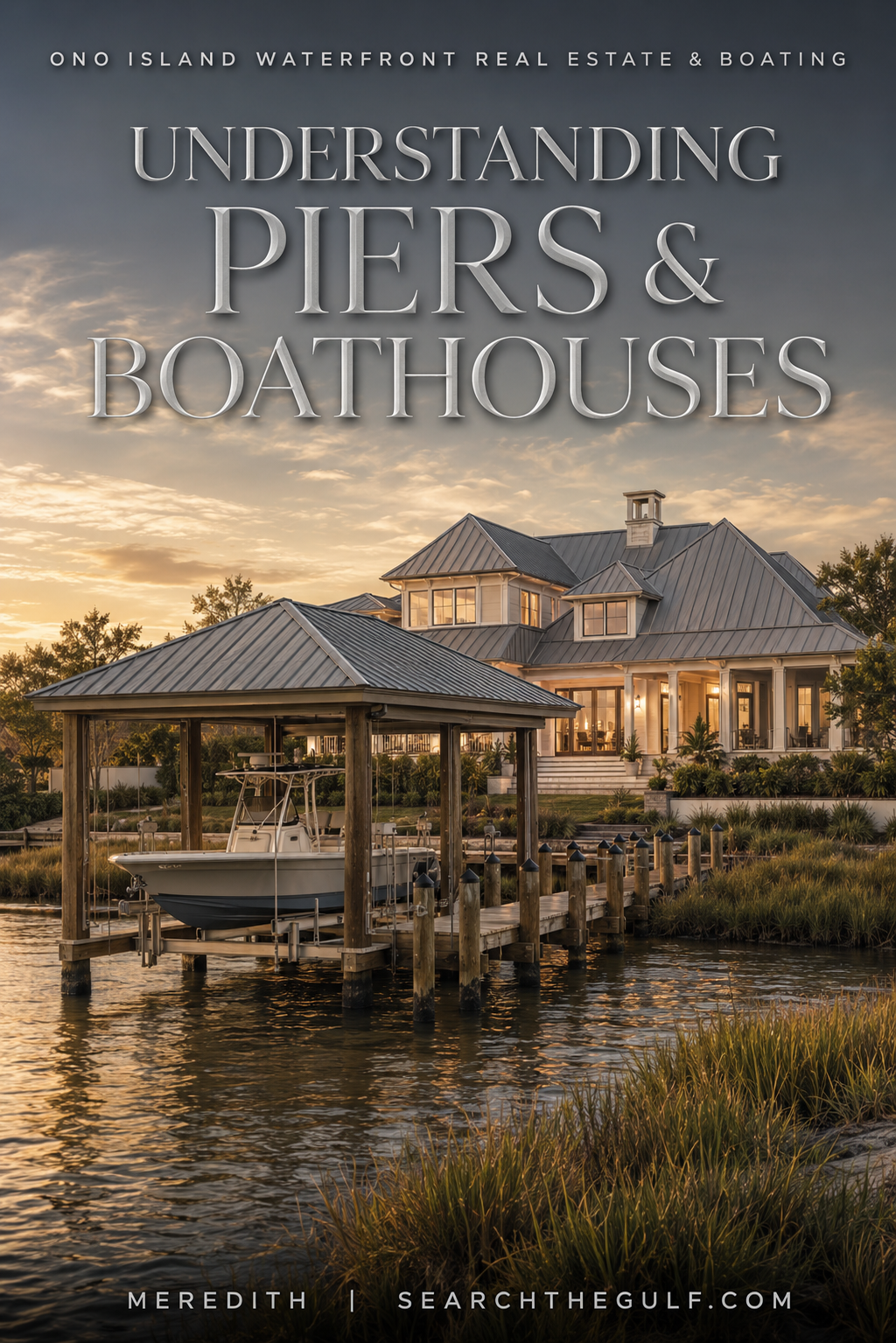
There is a particular moment when an Ono Island waterfront property begins to feel less like a house and more like a lifestyle.
It happens when you step through the back door, walk beneath the palms and reach a private pier where the boat is already waiting. There is no trailer to hitch, no crowded public ramp to navigate and no need to pack the entire day into the back of a vehicle.
The water is simply there—part of the property and part of the rhythm of living on Ono Island.
The First Question I Hear
“Can we leave from this dock and reach the Gulf in our boat?”
That is exactly the right question. But it should be followed by several more.
01. Is the pier properly permitted?
02. Does the boathouse comply with Ono Island ACC rules?
03. How deep is the water at ordinary and lower tides?
04. Will the buyer’s boat fit the existing slip and lift?
05. Is the property on a canal, Old River or Bayou St. John?
06. Are bridges part of the route?
07. Can the structure be enlarged, replaced or reconfigured?
A private pier or boathouse can be one of the most valuable lifestyle features associated with an Ono Island waterfront home. It can also be one of the most misunderstood.
The Essential Idea
A pier may appear simple from the shoreline, but its design is governed by property lines, riparian setbacks, navigable-channel requirements, environmental protections and several layers of permitting.
Where the Lifestyle Begins
Why Private Piers and Boathouses Are So Special on Ono Island
Ono Island is not simply a neighborhood near the water. It is a community shaped by the water.
Old River, Bayou St. John, the Intracoastal Waterway and the island’s canal systems create distinctly different boating environments. Some properties offer wide-water views and access for larger vessels. Others provide protected canal frontage that can be wonderfully convenient for smaller boats, paddleboards and personal watercraft.
A private pier changes the way an owner can experience all of it.
An early-morning fishing trip can begin before the roads are busy. An evening cruise may be decided upon while dinner is still on the grill. A quick run toward Perdido Pass, Robinson Island or the back bays does not have to become an all-day production.
“On Ono Island, a private pier does more than hold a boat. It shortens the distance between deciding to go and actually being on the water.”
This is why waterfront buyers often place such a high value on an existing, well-designed and properly permitted boathouse.
Approval Before Construction
The Ono Island Architectural Control Committee Comes First
The Ono Island Architectural Control Committee addresses piers, boat slips, decks, boathouses, mooring pilings and related waterfront structures.
The Required Order
Ono Island ACC pre-approval must be obtained before an application is submitted to applicable state and federal agencies.
That sequence matters. A property owner should not begin construction, order a lift or assume that approval from one agency satisfies every other requirement.
Depending on the property and scope of work, review may involve:
◆ The Ono Island Architectural Control Committee
◆ The U.S. Army Corps of Engineers
◆ The Alabama Department of Environmental Management
◆ Alabama State Lands or other applicable state authorities
◆ Baldwin County Building Inspection
◆ The Canal Owners Association when applicable
◆ Other agencies with jurisdiction over water bottoms, wetlands or coastal resources
The U.S. Army Corps of Engineers Mobile District, ADEM coastal permitting guidance and Baldwin County’s marine-accessory permit guidance are helpful research resources, but every property requires individual confirmation.
The Line Continues Over the Water
The First Critical Number: The Over-Water Setback
Piers and related structures, including mooring pilings, generally must be set back at least 10 feet from the lateral riparian-rights line unless the applicable unit covenants establish another requirement.
General Requirement
10-foot minimum over-water side setback
Units 5, 9, 12, 13, 20 and OE
20-foot side setbacks over water
The roof overhang, pilings, lift, deck and mooring configuration must all be considered. A boathouse that appears centered behind the residence may still conflict with an extended property line or required setback.
“The shoreline is not the end of the property-planning conversation. For a pier or boathouse, the relevant lines continue over the water.”
For additional background, read my Ono Island building setbacks guide and my guide to Ono Island building variances and ACC approval.
Big-Water Properties
Old River and Bayou St. John
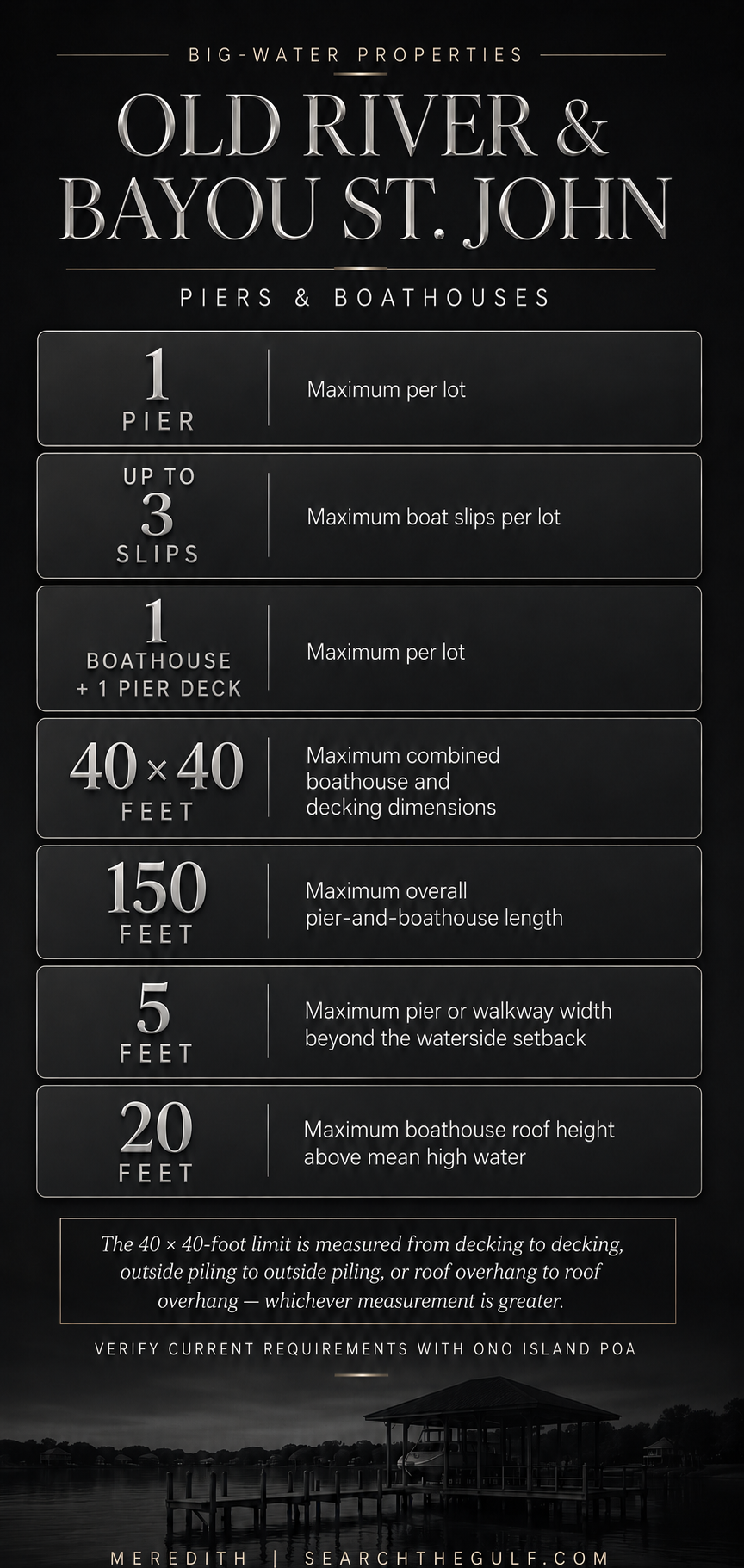
The ACC treats Old River and Bayou St. John differently from the Ono Island canal system. Under the supplied rules, these properties may include:
One pier per lot
Up to three boat slips per lot
One boathouse and one pier deck per lot
40 by 40 feet as the maximum combined boathouse and decking dimensions
150 feet as the stated maximum overall pier-and-boathouse length
Five feet as the maximum pier or walkway width beyond the waterside setback
20 feet as the stated maximum boathouse roof height above mean high water
The 40-by-40-foot limit is measured from decking to decking, outside piling to outside piling, or roof overhang to roof overhang—including roofing material—whichever measurement is greater.
“Three permitted slips do not automatically mean three large boats will fit.”
Why Slip Count Does Not Answer the Entire Question
A workable design must still account for:
✓ Vessel length and beam
✓ Lift dimensions and rated capacity
✓ Outboard-engine clearance
✓ Roof and piling placement
✓ Turning room and water depth
✓ Extended property lines
✓ Total permitted boathouse footprint
Protected-Water Properties
Ono Island Canal Lots Require a Different Calculation
Canal waterfront can be wonderfully protected and convenient, but canal boathouses are governed by a more compact set of dimensions.
Canal Structure Length Formula
Waterfront lot width × 0.375
60-foot waterfront measurement: 60 × 0.375 = 22.5 feet
80-foot waterfront measurement: 80 × 0.375 = 30 feet
100-foot waterfront measurement: 100 × 0.375 = 37.5 feet
These examples illustrate the mathematical formula only. They are not a determination of what any particular lot may be permitted to construct.
Boat slips must be positioned parallel to the shoreline.
The structure may not exceed 14 feet in width.
All dimensions include mooring pilings.
The stated maximum roof height is 16½ feet above mean high tide.
The walkway beyond the waterside setback may not exceed four feet in width.
The structure must remain at least 12 inches from the underwater grass fringe.
The outside piling face, roof overhang and mooring pilings must remain at least 15 feet from the canal centerline.
A 30-foot-wide unobstructed navigation channel must remain open.
Not All Canals Are the Same
Forty-Foot and Sixty-Foot Canals Are Treated Differently
Sixty-Foot Platted Canals
Shoreline indentations are not permitted.
Forty-Foot Platted Canals
Shoreline indentations are required.
The indentation may be no more than 10 feet deep, and the mouth of the indented slip must remain 15 feet from the extended property lines.
This design moves part of the slip into the shoreline rather than allowing the entire structure to project into the narrower canal.
Disturbed marsh fringe must be reconstructed in accordance with current Ono Island ACC and Corps requirements. The rules identify a $2,000 promissory note or grass bond associated with restoration. Owners should verify the current amount and procedure.
My guide to the Ono Island Canal Owners Association provides additional context for researching canal navigability, water depth and waterfront conditions.
Protecting the Water’s Edge
Living Shorelines Are Part of the Design
One of the most valuable ideas is that Ono Island canal shorelines are treated as living shorelines.
Natural and planted grasses help stabilize the shoreline, reduce erosion and support the character of the canal environment. The rules prohibit cutting or trimming cord grass, sea oats and other wild grasses within two feet horizontally or vertically from the shoreline.
Small mounds or “islands” within portions of the canal system are also protected. Docking, mooring, walking, parking and construction are prohibited on them.
“A beautiful waterfront improvement should work with the shoreline—not attempt to erase it.”
Architecture at the Water’s Edge
The Boathouse Roof Is Part of the Home’s Architecture
On Ono Island, a boathouse is expected to relate visually to the residence.
Boathouse roofs must match the home’s roof material and color, with a suggested 4-in-12 slope. If the boathouse is built before the residence, the home constructed later must use the same roof material and color as the boathouse.
Old River and Bayou St. John
Maximum stated roof height: 20 feet above mean high water
Ono Island Canal Lots
Maximum stated roof height: 16½ feet above mean high tide
Matching the Boat to the Property
Which Boats Are Well Suited to Ono Island?
There is no single “Ono Island boat.” The right vessel depends on the property’s depth, boating route, bridge clearance, slip configuration and the owner’s preferred time on the water.
Offshore Versatility
Center-Console Boats
Center consoles appeal to owners who enjoy fishing, open-water capability and trips through Perdido Pass. Larger models can be wide and heavy, making verified lift capacity, piling spacing, engine clearance and turning room especially important.
Shallow-Water Capability
Bay Boats and Hybrid Boats
Shallow-draft bay boats can be attractive for protected waterways and back-bay fishing. A lower draft can be advantageous for some canal properties, but it does not eliminate the need to measure actual water depth at a lower tide.
Cruising and Watersports
Dual Consoles and Bowriders
These versatile designs can work beautifully for cruising, watersports and relaxed trips toward the islands, restaurants and protected bays. Bow clearance, beam and lift-bunk configuration should still be verified.
Stability and Deck Space
Power Catamarans
Power catamarans are increasingly attractive for their stability, deck space and efficient ride. Beam is the critical consideration. A catamaran may be shorter than another boat but substantially wider, requiring careful review of lift design, piling spacing and canal turning radius.
Relaxed Coastal Cruising
Pontoons and Tritoons
Pontoons and tritoons can be enjoyable for leisurely cruising on protected water. Their broad decks provide comfortable seating, but their beam, wind profile and loaded weight must be considered.
Deeper-Water Properties
Larger Sport-Fishing and Cruising Boats
Some Old River and Bayou St. John properties may accommodate larger vessels. The existence of a long pier does not prove sufficient depth, however, and an open slip does not prove the vessel has a workable route to open water.
Read more about beam and waterfront compatibility in my guide to the KUSH 370 catamaran and Orange Beach waterfront living.
Three Tests That Matter
Boat-to-Property Compatibility Matters More Than Boat Length
Test One
The Dock Test
Will the boat physically fit the slip, lift and roofed area? Measure the vessel’s true overall length and beam, including engines, brackets, swim platforms, anchors and accessories.
Test Two
The Water Test
Is there sufficient depth at the dock and along the route during the conditions in which the owner expects to use the boat? A single depth measurement taken at a favorable tide is not enough.
Test Three
The Route Test
Can the vessel travel from the property to the intended destination without encountering an unsuitable bridge, narrow turn or shallow section? Air draft can be just as important as water depth.
“A property can be waterfront without being suitable for every boat.”
My Ono Island and Orange Beach tide outlook explains why the timing of depth measurements matters.
Existing Waterfront Improvements
What Should a Buyer Inspect?
Permit History
Ask for available ACC approvals, agency permits, surveys, inspection records and as-built documentation. Confirm that the structure standing over the water is the structure that was approved.
Pilings and Structural Components
Look for movement, impact damage, deterioration, cracking, rot and signs of uneven settlement. Concerns should be evaluated by a qualified marine contractor or engineer.
Roof and Connections
Inspect the roof, fasteners, framing, uplift connections, corrosion and the way the structure has weathered.
Boat Lift
Confirm the manufacturer, model, rated capacity, cable condition, motor condition, bunk configuration, piling arrangement and service history. Never rely only on a painted number or a seller’s recollection.
Electrical System
Salt, humidity, storms and rising water create a demanding marine environment. Shore-power outlets, lighting, lift motors and wiring should be evaluated by a properly qualified electrician.
Water Depth and Route
Measure depth at the slip, at the end of the pier and along the practical departure route. Record the time and tide condition so the measurement has meaningful context.
Construction Verification
Required Ono Island Inspections
Inspection One
Pre-site inspection: The owner and contractor meet with the island site inspector before work begins.
Inspection Two
Piling-placement verification: A surveyor verifies placement against the approved site plan before construction proceeds.
Inspection Three
Banding and roof inspection: The work is checked, including confirmation that the boathouse roof matches the residence in material and color.
Inspection Four
Final inspection: The completed project is reviewed for compliance with the approved plan, setbacks, footprint, pier width, roof height and permit conditions.
Before Planning a Change
Can an Existing Boathouse Be Expanded or Replaced?
Possibly—but never assume that an existing structure establishes the footprint for a future structure.
Rules may have changed since the original construction. The existing pier may be nonconforming, may have been built under an older approval or may be affected by current environmental conditions.
Is the existing structure permitted?
Does it comply with the approved plan?
Can it be repaired in place?
Would replacement trigger current standards?
Would the intended boat require wider piling spacing?
Would dredging or shoreline work be necessary?
Would a variance or additional agency approval be required?
Waterfront Real Estate Value
Why an Existing Private Pier Can Be a Unique Opportunity
From a real estate perspective, a private pier or boathouse can add utility, enjoyment and buyer appeal. The degree of value is property-specific and should be supported by comparable sales rather than assigned through a simple formula.
The greatest opportunity may be found where the existing structure is:
✓ Properly permitted
✓ Compatible with the buyer’s boat
✓ Located in useful water depth
✓ Connected to a practical boating route
✓ Structurally sound
✓ Equipped with an appropriate lift
✓ Supplied with safe electrical service
✓ Designed within ACC requirements
✓ Supported by a healthy shoreline
“Waterfront value is not measured only by the number of feet along the shore. It is measured by what those feet allow the owner to do.”
Waterfront Buyer Checklist
Questions to Ask Before Buying
- Is the property on Old River, Bayou St. John, the Intracoastal Waterway or an Ono Island canal?
- What is the surveyed waterfront measurement?
- Which unit covenants apply?
- Is the over-water setback 10 feet, 20 feet or another recorded distance?
- Is the canal platted at 40 feet or 60 feet?
- Is the existing pier and boathouse properly permitted?
- Are as-built surveys and final inspections available?
- What are the slip’s usable dimensions?
- What is the lift’s verified capacity?
- What is the water depth at an ordinary lower tide?
- Does the route include a bridge?
- Can the boat turn safely without impeding navigation?
- Are dredging or shoreline improvements anticipated?
- Are electrical and structural inspections advisable?
- Can the structure be altered for the buyer’s intended boat?
- Will new authorizations be required?
- Are there unresolved violations, bonds or restoration obligations?
Where the House Meets the Water
The Pier Is Part of the Property’s Story
A private Ono Island pier is one of those rare improvements that can make the water feel like an extension of the home.
It can be where the morning begins with coffee and a quiet tide, where a boat waits beneath a matching metal roof, or where the last light of the day catches the pilings after an evening cruise.
But that ease is supported by a careful framework of surveys, setbacks, permits, environmental protections and inspections.
“The rules are not separate from the boating lifestyle. In many ways, they help preserve it.”
Searching for Boat-Ready Waterfront?
Let’s Determine Whether the Property, Pier, Water and Boat Truly Work Together
If you are comparing Ono Island canal homes, big-water residences or waterfront homesites, I would be happy to help you look beyond the listing photographs and ask the questions that matter.
Search Ono Island Real EstateExplore waterfront homes and land at SearchTheGulf.com, the Gulf Coast’s premier website for searching all real estate listings along the coast.
Important Disclaimer
This information is deemed accurate but is subject to errors, omissions and changes. Rules, fees, standards and permitting procedures may have changed. Buyers, property owners, contractors and design professionals must independently verify current requirements with the Ono Island POA, applicable associations, Baldwin County, the U.S. Army Corps of Engineers, ADEM, Alabama State Lands and all governing authorities before purchasing property, designing improvements or beginning work. This content is general real estate information and is not legal, surveying, engineering, environmental, construction or permitting advice.
#searchthegulf #meredithamon #becausewelivehere
Through Meredith’s Lens · Fort Morgan, Alabama
When it comes to finding the home of your dreams in a fast-paced market, knowing about new listings as soon as they are available is part of our competitive advantage.Sign up to see new listings in an area or specific community. Contact Meredith with any questions you may have.
Ono Island Homes & Land for Sale – Luxury Waterfront Real Estate in Orange Beach Alabama

.gif)

Fort Morgan Sunset: A Peaceful October Evening | Meredith
An October Sunset at the End of Fort Morgan Road
By Meredith · October 13, 2026
Tonight, I stood at the end of Fort Morgan Road and watched a perfect October sky settle over the Gulf. Pale blue gave way to apricot and rose, with a ribbon of gold…
Long Bayou Preserve Orange Beach: New Site Plan & Update
Ask A Question or Sign Up To See New Real Estate Listings Before Your Competition