
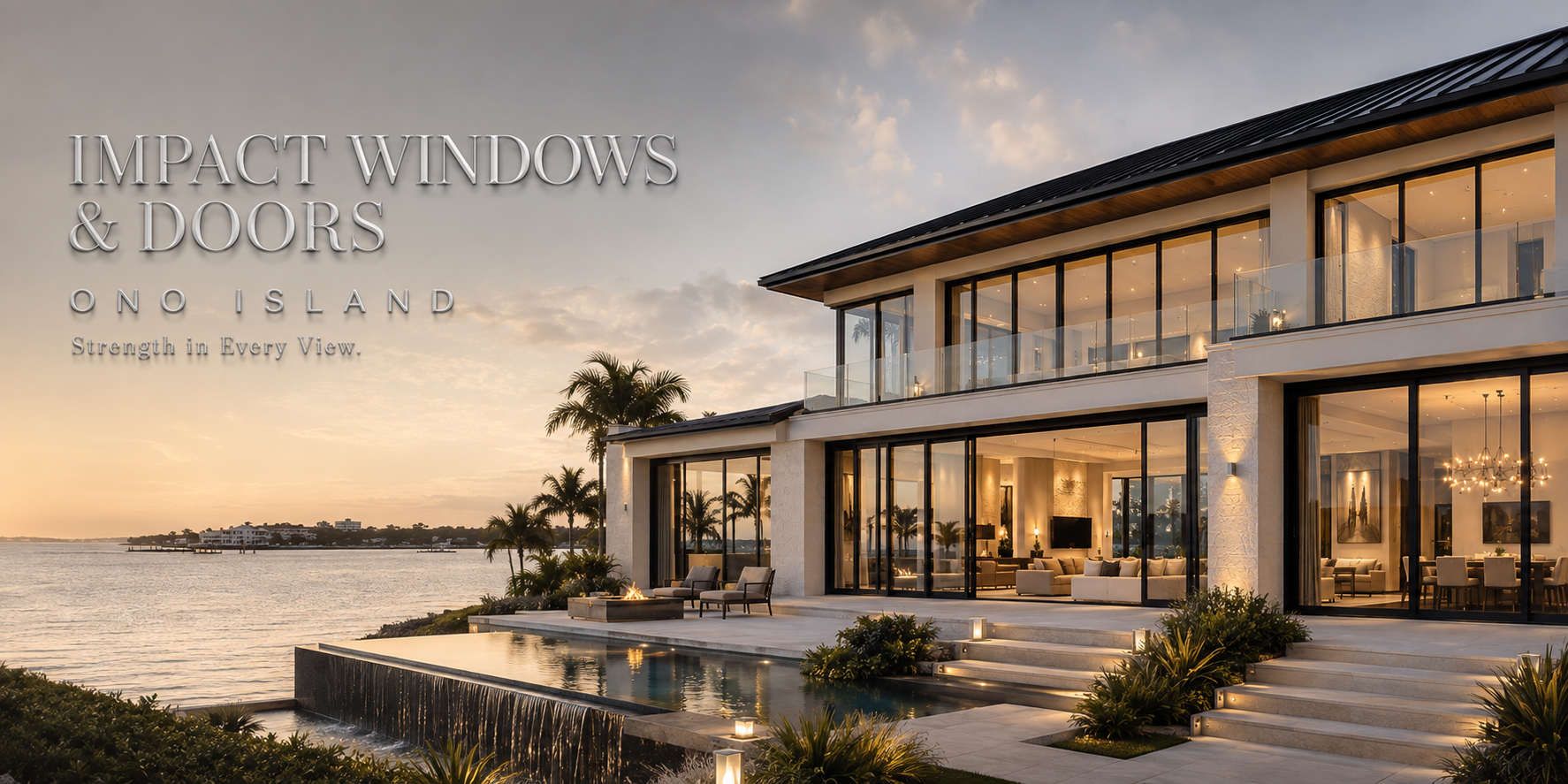
Ono Island Building & Coastal Renovation Guide
Impact-Resistant Windows & Doors on Ono Island
How I would balance storm protection, energy performance, privacy, views and modern coastal design
_(800_x_150_px)_(2).gif)

When I walk through a home on Ono Island, I am always aware of the relationship between the house and the outdoors. The windows frame ribbons of water, live oaks, palms, changing skies and the occasional boat making its way toward big water. Doors open to porches, pools and places where the salt air drifts through at the end of the day. On a barrier island, however, those beautiful openings are also among the most technically important parts of the home.
As an Ono Island homeowner, real estate advisor and neighbor—and as someone who genuinely loves construction and design—I do not think of impact-resistant windows and doors as a single upgrade. I think of them as an entire strategy. The right system can strengthen the building envelope, simplify hurricane preparation, soften outside noise, reduce solar heat, protect interiors from ultraviolet exposure, improve everyday comfort and give a home the clean architectural lines buyers appreciate.
On the coast, glass is never just glass. It is part of the view, part of the architecture, part of the energy plan and part of the home’s defense.
What Is an Impact-Resistant Window or Door?
The phrase high-impact glass is commonly used in conversation and online searches, but impact-resistant window or door assembly is the more useful way to think about it. Hurricane-rated laminated glass is usually made from two pieces of glass bonded to a strong clear interlayer. If struck, the glass may crack, but the interlayer is designed to hold the broken glass together and help the opening remain closed.
That glass is only one component. The frame, sash, locks, rollers, hinges, mullions, anchors, sealants and attachment to the wall must all work as a tested system. A beautiful pane of laminated glass placed in an inadequate frame is not the same as an approved impact-rated assembly.
The Question I Would Ask First
Is the complete unit tested for both impact and the positive and negative wind pressures required at this exact opening? Wind pressure varies with the home’s location, height, exposure, opening size and position on the building. The corner of an upper floor may require a different pressure rating than a smaller protected window elsewhere.
Current FORTIFIED guidance emphasizes tested impact and pressure protection for windows and doors. For FORTIFIED Silver and Gold projects, documentation matters: product approvals, test reports, labels, installation details and photographs may all become part of the verification record. No home is hurricane-proof, but protecting openings helps reduce the chance that wind and rain will enter and trigger a larger progression of damage.
Is Tempered Glass the Same as Impact Glass?
No. Tempered glass is heat-treated so that it breaks into relatively small pieces rather than sharp shards. It is safety glass and may be required near doors, tubs, showers, stairs or floors. By itself, however, tempered glass does not necessarily remain in the opening after a debris strike and is not automatically hurricane impact-rated.
Laminated impact glass may use annealed, heat-strengthened or tempered glass plies, depending on the tested design. Heat-strengthened glass can provide greater resistance to thermal stress than ordinary annealed glass. Tempered glass may be used where safety-glazing rules apply. What matters is the exact approved composition, not a general description on a sales proposal.
Are There Different Kinds of Laminated Impact Glass?
Yes, and two proposals that both say “impact glass” may offer very different comfort, appearance and performance. I would ask which of the following is included:
| Glass Configuration | What It Offers | Where I Would Consider It |
|---|---|---|
| Monolithic laminated impact glass | A laminated construction without a separate insulating cavity | Projects where approved storm performance and a slimmer or more economical configuration are the priorities |
| Insulated laminated glass unit | An impact laminate paired with another pane and a sealed air or gas space | Most conditioned Ono Island living spaces where energy efficiency, comfort and condensation resistance matter |
| Triple-pane impact system | Additional thermal and sometimes acoustic performance, with more weight and thickness | Select premium projects after confirming size, frame capacity, climate benefit and tested availability |
| PVB interlayer | A widely used clear polyvinyl butyral layer that bonds the glass | Many residential impact-rated windows and doors |
| Ionoplast or SGP-type interlayer | A stiffer premium interlayer that can help certain engineered systems meet demanding sizes or pressures | Large modern openings, elevated exposures and specialty architectural systems when specified by the manufacturer or engineer |
| Acoustic laminated glass | An interlayer or asymmetrical glass makeup selected to improve sound control | Bedrooms, offices and homes near boat traffic, community activity or mechanical equipment |
Laminated glass also tends to reduce ultraviolet transmission and can improve sound control and resistance to quick forced entry. I would describe those as valuable secondary benefits, not as promises that the window is soundproof, burglar-proof or indestructible.
Which Energy Upgrades Matter in Our Heat and Humidity?
A high-performance impact window should be chosen for everyday August afternoons as carefully as it is chosen for hurricane season. The NFRC label makes it easier to compare energy performance across products.
- U-factor: Measures heat transfer through the complete product. Lower generally means better insulating performance.
- Solar Heat Gain Coefficient: Measures how much solar heat enters. In our cooling-dominated climate, a lower SHGC can be particularly useful on sunny exposures.
- Visible Transmittance: Indicates how much daylight passes through. Lower glare is not always better if it makes rooms feel gloomy.
- Air leakage: Helps compare how much air moves through the closed assembly.
- Condensation resistance: Useful when interior humidity, exterior heat and strong air conditioning create challenging surface temperatures.
Should I Add a Low-E Coating?
For most conditioned Ono Island homes, I would want a serious discussion about an insulated impact unit with an appropriate low-emissivity coating. Low-E coatings are microscopically thin layers designed to manage infrared and ultraviolet energy while preserving useful daylight. Spectrally selective versions can reduce solar heat without making the glass look heavily tinted.
What About Argon, Krypton and Warm-Edge Spacers?
A sealed insulating cavity may contain air or an inert gas such as argon. Argon is common and can improve insulating performance. Krypton may be used in narrower premium cavities but generally costs more. A warm-edge spacer can reduce heat transfer near the edge of the glass and may help with interior-edge condensation. I would compare the whole-unit NFRC values rather than buying a window because one component sounds impressive.
Can I Choose a Bronze, Gray, Blue or Green Tint?
Often, yes. Fixed body tints and coated glass can reduce brightness and solar heat while changing the exterior character of the home. Bronze can feel warm and residential; gray or neutral tints can feel crisp and modern; blue-green glass can complement water views but may become commercial-looking if overused. I would review full-size samples outdoors at several times of day. A small sample held beneath showroom lighting rarely tells the entire story.
A Designer’s Question
Do I want the windows to disappear into the architecture, reflect the sky, warm the façade or become a dark graphic element? The glass color, frame color, interior finish and exterior lighting should all be considered together.
Can Impact Glass Give Me Privacy Without Window Treatments?
It can—but the word privacy needs to be defined room by room. Do you want softened views into a bathroom? Daytime privacy from the street? Complete privacy at night? Glare reduction without losing the water view? Or a window that becomes private only when requested?
Is One-Way or Reflective Glass Private Day and Night?
Generally, no. Reflective and so-called one-way privacy products depend on a lighting difference. During the day, when the exterior is brighter than the interior, they may make it difficult to see inside. At night, when the lights are on indoors and it is dark outside, that relationship reverses. A person outside may be able to see in clearly. Even 3M describes its residential solar-privacy film as daytime privacy only.
What Provides Permanent Privacy?
For spaces where privacy matters all the time, I would consider:
- Obscure or patterned glass that blurs detail while admitting light
- Acid-etched or frosted glass for a clean, softly luminous appearance
- Translucent laminated interlayers encapsulated within the glass makeup
- Ceramic frit in dots, lines, gradients or custom patterns
- Gradient privacy glass that is more opaque at eye level and clearer above
- Opaque panels where daylight or a view is not needed
These can be beautiful in baths, stairwells, entry sidelites, closets, garages and street-facing rooms. The tradeoff is that permanent obscure glass also softens or eliminates the view from inside.
Can the Glass Darken Automatically Throughout the Day?
Yes. Dynamic glazing is one of the most fascinating opportunities in modern residential design, although it requires early coordination and may not be available in every impact-rated window or door line.
| Dynamic Option | What It Does | What It Does Not Necessarily Do |
|---|---|---|
| Electrochromic glass | Gradually changes from clear to progressively darker tint using a small electrical signal; may be controlled manually, by schedule, sensors or automation | It usually manages sun and glare rather than becoming fully frosted or opaque |
| SPD glass | Changes quickly from lighter to darker while generally preserving a view | A dark tint may not provide complete nighttime privacy |
| PDLC switchable privacy glass | Switches rapidly between transparent and frosted states | Frosted is not always blackout; strong backlighting may reveal silhouettes |
| Photochromic glass | Responds to light intensity without a manual control | The homeowner has less control over when and how much it changes |
| Thermochromic glass | Changes in response to heat or glass temperature | It does not provide precise on-demand privacy or tint control |
Systems such as electrochromic smart glass can tint in response to changing sun conditions, preserving daylight and views while reducing glare. For a new home, wiring, controls, sensors, transformers, automation integration and replacement access should be planned before walls are closed.
The Impact-Rating Rule Still Applies
A smart film or switchable glass feature does not automatically create—or preserve—a hurricane impact rating. If dynamic glazing is used in an exterior opening, I would require written confirmation that the exact glass composition, frame, size and hardware are part of the approved tested assembly. Post-applied film may also affect a glass or seal warranty, so I would never add it before obtaining written approval from the window manufacturer.
Are There Simpler Ways to Eliminate Traditional Draperies?
Yes. Smart glass is exciting, but it is not the only clean solution. Impact-rated entry-door systems are available with cordless blinds enclosed between panes. Some specialty window and door systems may offer integral shades or blinds, although availability can be limited by the impact approval, opening size and product line.
I also like concealed pockets for motorized roller shades. The shade disappears into the ceiling or jamb when open, leaving the architecture quiet and the view uninterrupted. It can then provide reliable nighttime privacy or room darkening. Exterior motorized screens can reduce heat before it reaches the glass, while tested roll-down shutters may add storm protection. Each exterior product must be designed for wind, corrosion and safe retraction.
Which Frame Material Is Best Near Salt Air?
There is no universal winner. I would choose the frame as part of the complete architecture and maintenance plan.
- Coastal-grade aluminum: Strong, slim and well suited to large modern openings. I would ask about thermal breaks, high-performance powder coating or anodizing, finish testing, compatible fasteners and salt-air warranty exclusions.
- Vinyl: Naturally resistant to rot and corrosion and generally energy efficient. Frames may be wider, and color, reinforcement, expansion and maximum tested size deserve review.
- Fiberglass or composite: Dimensionally stable, thermally efficient and corrosion resistant, often with a refined profile. Availability, impact ratings, size and cost vary significantly.
- Clad wood: Beautiful on the interior with a protected exterior skin, but detailing, drainage, finish care and coastal warranties must be evaluated carefully.
Hardware is just as important as the frame. Multi-point locks, hinges, rollers, tracks, fasteners and screens live in the same salt-laden environment. I would ask what is stainless, what grade it is, how dissimilar metals are isolated, what requires lubrication and rinsing, and which corrosion conditions are excluded from the warranty.
Which Window Styles Work Best?
- Fixed or picture windows: No moving parts, broad views and often excellent air and water performance. They do not provide ventilation or emergency egress.
- Casement windows: Hinged at the side and closed against compression seals. They can offer excellent ventilation and a clean modern appearance.
- Awning windows: Hinged at the top and useful for ventilation during light rain, subject to exposure and manufacturer guidance.
- Single- or double-hung windows: Familiar and traditional, with performance dependent on sash, balance and seal design.
- Horizontal sliders: Practical and easy to operate, but track drainage, rollers and maintenance deserve attention.
- Tilt-turn and specialty windows: Beautiful and versatile when an appropriately tested coastal impact line is available.
I often like a composition of larger fixed glass for the best view, paired with strategically placed operable units for ventilation and egress. That approach can reduce visual clutter, but it must be coordinated with bedroom escape requirements, furniture placement and exterior elevations.
What Are My Impact-Rated Door Options?
The door system can have more influence on the experience of the home than almost any individual window. Options may include:
- Hinged entry doors with solid, partial-lite or full-lite designs
- French doors with multi-point locking
- Sliding patio doors and multi-slide systems
- Lift-and-slide doors for larger, heavier panels
- Pocketing sliders that disappear into wall pockets
- Corner-opening glass systems
- Folding or bifold wall systems
- Oversized pivot doors designed as tested coastal assemblies
Large impact doors are heavy. I would evaluate ease of operation, panel weight, handle height, roller access, track cleaning, water rating, sill height, drainage path, screen configuration, lock operation and service availability. A nearly flush sill may look extraordinary, but the water-management details are not the place to compromise. A lower threshold can involve a performance tradeoff, and the surrounding porch, roof overhang, drains and interior floor elevation must support the decision.
Does Impact Glass Mean I Never Need Shutters?
An appropriately rated impact window or door can provide permanent opening protection without installing removable panels before each storm. That convenience is one of its greatest advantages. A homeowner may still choose tested shutters for redundancy, shade or additional protection from windborne debris. The shutters themselves must be compatible with the opening, mounted correctly and documented if they are part of a FORTIFIED strategy.
I would also remember that impact glass can crack when struck. Its job is to help remain in place and protect the opening, not to remain cosmetically perfect after every impact.
What Benefits Might a Buyer Notice Every Day?
| Benefit | Why It Matters on Ono Island |
|---|---|
| Permanent readiness | Less last-minute labor than deploying removable protection over every opening |
| Comfort | Better glass packages can reduce hot spots, drafts, glare and radiant heat near broad openings |
| Interior protection | Laminates, coatings and films can reduce UV exposure that contributes to fading |
| Quieter rooms | Laminated and insulated configurations can soften outside sound |
| Security delay | Bonded laminated glass may be more difficult to breach quickly than ordinary glass |
| Architectural freedom | Engineered systems can create larger views, cleaner lines and striking indoor-outdoor connections |
| Potential insurance value | A documented FORTIFIED designation may qualify for wind-premium discounts; the homeowner should confirm with the insurer |
Alabama has meaningful incentives for resilience. The state’s Strengthen Alabama Homes information notes that homes with a FORTIFIED designation receive discounts on the wind portion of homeowners insurance. The separate grant program is primarily associated with resilient roofing, so I would not assume a window replacement qualifies for a grant. I would ask the insurer, evaluator and tax advisor about current discounts, deductions and documentation before work begins.
How Much Do Impact Windows and Doors Cost?
There is no responsible flat price because an “opening” might be a modest bedroom window or a forty-foot glass wall. As a broad 2026 planning reference, current national impact-window cost data places many professionally installed impact windows around $700 to $2,875 per window, with custom shapes and large openings substantially higher. A twelve-foot impact sliding door may approach $8,000 to $9,000 before unusually complex structural, waterproofing or finish work. Smart-glass cost data commonly estimates approximately $50 to $150 per square foot installed, while smart film may cost less but must be approved for the existing glass and warranty.
For early Ono Island budgeting, I would use the following only as conversation starters—not contractor quotes:
- Standard-size installed impact windows: often approximately $1,000–$3,000 per opening
- Oversized fixed or custom architectural windows: often $2,500–$10,000 or more per opening
- Impact entry or French-door systems: often several thousand dollars, with premium oversized systems substantially higher
- Conventional impact sliding doors: commonly several thousand dollars; broad multi-panel, pocketing, lift-slide, corner and folding systems may run well into five figures
- Whole-home replacement: a smaller straightforward project may begin in the tens of thousands, while a large custom Ono Island residence can readily reach $75,000–$200,000 or more when it includes extensive glass walls, premium finishes, structural work and interior restoration
The range is intentionally wide. Frame material, glass makeup, pressure rating, product line, finish, grids, hardware, opening size, story height, access, demolition, stucco or siding repair, rot remediation, interior trim, painting, electrical controls, permits, disposal and engineering all influence the final number. I would insist on itemized, comparable proposals.
How Would I Approach the Windows and Doors for a New Ono Island Home?
If I were buying a homesite and planning a custom home, I would begin with the windows before the floor plan was completely settled. That may sound early, but opening size, structure, energy, furniture, privacy and exterior composition all influence one another.
- Map the site and the sun. I would identify the best views, neighboring sightlines, morning light, western heat, prevailing weather and outdoor-living connections.
- Engage the architect, builder, structural engineer and FORTIFIED evaluator early. The evaluator should not arrive after products have been ordered if an official designation is the goal.
- Create an opening schedule. Every window and door should list size, operation, room, elevation, impact standard, required design pressures, energy values, glass color, privacy treatment, frame finish, hardware and screen.
- Design privacy into the architecture. I would use landscaping, window height, clerestories, offset sightlines, overhangs and selective obscure glass before covering every beautiful window with a treatment.
- Choose glass by elevation. A west-facing great room may need different solar control than a shaded north-facing bedroom. Consistency of exterior color must still be checked.
- Mock up the important glass. I would view full-size glass and frame samples outside, then test the handle, lock, roller and sill of any large door.
- Compare identical specifications. Every bidder should price the same sizes, ratings, glass, frames, finishes, installation details and documentation.
- Plan water management. Flashing, pans, sill dams, sealants, drainage and transitions to cladding are as important as the product.
- Document before concealment. I would retain approvals, labels, invoices, serial numbers, installation instructions and photographs of anchors and flashing.
- Prepare a maintenance file. Include cleaning products, fresh-water rinsing, lubrication, weep-hole care, inspection intervals and coastal warranty requirements.
For more on planning a home from the ground up, I invite buyers to explore my Gulf Coast building resources, Ono Island new-construction guidance and coastal homesite due-diligence guide.
How Would I Approach Replacing Every Window in an Existing Home?
A whole-home replacement is not merely a product purchase; it is a building-envelope renovation. I would first investigate before selecting a brand.
- Inventory what is there. Record every opening, existing label, permit, product approval, leak, seal failure, damaged frame, difficult lock and fogged insulated unit.
- Check the home’s FORTIFIED history. If a designation exists, I would speak with an evaluator before changing an opening so the replacement does not create a redesignation problem.
- Inspect the rough openings. Hidden rot, corrosion, missing flashing and water intrusion can change the scope after demolition.
- Decide between insert and full-frame replacement. A full-frame installation exposes more of the opening and may allow better flashing correction, but it involves more finish work. An insert may preserve surrounding materials but can reduce visible glass and may not address concealed problems.
- Confirm egress and structure. New frame profiles can change clear opening dimensions. Enlarged doors or windows may require engineered headers, wall reinforcement or load-path work.
- Coordinate the exterior and interior repairs. Stucco, siding, waterproofing, trim, drywall, paint, flooring, alarm contacts and motorized-shade wiring should be included in the schedule and budget.
- Replace strategically if phasing is necessary. I might begin with leaking units, the largest vulnerable openings, bedrooms, the most sun-exposed elevation or doors that no longer operate safely—but I would maintain a whole-home specification so later phases match.
- Obtain permits and final documentation. Baldwin County states that its Building Department permits and inspects construction, alterations, repairs and remodels within its jurisdiction. The contractor should confirm the exact current requirements for the property before ordering.
What Should Be Included in Every Proposal?
- Manufacturer, series, operation and exact unit size
- Impact test standard and product approval or evaluation report
- Positive and negative design-pressure rating for each opening
- Glass ply, interlayer, insulating cavity, coating, tint and gas fill
- NFRC U-factor, SHGC, visible transmittance and air leakage
- Frame material, reinforcement, finish and coastal corrosion provisions
- Hardware material, locks, rollers, hinges and screens
- Flashing, sill pan, anchors, sealants and attachment substrate
- Removal, disposal and protection of the home during work
- Stucco, siding, trim, drywall, paint and flooring repairs
- Permit, engineering, inspection and FORTIFIED documentation responsibilities
- Product, glass-seal, finish, hardware and labor warranties
- Lead time, installation sequence, payment schedule and service response after closing
A Question Worth Asking Before Signing
If this window leaks, fogs, corrodes or becomes difficult to operate five years from now, who will service it locally—and can replacement glass, rollers, locks and weatherstripping still be obtained?
What Would I Look for When Buying an Existing Ono Island Home?
I would not stop at the listing phrase “impact windows.” I would ask:
- Are all exterior openings impact-rated, or only some of them?
- Are the entry doors, garage-door glazing, transoms, sidelites, skylights and large sliders included?
- What are the manufacturer and series?
- Are permits, invoices, approvals, labels and warranties available?
- Do the installed sizes match the approved configurations?
- Are there signs of fogging, delamination, corrosion, sealant failure or water staining?
- Do doors lock smoothly and windows operate without force?
- Has after-market film been applied, and is it approved by the manufacturer?
- Does the home have an active FORTIFIED designation, and when does it expire?
- What maintenance and storm history can the seller provide?
Impact-resistant openings can be a meaningful advantage, but I want the documentation to support the description. I also want a buyer to understand the age and serviceability of the system, because glass, seals, rollers, hardware and coatings do not last forever in a coastal environment.
What Is My Ideal Specification?
For many new custom homes on Ono Island, my starting conversation would be an appropriately tested, site-specific impact-and-pressure-rated system with insulated laminated glass, a climate-appropriate low-E coating, a carefully selected SHGC, durable coastal frames and corrosion-resistant hardware. I would use large fixed units where the view deserves emphasis, operable units where ventilation and egress matter, and high-performance door systems sized for comfortable daily use rather than simply for drama.
For privacy, I would combine architecture, landscaping, selective obscure glass and concealed motorized shades. I might reserve dynamic tint or switchable privacy glass for the few rooms where it solves a genuine problem beautifully. That is a more thoughtful investment than specifying expensive technology everywhere simply because it exists.
For a renovation, I would prioritize correcting water-management problems and obtaining a coherent whole-home specification. The most expensive window is not automatically the best window, and the best glass can still be compromised by poor installation.
Because We Live Here
Would You Like Help Finding the Right Local Professionals?
I have relationships with builders and contractors who understand Ono Island, coastal construction and the importance of careful documentation. If you are evaluating a homesite, planning a custom home or considering a whole-house window-and-door replacement, reach out to me. I would be happy to share names and help you begin asking the right questions.
This article is intended as general real estate, design and construction education. Product availability, testing, building codes, FORTIFIED requirements, permits, insurance programs, costs and community standards can change. Each home and opening is different. Buyers and homeowners should consult the applicable building authority, architect, engineer, licensed contractor, window manufacturer, FORTIFIED evaluator, insurer, tax advisor and Ono Island architectural review authority before purchasing or altering a system.
Select one or more listings to compare
When it comes to finding the home of your dreams in a fast-paced market, knowing about new listings as soon as they are available is part of our competitive advantage.Sign up to see new listings in an area or specific community. Contact Meredith with any questions you may have.
#searchthegulf #meredithamon #becausewelivehere
# Ono Island Homes & Land for Sale – Luxury Waterfront Real Estate in Orange Beach Alabama, $500,000 - $600,000
Compare Listings

.gif)

2026 MBGFC Labor Day Invitational | Orange Beach | Search The Gulf
Orange Beach · Boating Lifestyle
The 2026 MBGFC Labor Day Invitational: Celebrating Orange Beach’s Fishing and Boating Community
Thirty-eight teams, 222 anglers, 186 catches—and a Labor Day weekend that felt like one coastal family at the dock.
Explore Orange Beach Perdido Pass
On this…
Cotton Bayou Marina Boats | Orange Beach Near Terry Cove

Orange Beach and Ono Island Real Estate Update September
Ask A Question or Sign Up To See New Real Estate Listings Before Your Competition


Enjoy this blog post? Click here to subscribe for updates
Leave A Comment