
Orange Beach and Ono Island Boating Guide
Orange Beach and Ono Island Boating Tips
Navigation rules, channel markers, trailering techniques, wind handling and practical on-the-water etiquette for Alabama’s Gulf Coast.
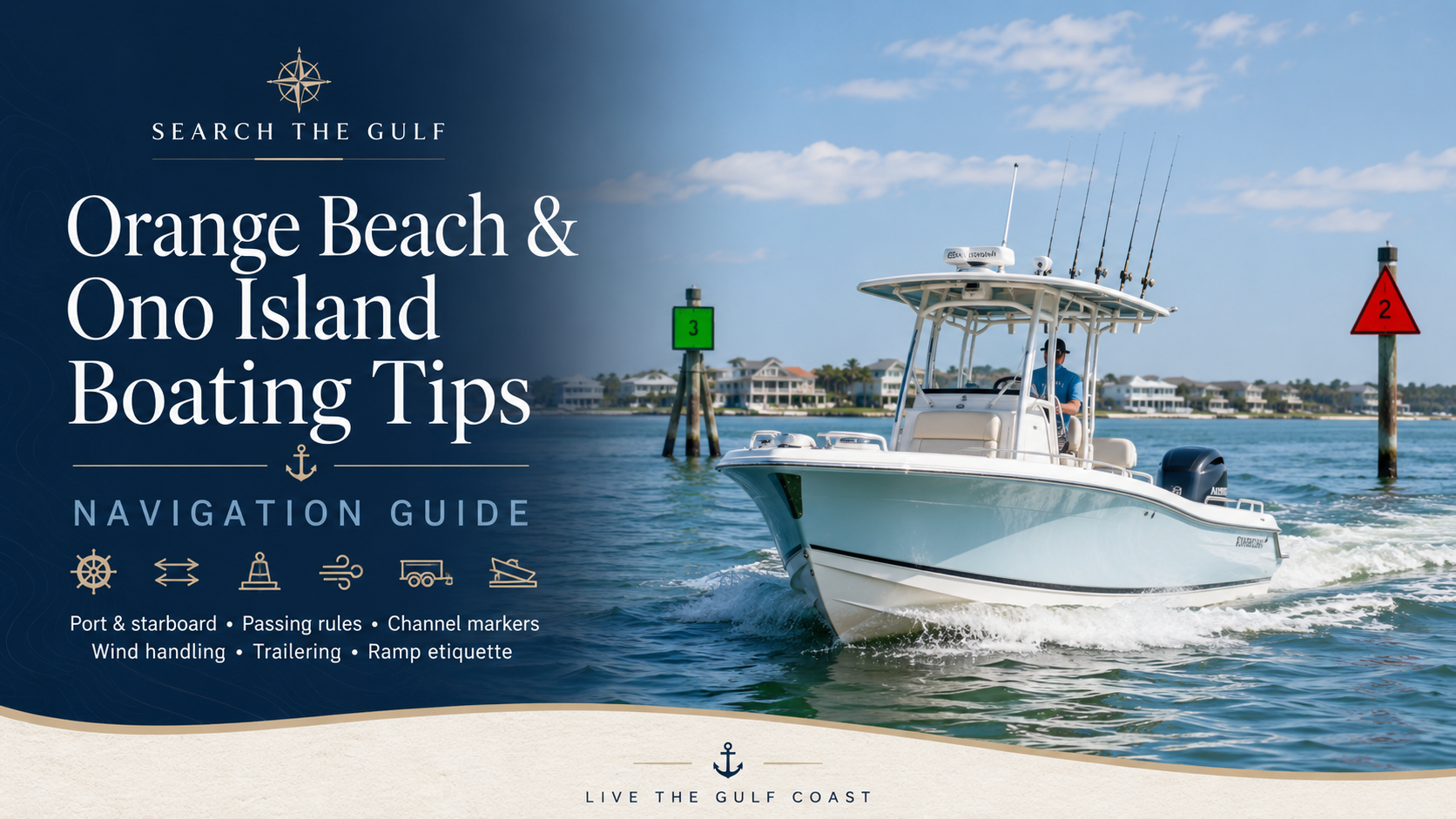
Living near the water in Orange Beach and on Ono Island comes with exceptional access to Bayou St. John, Old River, Terry Cove, Cotton Bayou, the Intracoastal Waterway and Perdido Pass.
It also means learning how to share busy waterways, read channel markers and handle a boat confidently around wind, current, docks and launch ramps.
I often remind waterfront buyers that boating convenience involves much more than having a dock or boat lift. Understanding the basic rules of navigation can make every trip safer and more enjoyable.
This guide is educational and does not replace an Alabama boating-safety course, current NOAA charts, posted signs, official no-wake maps or the judgment of an experienced captain.
Basic Boat Terminology
Bow
The front of the boat.
Stern
The back of the boat.
Port
The left side when facing forward toward the bow.
Starboard
The right side when facing forward toward the bow.
A simple way to remember port is that “port” and “left” both have four letters.
At night, the port side is represented by a red navigation light, while the starboard side is represented by a green navigation light. Alabama requires the appropriate navigation lights between sunset and sunrise and during periods of reduced visibility.
Passing Another Boat: Port to Port
When two power-driven boats approach nearly head-on and there is a risk of collision, each boat should generally turn to starboard. The boats then pass with their port sides facing one another.
Turn right and pass left side to left side.
Think of it as driving on the right side of the waterway. Make the course change early, clearly and deliberately so the other operator understands your intention.
Avoid making a series of small, uncertain turns. One obvious maneuver is easier for other boaters to interpret.
Crossing Situations: The Boat on Your Right
When two powerboats are crossing and another boat is approaching from your starboard side, you are normally the give-way vessel. You should slow down, turn to starboard or pass safely behind the other boat.
Avoid accelerating across the other boat’s bow. The vessel that has the other boat on its starboard side must generally keep out of the way.
When you see a boat to your right, give way rather than fight.
Overtaking a Slower Boat
The boat doing the overtaking is responsible for staying clear until it is completely past the other vessel.
- Look behind you for approaching traffic.
- Confirm there is adequate width and water depth.
- Slow down enough to minimize your wake.
- Pass with generous clearance.
- Do not cut immediately back in front of the other vessel.
- Watch for swimmers, towables, paddlecraft and fishing lines.
In a narrow channel, overtaking should be coordinated rather than assumed.
Basic Horn Signals
One Short Blast
I intend to leave you on my port side, commonly associated with a starboard maneuver.
Two Short Blasts
I intend to leave you on my starboard side, commonly associated with a port maneuver.
Three Short Blasts
I am operating astern propulsion.
Five Short Blasts
Danger, doubt or disagreement.
Five short, rapid blasts mean the other operator’s intentions are unclear or the proposed maneuver does not appear safe. Slow down and reassess.
Understanding Red and Green Channel Markers
Red, right, returning.
When returning from the Gulf through Perdido Pass, keep red lateral markers on your starboard side and green lateral markers on your port side.
When traveling out toward the Gulf:
- Red markers will generally be on your port side.
- Green markers will generally be on your starboard side.
Red markers are commonly triangular or nun-shaped and carry even numbers. Green markers are commonly square or can-shaped and carry odd numbers.
Do not assume the water immediately outside a marker is deep. The markers identify the navigable channel, but they do not guarantee that surrounding areas are free from shoaling, submerged debris or other hazards.
Intracoastal Waterway Markers
Markers along the Intracoastal Waterway may also display yellow symbols. When following the conventional direction of the ICW:
- Keep a yellow triangle to starboard.
- Keep a yellow square to port.
- A yellow horizontal band identifies the ICW but does not provide lateral direction.
Where a standard red or green marker appears to conflict with its yellow ICW symbol, the yellow triangle or square determines how the marker should be passed while following the Intracoastal Waterway.
Navigating Perdido Pass
Perdido Pass deserves particular attention because it combines bridge openings, current, recreational traffic, charter boats, commercial vessels, personal watercraft and changing weather.
A dredged entrance channel leads through the pass before dividing toward Terry Cove and Bayou St. John. Portions of the east jetty may be submerged, and submerged hazards may exist near the approach. Follow the marked channel carefully rather than cutting across the jetty area.
Stay in the Channel
Do not cut corners or assume the water outside the markers is deep enough for your boat.
Check Conditions
Review marine weather, tides, radar and wind before departure.
Allow More Space
Large vessels may have limited maneuverability and may be confined to deeper water.
Avoid Stopping
Do not stop, drift, anchor or organize gear in the main channel.
Secure Passengers
Prepare passengers and loose equipment before encountering inlet chop.
Know When to Turn Back
Turn around when conditions exceed the capability of the boat or operator.
No-Wake and Idle-Speed Areas
Orange Beach publishes official no-wake and idle-speed maps, including a separate map for East Ono Island. Review the current maps before heading out because a no-wake area may extend farther than expected.
“No wake” generally means operating slowly enough that the vessel does not create a damaging wake. Simply remaining slightly above idle or changing the boat’s trim does not make a disruptive wake acceptable.
A large wake can:
- Rock boats against lifts and pilings.
- Damage docks and shoreline structures.
- Cause someone aboard a moored boat to fall.
- Erode an unprotected shoreline.
- Disrupt paddleboarders, kayakers and anglers.
Watch the wake behind your boat, not merely the speedometer.
Handling a Boat in Wind and Current
Wind pushes the portion of the boat above the water, while current moves the underwater hull. In protected Orange Beach waters, either may control the boat’s movement.
Before approaching a dock or trailer, pause in open water and determine which force is stronger. Notice how the boat drifts while briefly in neutral.
When Approaching a Dock
- Prepare lines and fenders before entering the docking area.
- Approach slowly at a shallow angle.
- Aim slightly into the stronger wind or current.
- Use short, controlled shifts between forward, neutral and reverse.
- Do not allow passengers to jump prematurely.
- Never use a hand, arm, leg or foot to stop the boat against the dock.
- Abort the approach and try again when the angle is wrong.
When the wind is blowing the boat toward the dock, use a shallower approach and adequate fenders. When the wind is pushing the boat away, approach with slightly more angle and secure the upwind line first.
At very low speed, steering response may be delayed. Short bursts of power followed by neutral are often more controlled than continuous throttle.
Choosing the Proper Trailer Depth
There is no universal trailer depth that works for every boat, ramp and trailer. Hull shape, bunk placement, roller configuration, ramp angle, tide, wind and current all affect the correct position.
For many bunk trailers, a practical starting point is to submerge most of the rear bunks while leaving enough of the forward bunks above water to guide and center the bow.
Create a Repeatable Reference
- Load the boat successfully on a calm day.
- Notice where the water reaches the trailer fender, guide post or frame.
- Record or mark that reference point.
- Adjust for tide, ramp angle, boat load, wind and current.
Signs the Trailer Is Too Deep
- The boat floats over the bunks instead of being guided by them.
- The stern swings sideways.
- The bow reaches the winch post while the hull remains crooked.
- The boat settles off-center when the trailer is pulled out.
Signs the Trailer Is Too Shallow
- Excessive winching force is required.
- The bow cannot reach the bow stop.
- The hull contacts only the rear edge of the bunks.
- The boat must be heavily powered onto the trailer.
When the boat will not center naturally, stop and reposition the trailer rather than forcing the boat sideways with the winch.
Using Trailer Guide Posts and Side Guides
Guide posts are especially helpful in Orange Beach crosswinds and tidal current.
They should be:
- Tall enough to remain visible when the trailer is submerged.
- Positioned just outside the appropriate widest portion of the hull.
- Adjusted closely enough to center the boat without rubbing or trapping it.
- Securely mounted and regularly inspected for corrosion.
As you approach the trailer, line up the bow with the winch post, not merely with the tow vehicle.
Aim slightly upwind or up-current so the boat drifts toward the trailer’s centerline.
- Shift into neutral as the bow enters between the guide posts.
- Allow the bunks or side guides to begin centering the hull.
- Use bow and stern lines when practical.
- Attach the winch strap.
- Keep everyone away from the direct line of the winch cable or strap.
- Winch the boat securely to the bow stop.
- Attach the bow safety chain before leaving the ramp.
Boat-Ramp Etiquette
Orange Beach has public launch options at Boggy Point, Cotton Bayou and The Launch at ICW. Boggy Point is directly adjacent to the main channel and can experience substantial marine traffic.
Prepare Before Backing Down
- Load coolers, safety gear and personal belongings in the staging area.
- Install the drain plug.
- Remove transom straps when appropriate.
- Attach bow and stern handling lines.
- Check fuel, batteries and engine operation.
- Make sure passengers are ready.
- Do not block an active ramp while organizing equipment.
- Wait your turn and use only one lane.
- Move the boat promptly to a courtesy dock.
- Pull completely away from the ramp before securing equipment for the road.
When retrieving, have the trailer ready before bringing the boat into the ramp lane. After loading, move to the staging area before installing transom straps, draining the bilge and reorganizing equipment.
General Boat Etiquette for Orange Beach and Ono Island
Slow Near Docks and Small Craft
Give kayaks, paddleboards, sailboats, anchored fishing boats and residential docks substantial room.
Do Not Anchor in a Channel
Anchoring, fishing or stopping in a marked channel creates a hazard for vessels that cannot safely leave deeper water.
Cross Behind Towing Boats
Never pass between a towing boat and its skier, wakeboarder or tube.
Protect People Near the Stern
Confirm swimmers, lines and equipment are clear of the propeller before starting the engine.
Respect Residential Areas
Lower music and conversation levels when entering canals, marinas and neighborhoods.
Dim Unnecessary Lights
Bright deck lights can interfere with night vision and make navigation lights difficult to distinguish.
Keep Fishing Lines Clear
Do not troll across busy channels, marina entrances or boat-ramp approaches.
Offer a Courtesy Slow Pass
Reduce speed early when passing anglers, paddlecraft, dock workers or smaller boats.
Carry the Required Safety Equipment
Alabama requires a wearable life jacket for each person aboard. Recreational vessels 16 feet and longer must also carry a throwable flotation device.
Required equipment varies by boat size and operation. Before leaving the dock, confirm that life jackets, fire extinguishers, navigation lights, distress signals, sound-producing equipment and the engine cut-off system are aboard and operational.
My Final Boating Tip
I encourage Orange Beach and Ono Island boat owners to practice difficult maneuvers on calm weekdays rather than during the busiest part of a summer weekend.
Spend time learning how the boat reacts in reverse, how far it travels after shifting into neutral and how wind affects the bow and stern.
The best operators are rarely the fastest or most aggressive. They are predictable, patient and willing to abandon an approach and try again.
Search Orange Beach and Ono Island Waterfront Real Estate
For information about waterfront homes, canal-front properties, boating access, boat lifts and private docks, explore Search the Gulf, the Gulf Coast’s premier website for searching all real estate listings on the Gulf Coast.
Meredith Folger Amon
Gulf Coast Real Estate Advisor
Licensed in Alabama and Florida
Licensed in Alabama and Florida – Guided by Integrity. Backed by Experience. Search the Gulf with Meredith Amon.
No listings were found matching your search criteria. No listings were found matching your search criteria.
Ono Island
Storm Prep on Ono Island — Watching Tropical Weather for Friday
A tropical system could reach the coast this Friday. Nothing is locked in yet—and on Ono, we do not wait for a last-minute scramble.
When it comes to finding the home of your dreams in a fast-paced market, knowing about new listings as soon as they are available is part of our competitive advantage.Sign up to see new listings in an area or specific community. Contact Meredith with any questions you may have. #searchthegulf #meredithamon #becausewelivehere
 SEARCH ORANGE BEACH REAL ESTATE LISTINGS FOR SALE
Ono Island Homes & Land for Sale – Luxury Waterfront Real Estate in Orange Beach Alabama

.gif)

Storm Prep on Ono Island — Watching Tropical Weather for Friday | Search The Gulf
Ono Landing Launch vs Dock
On this page
Watching Friday’s weather
Boat launch…
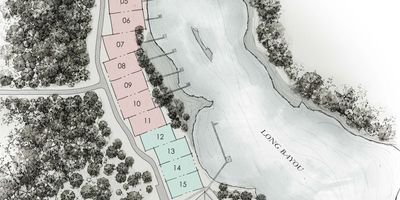
Long Bayou Preserve Orange Beach: New Site Plan & Update
Ask A Question or Sign Up To See New Real Estate Listings Before Your Competition
Posted by Meredith Folger Amon on
Enjoy this blog post? Click here to subscribe for updates
Leave A Comment