Ono Island Buyer Guidance & Coastal Home Care
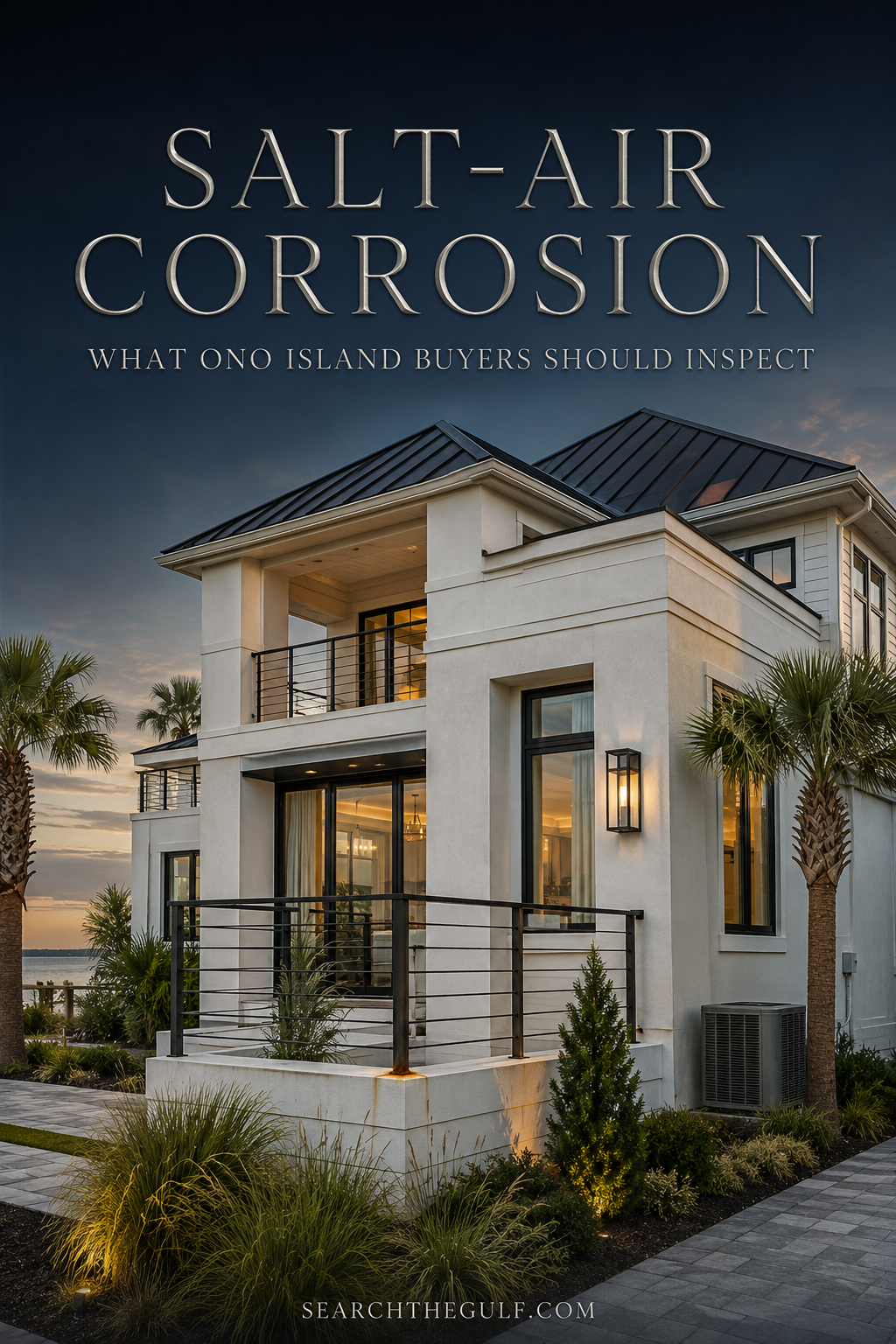
Salt-Air Corrosion: What Ono Island Buyers Should Inspect
How to look beyond the pretty view and understand what coastal air may be quietly telling you about a home.
_(800_x_150_px)_(2).gif)
The first thing most buyers notice on Ono Island is the beauty: the palms moving in a soft breeze, the changing light over the water and homes that seem designed for long afternoons outdoors. I notice those things too. I still feel grateful for them every day.
But as an Ono Island homeowner, real estate advisor and lifelong student of coastal design, I have also learned to look at the little things—the screw beneath an exterior light, the edge of an air-conditioning cabinet, the fastener at a railing post and the metal connector tucked into the shadows of an attic.
Salt air rarely arrives with a grand announcement. It settles quietly. It rides inland on the breeze, mixes with our warmth and humidity and leaves chlorides on exposed surfaces. Over time, those deposits can accelerate corrosion in metals that might live very differently in a drier climate.
“The coast asks us to look closely. Not fearfully—just faithfully, with an eye for the details that allow a beautiful home to age with grace.”
— Meredith Folger Amon
If you are considering an Ono Island home, corrosion should not automatically frighten you away. It should encourage a better inspection, thoughtful questions and a realistic maintenance plan. My goal is to help you know where to look, whom to call and how to separate an ordinary coastal maintenance item from a condition that deserves deeper investigation.
What Is Salt-Air Corrosion—and Why Does It Happen So Quickly Near the Coast?
Corrosion is the deterioration of a material through chemical or electrochemical reactions with its environment. In our coastal setting, airborne salt, warm temperatures, high humidity, recurring dew and wind-driven rain can create an especially hospitable setting for those reactions.
Salt does not have to arrive as a visible splash from the Gulf. Tiny airborne droplets and particles can travel with prevailing winds and settle on shaded surfaces, roof equipment, fasteners and protected crevices. When moisture lingers, the salt helps conduct the electrochemical process that attacks susceptible metal.
FEMA’s coastal guidance identifies salt spray, proximity to the shoreline, temperature, humidity, exposure and sheltering as factors that can accelerate corrosion. That means two homes on the same island may weather differently depending on their orientation, vegetation, elevation, drainage and exposure to prevailing wind. Review FEMA’s coastal building-material guidance.
My first coastal observation
Distance from the water matters, but exposure is personal to the property. I want to understand how the wind, shade, landscaping and drainage behave at that particular house.
Is Every Rust Stain a Serious Problem?
No—but every recurring stain deserves an explanation.
A tiny rust mark beneath a replaceable screw is not the same as deep section loss in a structural connector. White chalky oxidation on aluminum is not red rust, and the green patina on copper tells a different story again. Some changes are chiefly cosmetic. Others indicate that a coating has failed, incompatible metals are reacting or the metal itself is losing thickness and strength.
I would never diagnose the condition from color alone. I want the inspector to consider the material, location, depth, pitting, flaking, movement, moisture source and importance of the component. A stain can be cleaned. A compromised load-path connection is a different conversation.
Where Should an Ono Island Buyer Look First?
I begin outside and work inward, paying special attention to places where salt can collect, water can linger and metal is expected to carry a load or protect an opening.
My Ono Island corrosion walk-through
✓ Roof edges, flashing, fasteners, gutters, downspouts and exposed metal trim
✓ Attic hurricane clips, straps, truss plates, nails and mechanical equipment
✓ HVAC condenser cabinets, coils, fins, refrigerant lines, fasteners and equipment stands
✓ Electrical meter bases, service equipment, disconnects, receptacles, panels and generator enclosures
✓ Window and door frames, hinges, locks, rollers, thresholds, screens and fasteners
✓ Garage-door panels, springs, tracks, brackets, hinges, rollers and bottom edges
✓ Balcony, stair, porch and deck railings—including bases and concealed attachment points
✓ Exterior lighting, fans, cameras, speakers, gate hardware and mounting screws
✓ Pool equipment, heaters, pumps, metal fencing and outdoor kitchens
✓ Docks, boat lifts, pilings, brackets, cables, motors, electrical service and shore-power equipment when applicable
Why Are Roof Connections and Attic Hardware So Important?
Because the strongest-looking roof is still dependent on its connections. Metal clips, straps, truss plates, fasteners and anchors help transfer wind forces from the roof through the walls and toward the foundation. FEMA has observed that structural failures often occur at connections rather than in the framing members themselves, and coastal corrosion can weaken that continuous load path.
In an accessible attic, I would ask the inspector to look for orange or red rust, white deposits, flaking coatings, fastener deterioration, staining around roof penetrations and corrosion on mechanical hangers or truss plates. I would also ask whether the attic is vented or unvented, because salt-laden outside air and moisture patterns can influence concealed metal over time.
If a connector appears materially deteriorated—or if the home has an altered roofline, added porch or unusual load path—I would want a licensed structural engineer to determine significance and repair design. This is not a place for a handyman to choose a shiny bracket that merely looks similar.
“The prettiest finish on the coast is peace of mind—and that often begins with the parts of a home no guest will ever see.”
What Should I Inspect on the Metal Roof?
A metal roof can be beautiful and exceptionally well suited to coastal architecture, but “metal roof” is not a complete specification. I want to know the panel material, coating system, fastener type, flashing details, age, installer, warranty and maintenance history.
Look closely at cut edges, scratches, panel laps, eaves, valleys, ridge caps, pipe penetrations, fastener heads, gutters and places where leaves or debris hold moisture. Rust streaks may originate from a small incompatible fastener above an otherwise sound panel. Ponding, clogged drainage or contact between dissimilar metals can accelerate the problem.
The Insurance Institute for Business & Home Safety explains that galvanic corrosion can occur when dissimilar metals touch in the presence of an electrolyte such as salty moisture. In practical terms, the roof panel, clips, screws, flashings, gutters and nearby accessories should be selected as a compatible system. Read IBHS guidance on metal compatibility.
Could Salt Air Be Shortening the Life of the HVAC System?
It can. The outdoor condenser sits in the very environment it is working to control. Salt deposits can attack aluminum fins, copper tubing, steel cabinets, electrical contacts, fasteners and the equipment stand. Bent or deteriorated fins can reduce airflow; advanced coil corrosion may lead to refrigerant leaks or loss of performance.
I would ask an HVAC professional—not only the general inspector—to examine cabinet corrosion, coil condition, fin loss, refrigerant-line insulation, electrical connections, drain management, condenser clearances and the condition of the stand and anchors. I would also ask for the model and serial numbers, installation date, service history and any remaining warranty.
For replacement equipment, factory-applied coastal or coil-protection options may be available. The U.S. Department of Energy has recognized improved coil coatings as one way equipment specifications can respond to salty coastal air. The correct coating, cleaning method and warranty conditions must come from the equipment manufacturer; an indiscriminate spray can cause more trouble than it prevents. See the DOE coastal-equipment example.
What Should I Notice Around Windows and Exterior Doors?
Windows and doors are a gathering place for different materials: aluminum or steel components, stainless fasteners, coated frames, glass, sealants, weatherstripping and surrounding cladding. I look for bubbling paint, pitting, staining at fasteners, swollen frames, failed sealant, stiff locks, reluctant rollers, worn thresholds and evidence that wind-driven rain has reached the interior.
On sliding doors, I would test every panel and inspect the track, rollers, handles, locks and drainage openings. On impact-rated systems, I would preserve labels and documentation and avoid field modifications. If replacement is being considered, my Ono Island impact windows and doors guide explains glazing, privacy, tint and performance options in greater detail.
Should the Garage Door Be Part of a Corrosion Inspection?
Very much so. The garage door may be the largest opening in the home, and its coastal condition is about more than a little discoloration. I would inspect the bottom edge, panel seams, springs, cables, tracks, rollers, hinges, struts, jamb brackets, anchors and opener hardware. Corrosion on a decorative handle is one thing; corrosion affecting a spring, cable or wind-load component deserves prompt professional attention.
Ask whether the door is wind-pressure-rated, impact-rated or both, and whether its label and installation records are available. A painted-over label, substituted track or field-added alteration can complicate that answer. The door should be evaluated as a complete tested assembly—not as a collection of individual parts.
What About Railings, Cable Systems and Exterior Stairs?
This is where safety and design meet in plain view. Coastal railings may be aluminum, stainless steel, galvanized steel, cable, glass or a combination. I look at post bases, welds, fasteners, cable terminals, stair stringers, hidden drainage points and any place two different metals touch.
A railing can appear elegant from ten feet away and still move at the base. I would gently check for movement without leaning my full weight against an unverified system, then have a qualified contractor assess attachment, corrosion and code compliance. Tea staining on stainless steel may be superficial; pitting, fractured welds, loose anchors or loss of section are more consequential.
A design note I believe in
Corrosion resistance does not require a home to look industrial. Powder-coated aluminum, thoughtfully detailed glass, marine-appropriate stainless assemblies and concealed compatible fasteners can create a clean, modern coastal expression. The elegance lies in choosing a system that is beautiful all the way through—not simply on the surface.
If the Property Has a Dock or Boat Lift, What Changes?
The inspection becomes more specialized. A dock and lift live at the intersection of salt or brackish water, electricity, moving equipment, structural loads and weather. I would want a qualified marine contractor to examine pilings, framing, hardware, bolts, brackets, joist hangers, decking connections, lift cables, pulleys, bunks, motors, gear units and capacity labels.
Electrical service near water deserves its own licensed evaluation. The panel, disconnects, grounding and bonding, receptacles, shore-power equipment and conduit should be reviewed by an electrician familiar with marine installations and current requirements. Surface rust on a box is not enough information to tell us what is happening inside it.
I also ask buyers to connect condition with boating use. Is the lift capacity appropriate for the intended boat? Are the cables equally worn? Is there comfortable access at varying tides? My guides to Ono Island waterfront architecture and boating access and Ono Island tides can help frame those additional questions.
Can Stainless Steel Still Corrode?
Yes. “Stainless” means corrosion-resistant, not corrosion-impossible. Grade, finish, fabrication, cleaning, salt exposure and contact with other metals all matter. Type 316 stainless is often considered for more aggressive marine exposure because of its improved chloride resistance compared with common 304 stainless, but even 316 can stain or pit in the wrong conditions.
The most expensive metal is not automatically the correct answer. A knowledgeable designer or engineer should match the metal, coating, fastener and substrate to the exposure and load. Compatibility matters as much as the label on the box.
Could Two “Good” Metals Be a Bad Combination?
They can. When dissimilar metals touch and moisture containing salt completes the circuit, galvanic corrosion may cause the more active metal to deteriorate faster. This is why I pay attention to the small interfaces: a fastener through aluminum, copper runoff reaching galvanized steel, a stainless component attached without appropriate isolation or incompatible flashing materials meeting at the roof.
Good coastal detailing may include compatible materials, approved barriers, gaskets, washers, sealants, drainage and enough air movement to help surfaces dry. Those details are wonderfully unglamorous—and wonderfully important.
“Coastal luxury is not the absence of maintenance. It is the presence of thoughtful materials, honest craftsmanship and a plan for caring for them.”
— Meredith Folger Amon
What Questions Should I Ask the Seller?
A good inspection is stronger when it is paired with good records. Subject to the contract, I would ask:
• When were the roof, HVAC systems, windows, exterior doors and garage door installed?
• Are permits, invoices, product approvals, warranties and service records available?
• Have any coils, condensers, fasteners, railings, roof panels or structural connectors been repaired or replaced?
• What exterior cleaning and coating schedule has been followed?
• Have there been recurring leaks, electrical faults or equipment failures?
• Has a structural engineer, roofer, HVAC contractor, electrician or marine contractor evaluated prior corrosion?
• If there is a FORTIFIED designation, when does it expire and are supporting records available?
Which Inspections Would I Consider Before Closing?
I would begin with an experienced coastal home inspector and attend the inspection whenever possible. If that inspection identifies concerns—or if the property includes specialized systems—I may recommend additional evaluations during the contractual due-diligence period.
The right specialist for the right question
General home inspector: accessible components, overall condition and referral points.
Licensed roofer: panels, coatings, flashing, fasteners, penetrations, drainage and repair history.
HVAC contractor: coils, cabinets, controls, performance, leaks, stands and remaining service life.
Licensed electrician: service equipment, panels, disconnects, generator and marine electrical systems.
Structural engineer: materially corroded connectors, altered load paths, elevated framing, stairs or structural railings.
Marine contractor: dock, pilings, lift structure, cables, motors, brackets and marine exposure.
The general inspection is not a warranty, and it usually cannot reveal conditions behind finishes or inside sealed assemblies. If a specialist recommends further invasive investigation, I would discuss access, permission and restoration responsibilities before proceeding.
What Might the Repairs Cost?
Corrosion repair does not fit neatly into a price-per-square-foot formula. Cleaning and replacing a small group of exterior fasteners may be a modest service call. Replacing a corroded HVAC coil, rebuilding a railing system, repairing structural connectors or replacing a roof assembly can reach thousands—or considerably more on a large custom home.
How I would build a repair budget
1. Identify the material and cause—not simply the stain.
2. Determine whether the condition is cosmetic, operational, safety-related or structural.
3. Obtain written scopes from the appropriate licensed professionals.
4. Include access, permits, finish restoration, compatible materials and disposal.
5. Add a contingency for concealed deterioration discovered after removal.
If I Were Renovating, What Would I Upgrade First?
I would prioritize life safety, structural capacity, water management and equipment reliability before cosmetic perfection. That usually means compromised electrical components, load-path connectors, railings, stairs, roof details, HVAC equipment and rated openings rise to the top.
Then I would create a compatible material schedule for the entire exterior. Instead of replacing one corroded screw with whatever is close at hand, I would ask the architect, engineer or manufacturer to specify the fastener, coating, isolation method and sealant appropriate to the assembly. When the exterior palette is coordinated—roof, gutters, lights, railings, doors and hardware—the result can look cleaner as well as perform better.
If you are considering a larger project, visit my guides to building along the Gulf Coast, Ono Island home construction and the architecture of Ono Island.
What Can an Ono Island Homeowner Do After Closing?
Follow each manufacturer’s coastal maintenance instructions. Gentle freshwater rinsing may be appropriate for many exterior surfaces and HVAC components, but frequency and method should come from the manufacturer or service professional. High pressure, harsh chemicals and unapproved coatings can damage finishes, force water into assemblies or affect warranties.
Keep gutters, roof valleys, drains and weep paths clear. Trim vegetation enough to support airflow without sacrificing the lush landscape we love. Touch up approved coatings promptly. Schedule HVAC service, inspect marine equipment and review exterior hardware at least annually—and more often for highly exposed systems or after major weather.
A simple rhythm for coastal care
Spring: inspect before the hottest months and hurricane season.
After severe weather: look for coating damage, displaced components and new water paths.
Autumn: clear drainage, service equipment and document changes.
Any time a stain returns: find the source instead of simply painting over it again.
What Is My Best Advice to an Ono Island Buyer?
Do not expect a coastal home to be untouched by its environment. Expect it to have been thoughtfully designed, honestly inspected and consistently maintained for that environment.
The presence of a little oxidation does not make a home unsuitable, just as a fresh coat of paint does not make every component sound. The value lies in understanding what you are seeing, obtaining the right professional opinions and building the condition into your ownership plan.
That is the kind of real estate guidance I believe in: admiring the view, certainly, while also noticing the fastener beneath the light fixture. Both details belong to the story of living well on Ono Island.
Let’s Look a Little Closer
Are You Considering a Home on Ono Island?
I would be delighted to help you evaluate the property, organize the right questions and understand how condition, maintenance and future improvements fit into the purchase. I have relationships with local inspectors, contractors, builders and specialists and am happy to share names so you can conduct your own interviews and due diligence.
Meredith Folger Amon · Alabama & Florida Licensed Real Estate Advisor · Ono Island Homeowner
SearchTheGulf.com is the Gulf Coast’s premier website for searching real estate listings along the Gulf Coast.
A thoughtful note: This article offers general educational information, not structural-engineering, inspection, construction, electrical, HVAC, marine, insurance or legal advice. Corrosion severity cannot be determined from appearance alone. Buyers should rely on the applicable contract and qualified professionals who have inspected the specific property.
Published August 2026. Cost ranges are broad national planning figures and may not reflect an Ono Island proposal.
Select one or more listings to compare
When it comes to finding the home of your dreams in a fast-paced market, knowing about new listings as soon as they are available is part of our competitive advantage.Sign up to see new listings in an area or specific community. Contact Meredith with any questions you may have.
#searchthegulf #meredithamon #becausewelivehere
Ono Island Homes & Land for Sale – Luxury Waterfront Real Estate in Orange Beach Alabama, $400,000 - $500,000
Compare Listings

.gif)

2026 MBGFC Labor Day Invitational | Orange Beach | Search The Gulf
Orange Beach · Boating Lifestyle
The 2026 MBGFC Labor Day Invitational: Celebrating Orange Beach’s Fishing and Boating Community
Thirty-eight teams, 222 anglers, 186 catches—and a Labor Day weekend that felt like one coastal family at the dock.
Explore Orange Beach Perdido Pass
On this…
Cotton Bayou Marina Boats | Orange Beach Near Terry Cove

Orange Beach and Ono Island Real Estate Update September
Ask A Question or Sign Up To See New Real Estate Listings Before Your Competition


Enjoy this blog post? Click here to subscribe for updates
Leave A Comment