Ono Island Canal Homes and Lots: Understanding the Water Before You Buy

When people ask me what makes Ono Island so appealing to boat owners, I often begin with its canals. They create some of the island’s most protected waterfront settings, where a boat can be kept close to home and the surrounding waterways become part of everyday life.

Yet buying a canal-front home or homesite involves more than confirming that a property touches the water. Canal width, depth, turning room, location, dock design and the route to open water all influence how comfortably the property will accommodate a particular boat.

Explore the Canals of Ono Island

Discover the distinctive canals, private docks and boating lifestyle that make waterfront living on Ono Island so special. Search Ono Island homes and land for sale and explore my local real estate guidance at SearchTheGulf.com .

The right canal property is one where the water, dock and route to open water genuinely complement the boat—and the lifestyle—you plan to enjoy.

Ono Island Waterfront Homes and Real Estate Listings For Sale on the Canal | Orange Beach Realtors

Sort by:

Compare Listings

Add Home

Select one or more listings to compare

Listings Per Page:

Life Along an Ono Island Canal

There is a quiet rhythm to canal-front living on Ono Island. Mornings may begin with still water outside the windows and a boat waiting at the dock. Afternoons can unfold on Bayou St. John, the Intracoastal Waterway, Old River or beyond Perdido Pass, followed by a slow return to the more protected water beside the house.

That sense of ease is one of the principal attractions. For many homeowners, the dock is not simply an amenity. It becomes another living space—a place to prepare for the day, rinse down the boat, watch the weather change or sit quietly near the water in the evening.

Canal-front properties can also offer a more sheltered setting than homes directly exposed to larger bodies of water. The amount of protection varies by location, but calmer water around the dock can make routine boat handling, loading and maintenance more comfortable.

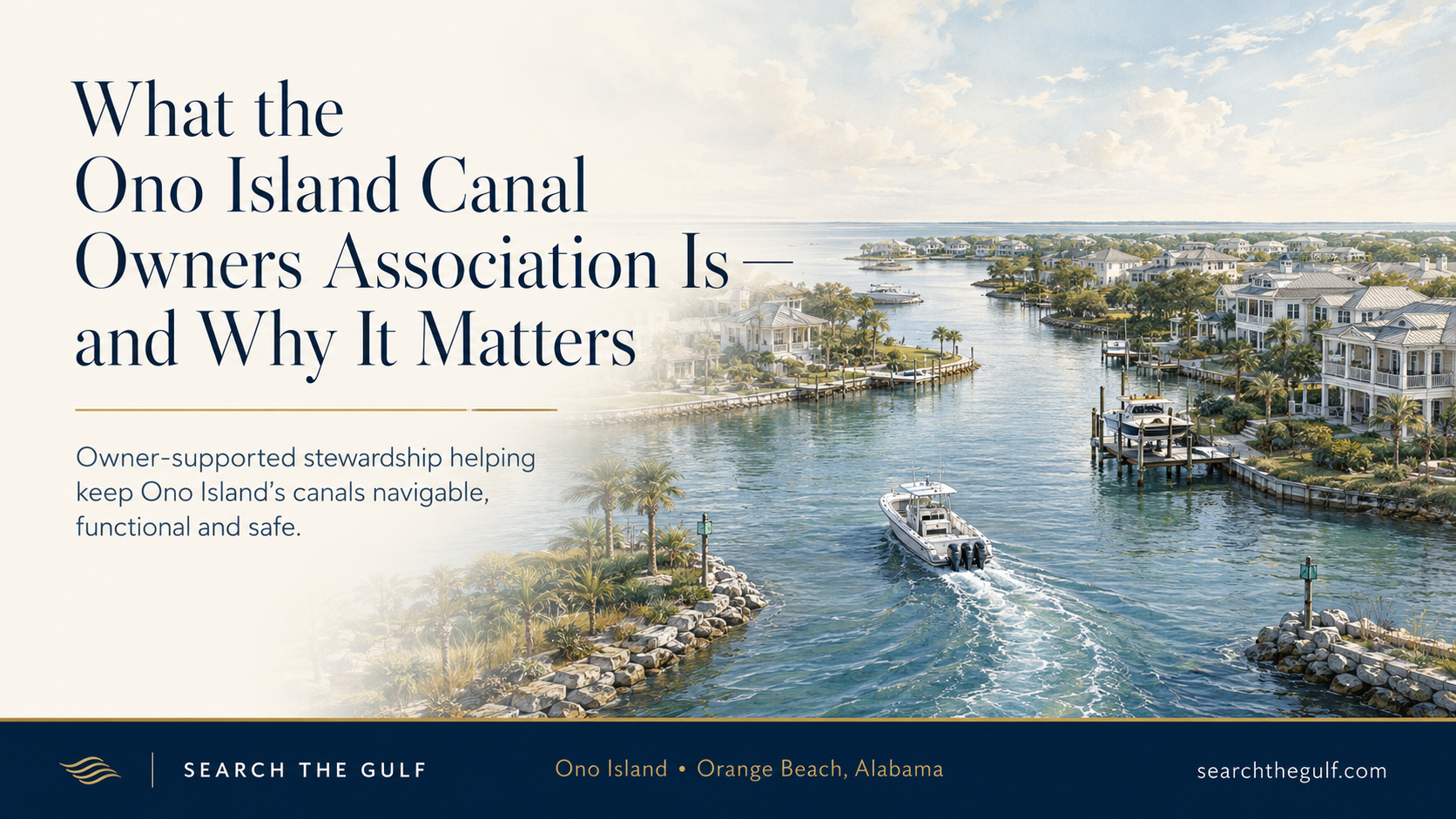
COA Canal Owner Association Ono Island

No Two Ono Island Canals Are Exactly Alike

One of the most important things I explain to buyers is that the word canal does not describe one uniform boating environment. Different sections of Ono Island offer different canal widths, depths, orientations and routes to surrounding water.

Some canals feel broad and open, providing generous room for turning, docking and passing another boat. Others are narrower or include bends that make the experience more dependent upon boat length, beam, wind and the placement of neighboring docks.

Location within a canal matters as well. A property near the entrance may offer a shorter run to open water, while a homesite farther inside the canal may feel more secluded and protected. Neither is automatically better; the right choice depends on the owner’s boat and priorities.

A canal can look spacious from the lawn, but the real question is how it will feel from the helm when the wind is moving, another boat is passing and you are easing into the lift.

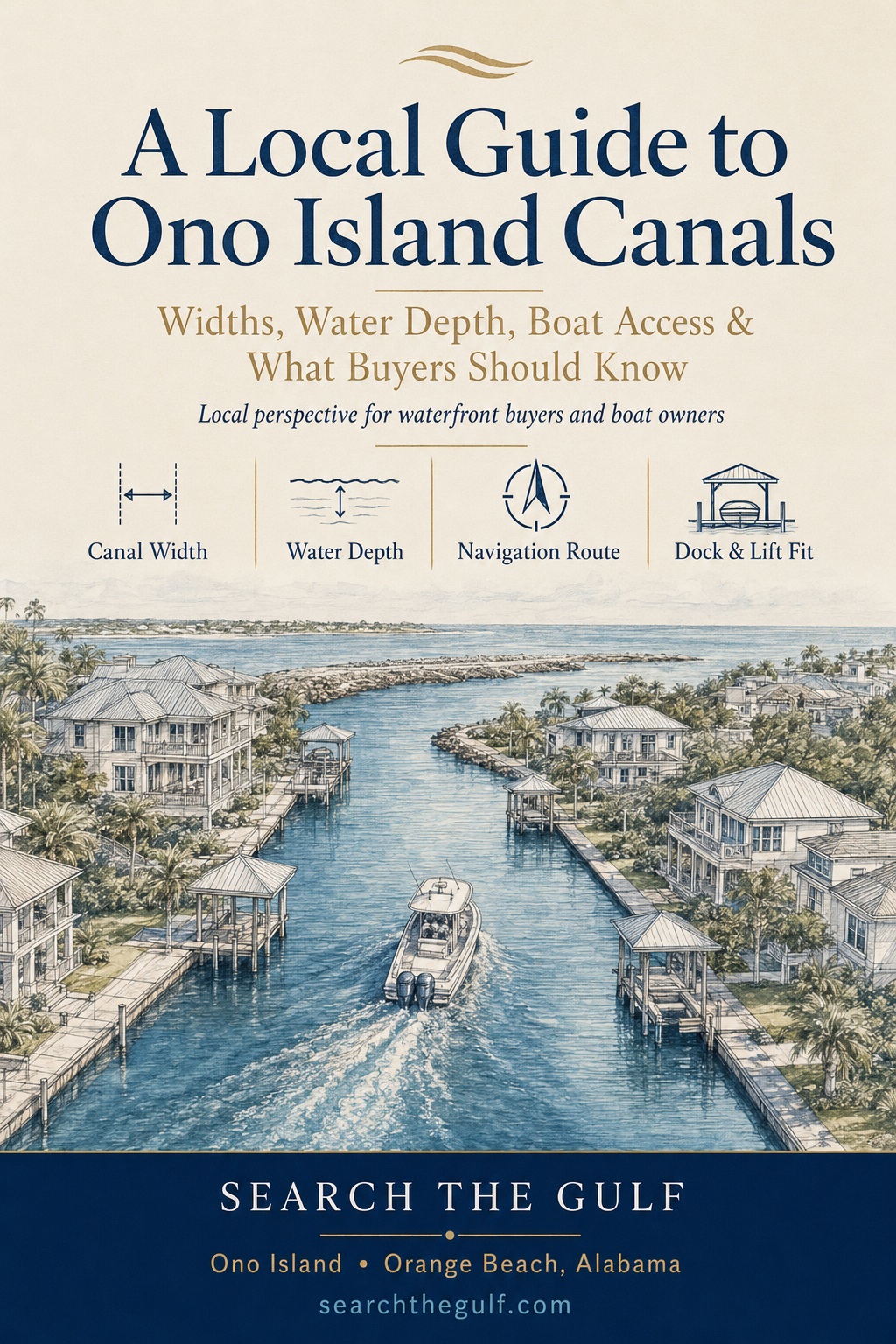
Buyer Guide Ono Island Canal Homes For Sale

Canal Width and Turning Room

Canal width is one of the first details I consider when evaluating a property for a boater. Ono Island includes canal corridors described as wide, with certain areas associated with approximately 60-foot widths. Those broader corridors can provide greater comfort when backing away from a dock, approaching a lift or meeting light boat traffic.

The stated width is only part of the story. The usable space in front of an individual property may be affected by docks, pilings, lifts, covered boathouses and the shape of the canal. A property near a bend, basin or intersection may handle differently from one along a straight stretch.

This becomes increasingly important with larger center consoles, offshore fishing boats, pontoons and vessels with multiple outboards. Boat length matters, but beam, draft, motor clearance and turning behavior can be equally significant.

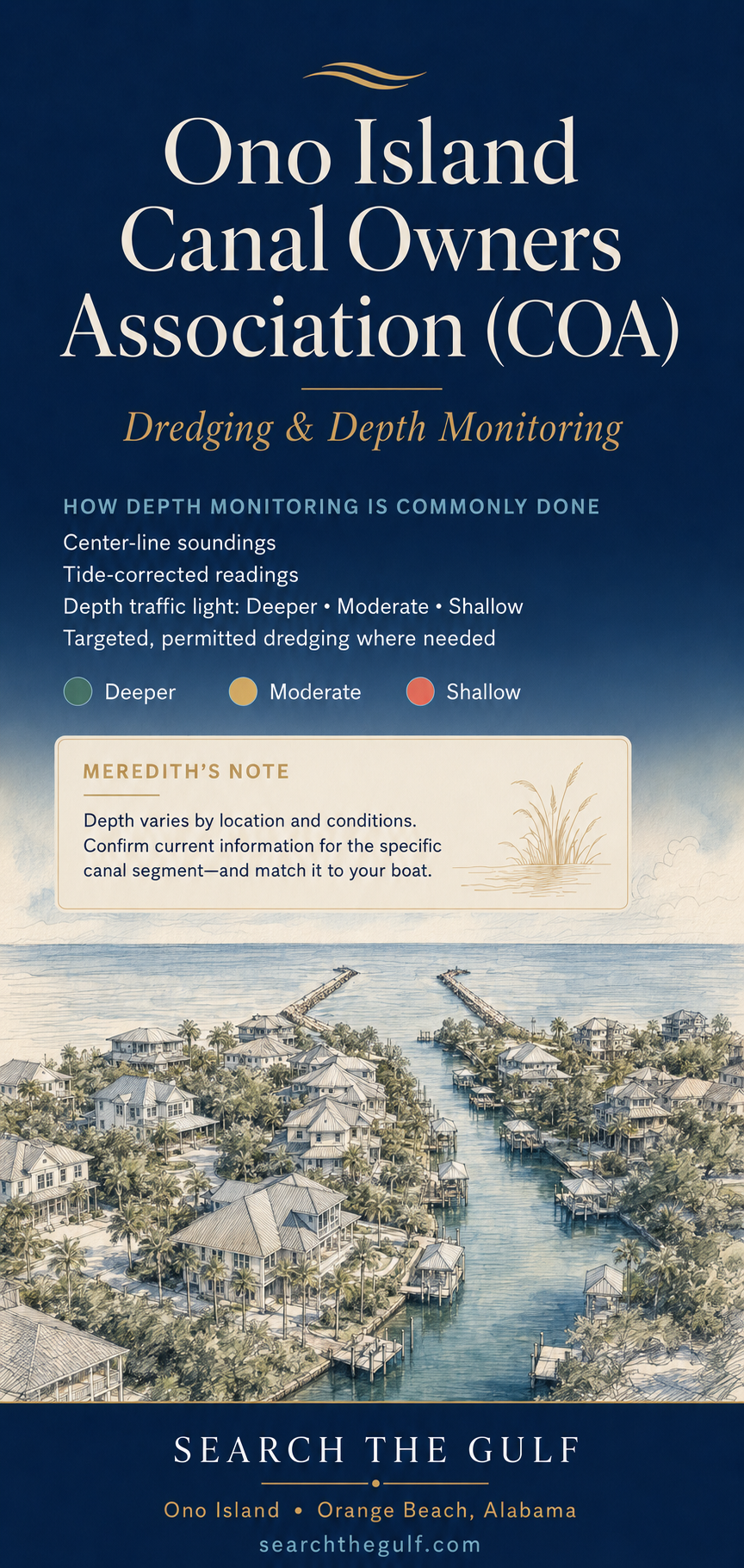
COA Ono Island Canal Association Dredging and Depth Monitoring

Water Depth Is Specific to the Boat and the Dock

Buyers frequently ask how deep the Ono Island canals are. Some canal-front properties are associated with water-depth descriptions of four feet or greater, and portions of the canal system may be maintained through periodic dredging with target depths that can reach approximately six feet.

Those numbers are helpful starting points, but they should never replace a property-specific evaluation. Actual depth may vary with the tide, recent weather, maintenance cycles, sediment movement and the precise location of the dock.

I encourage buyers to think about depth in practical terms. What is the boat’s true operating draft? How much clearance is needed beneath the motors? Will the boat remain in a lift, and can it approach that lift comfortably at lower water? Is the water deeper in the canal’s center than along the dock face?

A depth measurement taken in the correct location and under understood tidal conditions is far more useful than a general description applied to an entire canal.

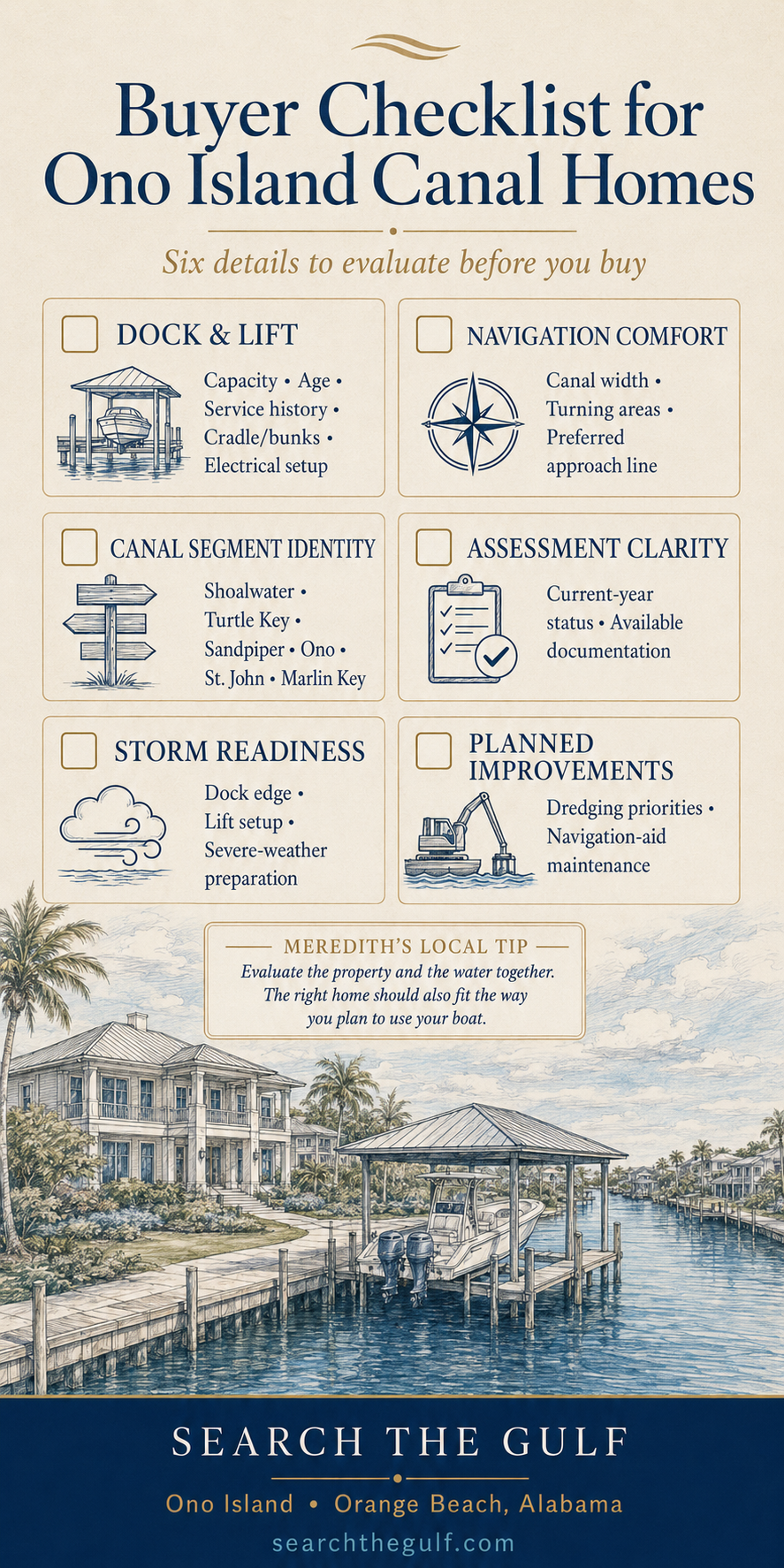
Buyer Checklist Ono Island Canals

The Route from the Dock to Open Water

The boating experience does not end at the property line. I also look carefully at the complete route from the dock to Bayou St. John, the Intracoastal Waterway and the owner’s preferred destinations.

Certain Ono Island canal routes offer access without bridges, an important consideration for boats with towers, upper stations, radar equipment or greater vertical clearance requirements. A bridge-free route can also make day-to-day planning simpler because the owner is not working around a fixed overhead restriction.

Travel time matters, too. Buyers who frequently fish offshore may value an efficient route toward Perdido Pass. Others may spend more time cruising the Intracoastal Waterway, visiting waterfront restaurants or enjoying the protected bays and rivers surrounding Orange Beach.

I like to trace the route as a boater would experience it: leaving the lift, moving through the canal, entering broader water and continuing toward the places the owner plans to use most often.

Different Canal Settings for Different Boating Priorities

Wide Canal Corridors

A broader canal can provide more comfortable maneuvering room, particularly for larger boats or owners who prefer additional space when approaching the dock.

I still consider the usable width immediately in front of the property, existing structures and the boat’s turning radius.

Canals Near Bayou St. John

These locations may appeal to owners who value access toward Bayou St. John and the Intracoastal Waterway, along with a protected setting at home.

The precise route, depth and maneuvering space should be considered in relation to the boat.

East-End Canal Locations

Canal-front properties toward the eastern portion of Ono Island, including the broader Marlin Key area, can offer convenient proximity to the Intracoastal Waterway.

These locations may be particularly attractive to buyers who envision frequent day trips through the surrounding coastal waterways.

Sheltered Canal Pockets

A quieter canal position can create a peaceful atmosphere around the home and more protected conditions at the dock.

Canal bends, tidal movement and sediment patterns remain important considerations when evaluating the individual property.

The Dock Should Be Evaluated as Carefully as the Home

On a canal-front property, the dock and boathouse deserve the same attention as the kitchen, roof or mechanical systems. A beautiful home may not be the right boating property if the existing lift is undersized, the slip is too narrow or the approach does not work well for the owner’s vessel.

I look at the lift capacity, cradle configuration, piling placement, roof clearance, electrical service, water service and the physical condition of the decking and structural components. I also consider whether the setup accommodates the boat as it is currently configured, including hardtops, towers, antennas and outboards.

When purchasing a vacant canal lot, the questions begin even earlier. The buyer should understand where a dock or covered boathouse may be positioned, how far it may extend, and whether setbacks or neighboring improvements could affect the design.

Ono Island and the appropriate governmental authorities may have approval and permitting requirements for shoreline and boating improvements. Those details should be understood before relying on a future dock, lift or boathouse as part of the purchase decision.

Download the Ono Island canal property guide

What I Consider Before Recommending a Canal Property

  • The boat’s length, beam, draft, weight and overall height
  • The usable canal width in front of the property
  • Turning room under ordinary wind and traffic conditions
  • Depth at the dock and along the route to open water
  • The condition and capacity of the existing boat lift
  • Dock, piling and boathouse placement
  • The route to Bayou St. John or the Intracoastal Waterway
  • Whether bridges or other overhead restrictions are present
  • Shoreline, bulkhead and erosion considerations
  • Future dock or boathouse feasibility for vacant homesites
  • Canal maintenance and dredging considerations
  • The owner’s preferred boating destinations and frequency of use

These details are not meant to make the process feel complicated. They are what allow a buyer to move beyond the word waterfront and understand how the property will actually function.

Buying an Ono Island Canal Lot

A vacant canal-front homesite can be an appealing way to create a home around a specific boat and lifestyle. The residence, garage, outdoor living areas and boating improvements can be considered together from the beginning rather than adapted after construction.

I encourage buyers to study the buildable area, elevation, flood zone, setbacks, architectural standards, shoreline condition and probable dock location before becoming focused on a particular house plan.

The most successful designs respond to the homesite. They frame the water, create a natural relationship between the house and dock, and provide an easy transition from indoor living to the pool, outdoor entertaining areas and boat.

On Ono Island, the right canal lot is not simply a place to build a house beside the water. It is an opportunity to design the entire property around the way you want to live and boat.

The Character of Canal-Front Living

Canal-front homes offer a distinctive side of Ono Island. They can feel peaceful and tucked away while remaining connected to some of the Gulf Coast’s most enjoyable boating waters.

What I appreciate most is the way the water becomes part of the home’s daily rhythm. The boat is visible from the house. The dock becomes part of the outdoor living space. A spontaneous afternoon cruise does not require trailering, launching or planning far in advance.

For the right owner, that convenience changes the experience of living on the Gulf Coast. Boating becomes less of an occasional event and more of a natural extension of life at home.

Explore Ono Island Canal Homes and Homesites

Begin with current Ono Island homes, waterfront properties and homesites for sale . Search The Gulf brings the island’s real estate and boating lifestyle together so buyers can look beyond the basic listing details and better understand how a property may fit their plans.

Buyers can also explore Gulf Coast properties with boating accommodations and learn more about the Ono Island Canal Association .

Does an Ono Island canal property fit your boat?

I would be happy to help you evaluate canal width, water depth, turning room, dock configuration and the route to open water. These are often the details that determine whether a waterfront property merely looks appealing—or truly works for the way you plan to live.

Quick orientation for buyers

  • West and central canal areas: fast access toward Bayou St. John and the Intracoastal Waterway. 
  • East end canal areas: quick proximity to the Intracoastal Waterway, with notes about wide canals and access for day trips. 
  • Sheltered canal settings: can appeal to owners who prefer calmer water around the dock. 

Canal “styles” I see most often on Ono Island

Canal area patternWhat it tends to mean for boatersVerify during due diligence
Wide-canal corridors (including 60-foot references)  More comfortable passing room and docking margin, especially with traffic or wind. Turning radius by the lot, bulkhead condition, setbacks for dock/boathouse design, and lift location.
“No bridges” routes to Bayou St. John / ICW  Fewer route constraints and simpler access planning for taller profiles or upper stations. Confirm the actual route from dock to open water, note any pinch points, and ask for current channel markers.
East-end ICW-near canals (Marlin Key area)  Short run to the Intracoastal, with reports noting wide-canal access for broader boating plans. Dredging cadence and any nearby association-designated “spoil area” used when canals are dredged. 
Sheltered canal pockets  Calmer water at the dock can be appealing for routine handling and light maintenance days. Tide swing at the dock face, depth at low tide, and whether the canal bend affects silting patterns.


ONO ISLAND CANAL ASSOCIATION INFORMATION


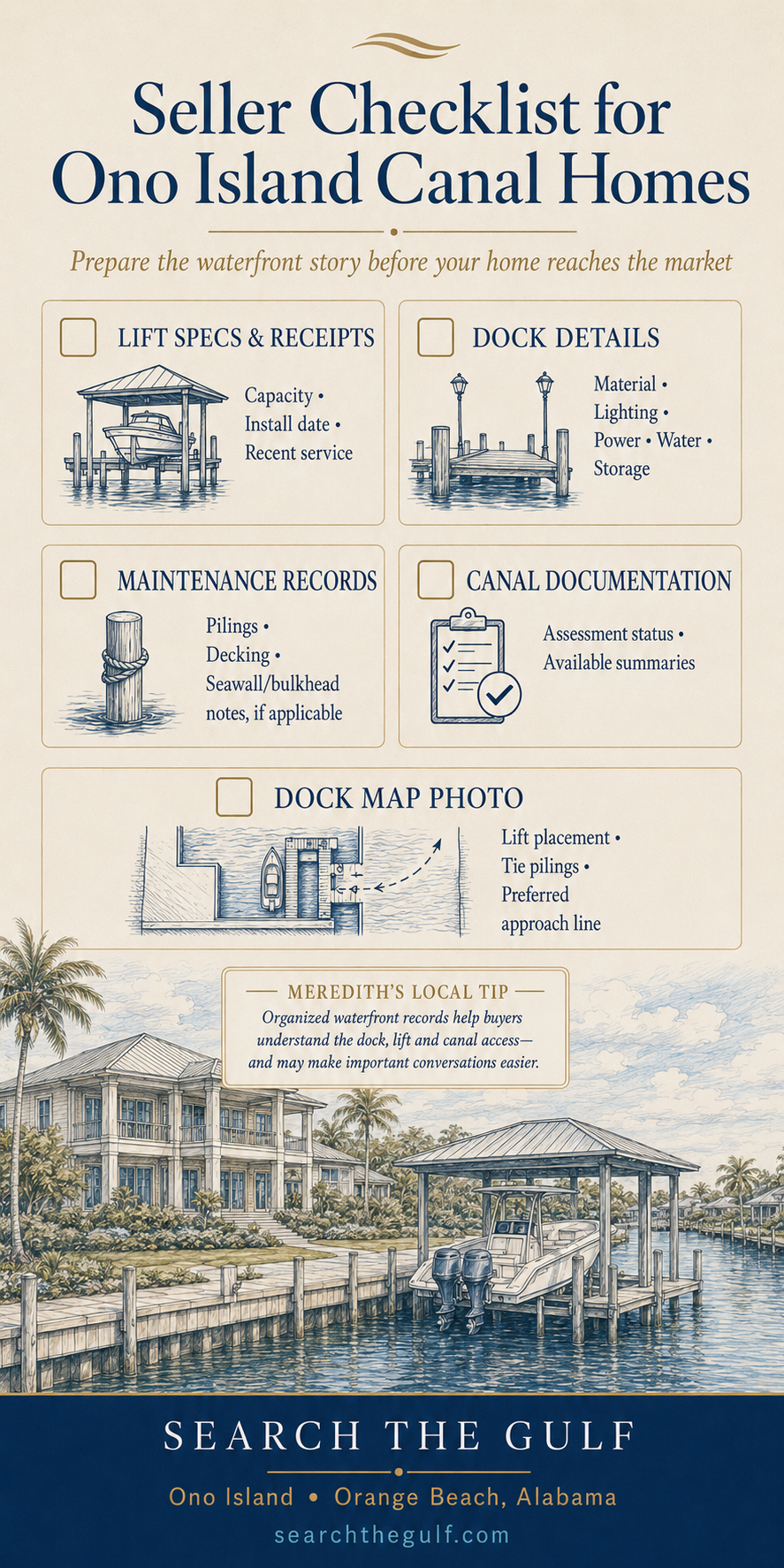
Seller Checklist Ono Island Canal Homes

Call or text:

Call or Text Meredith on her direct line. 970/389.2905

You may also send me a message through Search The Gulf.

Back to Top