What Does “Bridge-Locked” Mean for an Ono Island Waterfront Property?
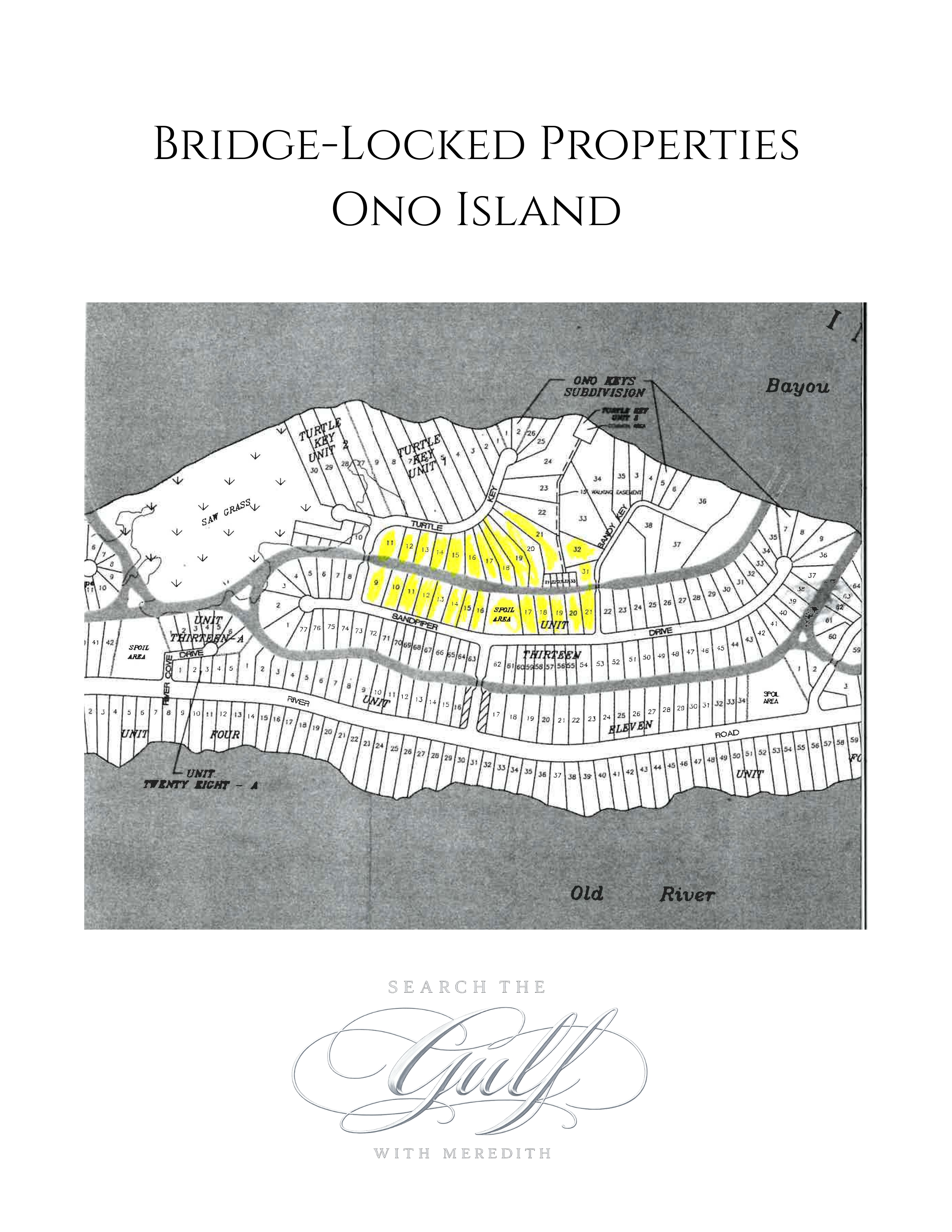
A local guide to select canal-front properties in Ono Island Unit Thirteen, including portions of Sandpiper Drive and the Turtle Key and Sandy Key areas.

On Ono Island, two homes can both be described as waterfront and still offer very different boating experiences. One may open directly onto big water, while another may sit along a peaceful interior canal where the route out passes beneath a fixed roadway bridge.
That second property is often described as bridge-locked or, more precisely, bridge-restricted. The distinction matters—not because the property cannot accommodate a boat, but because the height and configuration of the boat must match the entire route from the dock to open water.
Select canal-front properties on the eastern end of Ono Island, including portions of Unit Thirteen and properties in the Sandpiper Drive, Turtle Key and Sandy Key areas, are located along interior canals rather than directly on Bayou St. John, the Intracoastal Waterway or Old River.
Not every property on these streets should automatically be labeled bridge-locked. The deciding factor is the location of the property’s dock and the water route from that dock. A home with direct exterior-water frontage may have unrestricted access, while another home on the same general street may have a dock inside the canal system.
A beautiful dock, adequate water depth and a capable lift do not guarantee that a boat can reach open water. The bridge must be evaluated as part of the property’s complete boating route.
Unlike a drawbridge, a fixed neighborhood bridge does not open for taller vessels. Its usable clearance changes as the water rises and falls.
The relevant measurement is the boat’s air draft: its height from the waterline to its highest non-lowered point, including hardtops, antennas, radar, outriggers or towers.
Tide, wind-driven water, rainfall, boat loading and wake can change the available margin. A clearance that works under one condition may be uncomfortably tight under another.
Bridge-restricted does not mean “no boating.” Many owners can enjoy the canals with an appropriately sized and configured vessel. The following is a starting point only; actual fit must be measured and verified.
| Boat type | General bridge-fit outlook | What I would verify |
|---|---|---|
| Low-profile bay boats and flats boats | Often among the more practical choices | Console height, windshield, antennas, shallow-water anchors and actual waterline-to-highest-point measurement. |
| Smaller center consoles | Potentially compatible | T-top height, radar, antenna mounts, outriggers and whether equipment can be lowered safely and conveniently. |
| Pontoons and deck boats | Configuration dependent | Bimini position, helm enclosure, arch height and the boat’s loaded waterline. |
| Runabouts and bowriders | Often possible, depending on profile | Wakeboard towers, arches, windshields and accessories above the hard structure. |
| Large offshore center consoles | Requires careful measurement | Hardtop, radar, outriggers, antennas and both height and turning room through the canal route. |
| Sportfishing yachts, flybridge boats and tall cabin vessels | Frequently incompatible with low fixed bridges | Full air draft, tower or flybridge height and whether any equipment is genuinely designed to lower. |
| Sailboats | Generally incompatible with a fixed mast | Mast height and whether the mast can be stepped or lowered; most buyers should assume a fixed mast will not fit until proven otherwise. |
My rule: I do not tell a buyer that a boat “should fit” based only on its advertised model specifications. Added electronics, custom tops, fuel, gear and passenger load can change the real-world measurement.
This is part of what I call the Ono Island Dock-to-Gulf Test. I also recommend reviewing the Ono Island Air-Draft Test, because the bridge, boathouse and full route must work together—not as separate assumptions.
For the right buyer and the right boat, an interior canal property can be a wonderful fit. The water may feel calmer and more protected than an exposed big-water shoreline. The setting can also offer a quiet, tucked-away character that appeals to owners who value privacy and a gentler dockside experience.
The goal is not to label a property as “good” or “bad.” The goal is to match the property to the buyer’s boating plans. A low-profile bay boat owner may see little practical limitation, while the owner of a tall sportfishing boat may need direct big-water frontage.
As an Ono Island homeowner and a real estate advisor with 25 years of experience, I know that some of the most important property details are not obvious in a listing description. They are learned by living here, traveling these roads and waterways, watching water conditions and knowing which questions to ask before a buyer becomes emotionally or financially committed.
The same principle applies when selecting a builder, marine contractor, dock specialist, surveyor, inspector or other professional. Someone familiar with Ono Island is more likely to understand the island’s waterways, property-owner procedures, construction environment and the practical sequence for getting reliable answers.
Relationships matter. Established working relationships among local real estate professionals, builders, contractors and community administration can make it easier to identify the right resource, communicate efficiently and anticipate issues. That experience can be worth every penny when it helps a buyer avoid a costly redesign, an unsuitable boat lift, a delayed project or the discovery—after closing—that a beloved boat cannot reach the property.
When I evaluate an Ono Island waterfront property, I begin at the dock—but I do not stop there. I follow the route, identify the bridges, consider water depth and turning room, and compare the entire system with the buyer’s present boat and future plans.
A bridge-restricted canal home can be an exceptional property when the boat, dock and route are properly matched. The expensive mistakes happen when someone assumes that “waterfront” automatically means unrestricted access.
No. Bridge restriction depends on the individual property’s waterfront orientation and the route from its dock. Each property should be evaluated independently.
Some may, but the answer depends on the vessel’s actual air draft and the bridge clearance under current water conditions. T-tops, radar, antennas and outriggers must be included in the measurement.
No. It means the route to big water passes beneath a fixed bridge. Boats that fit safely beneath the bridge can still use the route.
I recommend verifying it. Water levels and measuring methods vary, and even a small difference matters when the clearance is close.
Future boating plans should be part of the purchase decision. A property that fits today’s boat may not fit a future tower boat, offshore center console or sportfishing yacht.
I can help you evaluate the complete relationship among the home, dock, lift, canal, bridge clearance and route to big water. My goal is to help you understand the property before you buy—not after.
Contact MeredithExplore Ono Island homes and properties on Search The Gulf, the Gulf Coast’s premier website for searching all real estate listings on the Gulf Coast.
Orange Beach Luxury Real Estate
Turquoise Place Condos
An August Day at One of Orange Beach’s Most Iconic Gulf-Front Addresses
Luxury Gulf-front residences, unmistakable turquoise architecture and a resort experience unlike any other along the Alabama Gulf Coast.
View Turquoise…
When it comes to finding the home of your dreams in a fast-paced market, knowing about new listings as soon as they are available is part of our competitive advantage.Sign up to see new listings in an area or specific community. Contact Meredith with any questions you may have.