
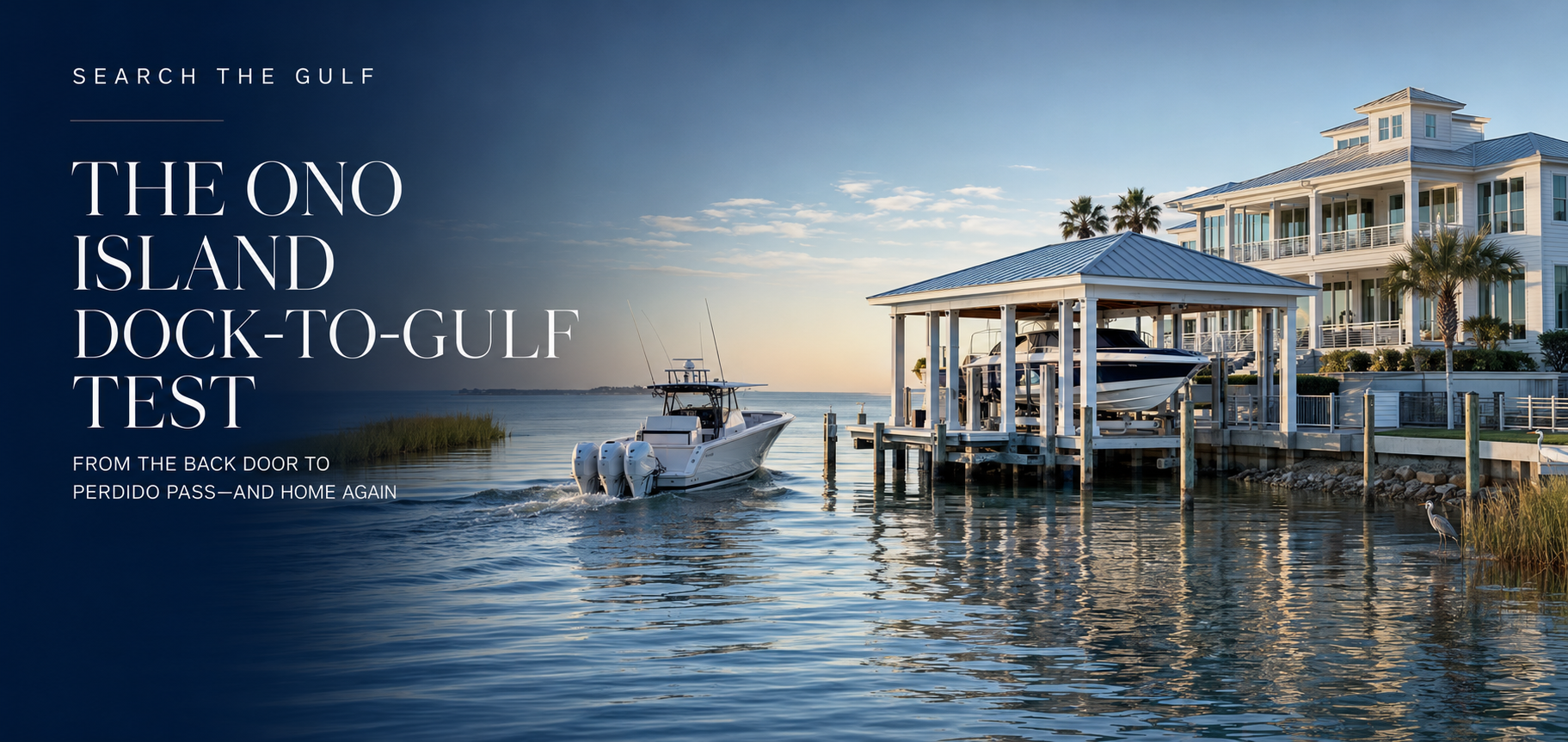
Ono Island Waterfront Real Estate • Boating Guide
The Ono Island Dock-to-Gulf Test: How I Evaluate a Waterfront Home by the Journey, Not Just the View
A signature Search The Gulf framework for comparing the complete journey from the back door and boat lift to Perdido Pass—and safely home again.
_(800_x_150_px)_(2).gif)
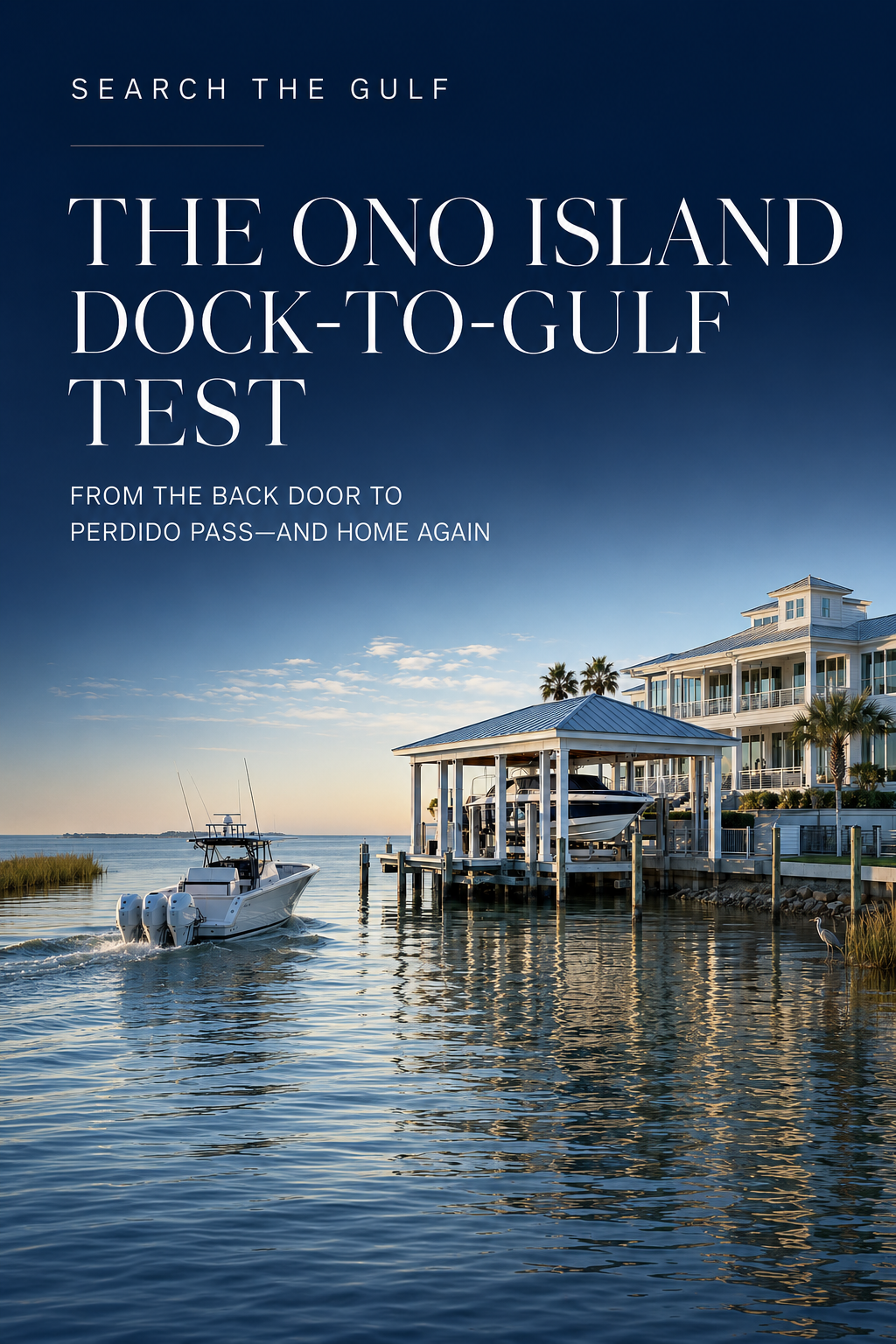
There is a small moment before every boat ride that tells me almost everything.
The dock boards are still cool beneath my feet. A thin sheen of morning dew catches the light. Somewhere across the water, an outboard settles into its low, familiar hum, and the air carries that mixture of salt, fuel and marsh grass that immediately feels like the Gulf Coast.
Lines come aboard. The lift lowers. The boat floats free.
Sometimes the transition from home to open water feels almost effortless. Other times, the homeowner must carry coolers down a long flight of stairs, maneuver through a narrow slip, idle through several turns, watch a shallow approach and remember where the afternoon current likes to push the stern.
Both properties may be described as “waterfront.” Both may have docks. Both may photograph beautifully.
But they do not offer the same boating life.
I am a homeowner on Ono Island as well as a local real estate advisor, and this distinction has become one of the most important ways I evaluate island property. I call it the Ono Island Dock-to-Gulf Test.
“I do not simply ask whether a home has boating access. I ask how the entire boating day begins, unfolds and ends from that particular address.”
This is a more complete way to compare waterfront homes because the dock is only one link in the chain. The experience also includes how easily you move gear from the house, whether your boat fits the lift, how you leave the slip, the route you travel, the water you cross, the time spent at idle and how comfortable the return feels after a long day.
For many Ono Island buyers, that journey is not a minor amenity. It is the reason for owning the home.
Why “Waterfront” Is Too Broad a Search Term for Ono Island
Ono Island is surrounded and threaded by distinctly different bodies of water. A home may front a protected canal, Bayou St. John, Ole River, the Intracoastal Waterway, Ono Harbour or another connected waterfront setting. Each location has its own rhythm.
One property may provide a sheltered slip and a calm morning departure. Another may offer broad views and a more direct relationship with big water. A third may have the right house but require a longer idle before the boat can comfortably come onto plane. A fourth may be beautifully positioned for a sunset cruise but less convenient for a large catamaran or deeper-draft vessel.
This is why I encourage buyers to move beyond a simple checklist that says:
- Waterfront: yes
- Dock: yes
- Boat lift: yes
- Gulf access: yes
Those answers are useful, but they do not describe the ownership experience.
The Better Question
How much effort stands between the kitchen door and the day you want to have on the water?
That is the heart of the Dock-to-Gulf Test.
What Is the Ono Island Dock-to-Gulf Test?
The Dock-to-Gulf Test is my way of measuring the practical relationship among four things:
- The home
- The marine improvements
- The boating route
- The owner’s preferred day on the water
I think of this relationship as a property’s boating radius.
A boating radius is not simply mileage. It is the realistic circle of places you will comfortably use from the property, based on time, vessel, conditions and effort.
For one owner, that radius may revolve around quick evening cruises, nearby islands and waterfront dining. For another, the entire decision may depend on efficient access through Perdido Pass for offshore fishing. A sailing owner may prioritize clearance, depth and maneuvering room. A family with a pontoon may care most about protected water, easy boarding and relaxed day trips.
The right home expands the boating radius that matters to you.
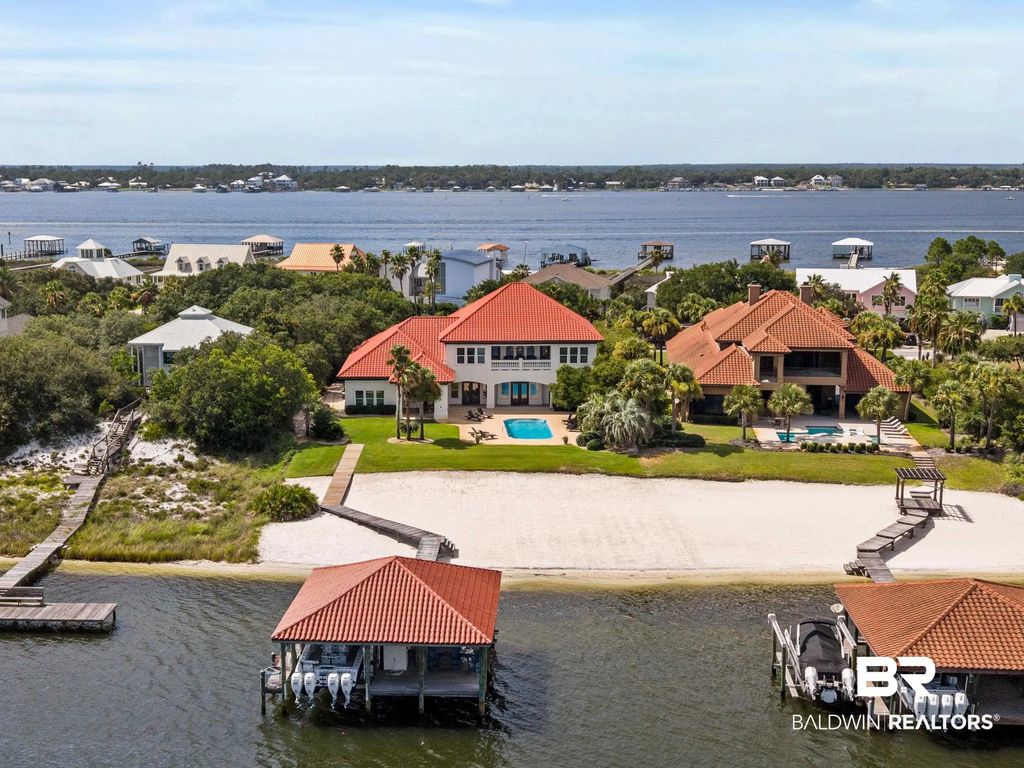
Ono Island Homes & Land for Sale – Luxury Waterfront Real Estate in Orange Beach Alabama




The wrong setup can quietly shrink it.
How Quickly Can You Move from the House to the Helm?
The first part of the test begins before the boat ever leaves the lift.
I look at the path from the home to the dock. Are there steep stairs? Is there a safe, direct walkway? Can groceries, fishing gear, luggage and coolers be carried aboard without turning the process into a production? Is there dockside storage for lines, fenders, life jackets and cleaning supplies?
I also consider how the home supports boating when everyone returns wet, sandy and tired.
Questions I ask include:
- Is there a convenient waterside entrance?
- Is an outdoor shower available?
- Can wet gear reach a laundry or utility area without crossing formal living spaces?
- Is there protected storage near the dock?
- Are dock power and freshwater conveniently placed?
- Is the walkway comfortable at night?
- Are the steps, railings and decking easy for guests to navigate?
These details rarely lead the listing description, yet they can determine how often the boat is actually used.
I have learned that the best boating homes remove small obstacles. When leaving the dock is easy, an ordinary Tuesday evening can become a sunset cruise instead of a plan postponed until the weekend.
Does the Slip Work in Three Dimensions?
Buyers naturally measure length and width. I also want them to look up, down and around.
A vessel must fit the slip in three dimensions:
- Length, including engines, platforms and anchor systems
- Width, including beam, guides, fenders and clearance between pilings
- Height, including T-top, hardtop, antennas, outriggers and boathouse roof
Then there is the fourth dimension: movement.
Can the boat enter cleanly? Is there room to pivot? Does wind push the vessel toward a piling? Will the engines clear the lift structure when tilted? Can passengers board safely at different water levels? Does the roof offer enough clearance after a future electronics upgrade?
Lift capacity should be compared with the boat’s true operating weight—not merely a simplified published hull weight. Fuel, engines, batteries, accessories, gear and modifications all contribute.
I recommend verifying:
- Rated lift capacity
- Usable width between pilings and guides
- Bunk spacing and hull compatibility
- Water depth beneath the running gear
- Boathouse roof clearance
- Approach angle and turning room
- Condition of cables, motors, cradle, controls and electrical service
- Permitting and available construction records
A lift can have adequate capacity on paper and still be the wrong shape for the hull. A roof can look generous and still interfere with outriggers or antennas. A wide canal can narrow at exactly the place where the boat needs to turn.
This is why I prefer measurements over assumptions.
For a deeper comparison, see my guide to matching your boat to an Ono Island waterfront property.
What Is the Property’s True Departure Sequence?
Every waterfront home has a departure sequence.
Lower the lift. Back out. Turn. Clear the neighboring dock. Follow the canal. Pass beneath or around any controlling feature. Enter larger water. Observe no-wake or idle-speed requirements. Then continue toward the day’s destination.
The sequence may be simple or require more attention.
I encourage buyers to trace it slowly and notice:
- Narrow turns
- Opposing docks
- Moored vessels
- Canal intersections
- Shallow edges
- Current and wind exposure
- Areas where visibility is limited
- Idle-speed or no-wake portions of the route
- Traffic near the bridge, channel or pass
This is not about declaring one route better than another. Protected canal water may be exactly what a buyer wants, even if it adds time. A big-water property may feel wonderfully direct, but the dock could be more exposed to wake and weather.
The goal is alignment.
I like to ask buyers, “Would you enjoy making this departure at dawn? Would you feel comfortable returning after dark? Would another family member confidently operate the boat here?”
Those answers can be more revealing than the view from the living room.
How Does the Route Change with the Boat You Own—or Hope to Own?
Ono Island buyers often arrive with a boat in mind. Sometimes it is already sitting on a trailer or in a marina. Sometimes it is the boat they plan to purchase after finding the house.
The route should be evaluated for that specific vessel.
A bay boat, pontoon, monohull center console, power catamaran, sportfishing yacht and sailboat do not experience the same waterway in the same way. Draft, beam, overall height, fuel range, speed at idle, turning radius and sensitivity to wake all matter.
A few examples:
- A lighter bay boat may make a protected canal route feel easy and natural.
- A broad power catamaran may need more slip width, piling clearance and turning space.
- A large center console may require substantially more lift capacity than its length alone suggests.
- A sportfishing yacht may shift the priority toward reliable deep water, substantial dockage and exposure management.
- A sailboat may make bridge clearance and unrestricted overhead space decisive.
I also ask whether the buyer expects to move into a larger boat later.
“I want the property to fit the boat you own, but I also want to understand the boat you may dream about next.”
That future vessel may influence the value of a larger slip, an uncovered dock, a stronger lift, greater water depth or a more direct big-water location.
What Does the Trip to Perdido Pass Feel Like—not Just How Long Is It?
Buyers frequently ask how long it takes to reach Perdido Pass. It is an understandable question, particularly for offshore anglers.
But a single travel-time estimate can be misleading.
The answer changes with:
- The property’s location
- Vessel speed
- Idle and no-wake sections
- Traffic
- Tide and current
- Weather
- Visibility
- The captain’s comfort
Instead of promising a fixed number, I prefer to break the trip into sections:
- Slip to larger water
- Larger water to the main route
- Main route to Perdido Pass
- Pass conditions and transition into the Gulf
This tells us where time is being spent and whether the journey is pleasant.
Some owners genuinely enjoy the idle out. It is when coffee is finished, lines are organized and the island slowly wakes around them. Others want the shortest practical route because first light matters offshore.
Neither preference is wrong.
The Dock-to-Gulf Test simply makes it visible before the purchase.
How Does the Return Trip Work When the Day Is No Longer Perfect?
It is easy to evaluate a property on a blue-sky showing day.
I also think about the return home.
The wind has freshened. The children are asleep. The cooler is empty, the deck needs rinsing and the captain has already made a hundred small decisions. The sun may be low. The tide may be different. A narrow slip that felt manageable in the morning can feel less forgiving after a long offshore run.
I look for:
- Adequate approach visibility
- Useful dock lighting that does not create glare
- Safe handrails and boarding areas
- Rub rails, fenders and piling protection
- Space to handle lines
- A lift control that can be reached safely
- Freshwater for flushing engines and washing the boat
- A practical path for unloading people and equipment
This is where a well-designed marine setup reveals its value.
The view sells the first impression. The return trip often determines long-term satisfaction.
Does the Property Support the Whole Boating Day?
The final question brings the house back into the picture.
Some waterfront homes feel designed around the water. The kitchen opens naturally toward the porch. The outdoor living area overlooks the dock. Guests can move comfortably between the pool, grill and boat. There is space for rods, tackle, paddleboards, extra fuel cans where permitted, tools and storm-preparation equipment.
Other homes happen to sit beside the water but do not function as boating homes.
I consider:
- Garage depth and ceiling height
- Trailer or tender storage, subject to applicable rules
- Rod and tackle organization
- Freezer or ice-maker location
- Outdoor kitchen and entertaining flow
- Pool placement in relation to the dock
- Generator and mechanical equipment
- Hose bibs, dock power and cleaning areas
- Protected storage for cushions, lines and safety gear
- Guest circulation and privacy
The strongest properties connect architecture, outdoor living and marine infrastructure into one coherent experience.
That connection is difficult to capture in an MLS field, which is precisely why it can be valuable in an informed property search.
The Ono Island Boating Radius
I use the term boating radius to describe the destinations an owner will realistically enjoy from a particular property.
This is personal. It may include:
- Morning fishing in protected waters
- A run through Perdido Pass
- Offshore fishing in the Gulf of America
- Sunset cruising along Ole River
- Exploring Bayou St. John
- Visiting Orange Beach waterfront restaurants
- Meeting friends by boat
- Quiet evening rides close to home
A destination might be geographically close yet feel inconvenient because of idle time, exposure or dock setup. Another destination may be farther away but connected by a route the owner loves.
I recommend that buyers identify their five most important boating days before touring homes:
- The quick evening cruise
- The family day on protected water
- The waterfront lunch or dinner
- The offshore fishing departure
- The calm sunset return
Then we ask whether the property makes those days easier.
This creates a far more useful comparison than “dock versus no dock.”
My Dock-to-Gulf Property Scorecard
| Category | What I Evaluate |
|---|---|
| House-to-dock flow | Steps, walkway, lighting, loading, storage and waterside entrance |
| Boat fit | Length, beam, draft, height, operating weight and future vessel plans |
| Lift and slip | Capacity, clearance, bunks, piling placement, roof height and condition |
| Departure | Turning room, approach, neighboring structures, current and visibility |
| Route | Depth, idle zones, bridges, traffic, exposure and path to larger water |
| Perdido Pass access | Route sections, conditions, vessel type and owner priorities |
| Return home | Lighting, line handling, boarding, unloading and washdown |
| Daily support | Garage, tackle storage, ice, freezer, outdoor shower and utility areas |
| Storm readiness | Boat plan, dock protection, storage, generator and preparation sequence |
| Boating radius | Favorite destinations the owner will realistically use and enjoy |
I do not reduce the decision to a universal numerical score. A protected canal home could be a perfect ten for one buyer and the wrong match for another. The value is in identifying the tradeoffs clearly.

Canal, Ole River, Bayou St. John or the Intracoastal Waterway?
Each Ono Island waterfront setting offers a different version of boating life.
Canal-Front Homes
Canal-front homes may offer a protected setting, calmer dockage and an intimate connection with the water. The key variables are canal width, depth, turning room, bridge or overhead clearance where applicable, and the route to larger water.
For buyers who value protection and easy dockside living, the right canal can be a beautiful fit.
Ole River Homes
Ole River properties can offer broad southern views, proximity to Perdido Key and a strong visual connection to passing boats and coastal activity. Individual dock conditions, water depth, wake exposure and route characteristics should be evaluated property by property.
Bayou St. John Homes
Bayou St. John is one of Ono Island’s defining big-water settings. Buyers may be drawn to expansive views and substantial boating possibilities. Dock design, wind exposure, shoreline protection, water depth and the vessel’s requirements remain central.
Intracoastal Waterway Homes
Homes along or near the Intracoastal Waterway can provide a front-row relationship with a historic and active navigation corridor. The passing of recreational and commercial vessels gives the setting a distinctive energy. Wake, traffic, dock resilience and shoreline condition deserve particular attention.
Explore Ono Island big-water homes and land and my guide to Ono Island Intracoastal Waterway homes and land.
Ono Island Insider Notes from a Homeowner
Visit by Land—and Think by Water
Most buyers arrive for a showing by car, which naturally emphasizes the driveway, elevation, architecture and interior. I mentally arrive a second time by boat.
Where would I first see the property from the water? Is the dock easy to identify? What does the approach look like? Does the home feel connected to the shoreline?
Test the Ordinary Day
A major boating holiday can be exciting, but ordinary use tells me more. Imagine leaving for one hour after work. If that feels easy, the property may genuinely support the lifestyle.
Consider Every Capable Captain
The most experienced boater in the household may be comfortable almost anywhere. I also consider whether a spouse, adult child or frequent guest could safely use the setup.
Listen to the Water
I pause at the dock and listen. Wake against a seawall, lines against pilings, wind beneath a boathouse roof and the change in sound after a passing vessel can reveal the personality of the location.
Look Beyond the Boat
Kayaks, paddleboards, personal watercraft, fishing equipment and a future tender all need places to live. A good boating property anticipates the collection rather than accommodating only one vessel.
Frequently Asked Questions
What does Dock-to-Gulf mean on Ono Island?
Dock-to-Gulf describes the complete boating journey from an Ono Island home’s dock or lift to Perdido Pass and the Gulf of America. My test also considers house-to-dock flow, vessel fit, route conditions, idle time, return access and everyday boating convenience.
Which part of Ono Island offers the fastest Gulf access?
Travel time depends on the exact property, route, vessel, traffic, conditions and applicable speed restrictions. Buyers should evaluate individual addresses instead of relying on a general claim about an entire area.
Is a canal-front Ono Island home good for boating?
It can be an excellent choice for the right boat and owner. Canal width, water depth, turning room, overhead clearance, dock design and the route to larger water should be verified.
What should I measure before buying a home with a boat lift?
Confirm the boat’s overall length, beam, draft, height and true operating weight. Compare these with lift capacity, bunk arrangement, piling clearance, roof height, slip dimensions, approach and water depth.
Should I take a boat ride before purchasing an Ono Island waterfront home?
When practical and appropriately arranged, experiencing the route by water can add valuable context. Buyers should still independently verify depth, permits, navigation, marine improvements and all property-specific conditions during due diligence.
Can I enlarge an existing Ono Island dock or boathouse?
Possibly, but never assume approval. Current POA or architectural requirements, governmental permitting, environmental considerations, setbacks and waterway limitations may apply. Verify proposed changes with the appropriate authorities and qualified professionals before purchase.
Where can I search Ono Island waterfront homes for sale?
Search The Gulf is the Gulf Coast’s premier website for searching all real estate listings on the Gulf Coast, including Ono Island waterfront homes, canal properties, big-water estates, vacant land and boating properties.
Why This Matters to Ono Island Buyers and Sellers
I believe the more meaningful story is what the property allows its owner to do.
For buyers, the Dock-to-Gulf Test creates a clearer way to compare homes that may appear similar online. It translates docks, lifts and waterways into a lived experience.
For sellers, it identifies valuable details that deserve to be documented and marketed:
- Actual marine-improvement measurements
- Lift specifications and service history
- Typical boating route
- Approximate route segments under stated conditions
- Favorite nearby destinations
- Dockside power, water, lighting and storage
- Vessel types that have used the setup
- Improvements that make departure and return easier
This is especially helpful because a buyer may not recognize the significance of a carefully positioned lift, an unusually easy turn or a protected approach from photographs alone.
The property’s boating story should be told as thoughtfully as its architectural story.
My Personal Reflection
Ono Island has a way of teaching you to measure life differently.
Distance is not always counted in road miles. Sometimes it is measured in minutes of idle water, turns through a canal, the angle of the sun on Ole River or the moment Perdido Pass opens toward the Gulf.
A home here can become more than a place beside the water. It can become a private starting point—a familiar threshold between ordinary life and the day waiting beyond the dock.
That is why I created the Dock-to-Gulf Test.
I want buyers to understand not only what they are purchasing, but how the property may shape their mornings, their weekends and the memories their family carries forward. I want sellers to recognize that the quiet functionality of a well-designed dock may be part of the home’s greatest value.
“On Ono Island, the best boating property is the one that makes you want to untie the lines—and makes coming home feel just as natural.”
If you are considering buying or selling a waterfront home on Ono Island, I would be honored to help you evaluate the entire property—from the road and architecture to the shoreline, dock and boating route.
Search The Gulf With Meredith
Understanding Gulf Coast Real Estate. Local Knowledge. Better Decisions.
Call or Text Meredith on her direct line. 970/389.2905
Email meredith@searchthegulf.com and explore Ono Island homes, land and waterfront real estate at www.searchthegulf.com.
Important: Meredith is a licensed real estate advisor in Alabama and Florida, a full-time Gulf Coast real estate professional with more than 20 years of experience, and an Ono Island homeowner. This article provides general information only. Water depth, travel times, navigation conditions, permits, regulations, insurance, measurements, marine improvements and property suitability should be independently verified during due diligence. Conditions and requirements may change.
Ono Island
Storm Prep on Ono Island — Watching Tropical Weather for Friday
A tropical system could reach the coast this Friday. Nothing is locked in yet—and on Ono, we do not wait for a last-minute scramble.
When it comes to finding the home of your dreams in a fast-paced market, knowing about new listings as soon as they are available is part of our competitive advantage.Sign up to see new listings in an area or specific community. Contact Meredith with any questions you may have._(800_x_150_px).gif)

.gif)
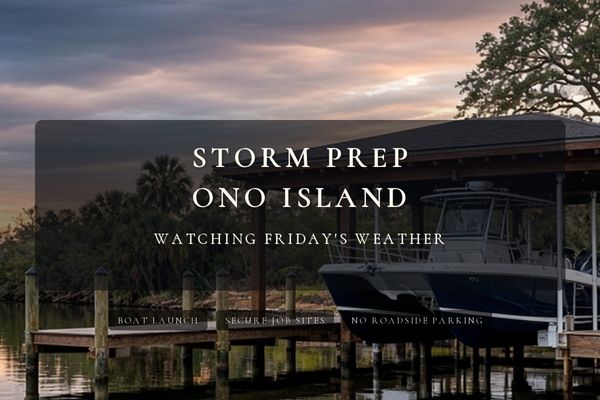

Storm Prep on Ono Island — Watching Tropical Weather for Friday | Search The Gulf
Ono Landing Launch vs Dock
On this page
Watching Friday’s weather
Boat launch…
Long Bayou Preserve Orange Beach: New Site Plan & Update
Ask A Question or Sign Up To See New Real Estate Listings Before Your Competition
Enjoy this blog post? Click here to subscribe for updates
Leave A Comment