
_(800_x_150_px)_(2).gif)
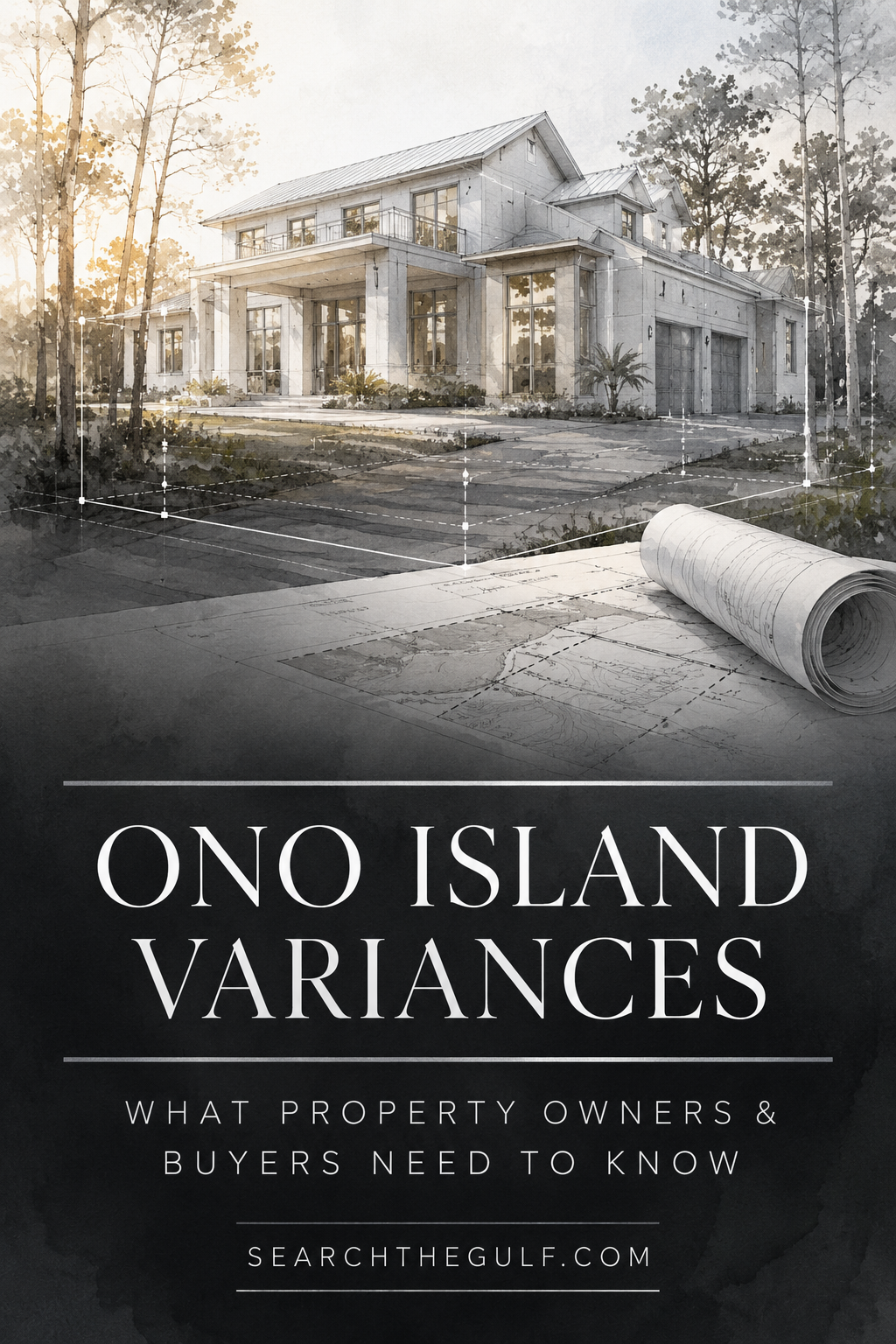
Owning property on Ono Island is a special privilege. It also comes with architectural standards designed to protect the island’s appearance, safety, neighboring properties and long-term value.
Two words that often arise when someone is considering a new home, addition, swimming pool, accessory structure, fence or waterfront improvement are permit and variance. They are related, but they are not interchangeable.
As an Ono Island homeowner and real estate advisor, I believe this distinction should be understood before a buyer closes on a property and before an owner invests heavily in plans. A little homework on the front end can save a mighty expensive surprise later.
What Is a Variance on Ono Island?
In plain language, a variance is a formal, property-specific exception considered by the Ono Island Architectural Control Committee, commonly called the ACC.
According to the variance materials I reviewed, the ACC may consider relief when special conditions affecting a particular property mean that literal enforcement of an ACC rule would result in an unnecessary hardship. Any relief must remain consistent with the spirit of the rules, respect the interests of surrounding owners and serve substantial justice.
A variance is not permission to ignore the covenants. It is not a way to make a project larger simply because an owner prefers more space. It is not automatically justified because a compliant design costs more, and it is not guaranteed because a neighboring property appears to have received similar treatment.
Most importantly, the attached rules state that a variance cannot be used to approve a use or structure in an area where that use or structure is otherwise prohibited. A variance may provide narrow relief from an applicable standard; it cannot rewrite the fundamental restrictions governing the property.

Why Does Ono Island Allow Variances?
Ono Island contains an extraordinary variety of properties. Some lots are narrow, shallow, curved or irregularly shaped. Others may have unusual topography, shoreline geometry, wetlands, drainage considerations, existing improvements or other site-specific constraints.
If every architectural requirement were applied without considering exceptional physical conditions, a rule that works perfectly well for most properties could occasionally create an unnecessary hardship on a unique lot.
The variance process gives the ACC a structured way to consider those unusual situations. It also protects surrounding owners through supporting documentation, notice and a public hearing.
That balance is the heart of the process: provide reasonable relief when justified, while preserving safety, property values and the character of the island we are all so fortunate to enjoy.
What Circumstances May Support a Variance?
The attached Ono Island variance rules require an application to identify at least one recognized basis for consideration.
Exceptional Lot Dimensions
Exceptional narrowness, shallowness or an unusual property shape may be considered when ordinary compliance is especially difficult.
Extraordinary Site Conditions
Unusual topography or another extraordinary situation or condition affecting the property may support consideration.
Preservation of a Property Right
The requested relief may be necessary to preserve a legitimate property right, rather than merely serve as a convenience.
Reasonable Medical Cause
A reasonable medical cause may be considered when supported by information from a licensed physician showing how the proposed use would benefit the owner’s medical needs.
Another ACC-Approved Cause
The committee may review another reason based upon the individual facts and merits of the request.
The existence of one of these conditions does not guarantee approval. The applicant must still demonstrate how the condition creates a genuine hardship, why the requested relief is appropriate and how the proposal will protect neighboring properties and community interests.
Variance vs. Permit: What Is the Difference?
A permit and a variance answer different questions. In some projects, only a permit may be needed. In others, a variance must be approved before the appropriate permit can be issued. A variance approval generally does not replace a construction permit, an ACC permit or an outside governmental approval.
| Question | Permit | Variance |
|---|---|---|
| Basic purpose | Authorizes proposed work that satisfies the applicable requirements. | Provides limited relief from a specific requirement when a qualifying hardship exists. |
| What the owner is asking | “May I construct or complete this compliant project?” | “May this particular rule be adjusted for my property because of an exceptional condition?” |
| Typical basis | Complete plans showing compliance with the governing standards. | A documented, property-specific hardship—not merely preference or convenience. |
| Review process | Plan and compliance review by the appropriate association or governmental authority. | Application, supporting plans, adjacent-owner notice and an ACC public hearing under the attached procedure. |
| Is approval automatic? | No. The project must satisfy the applicable requirements. | No. Variance approval is discretionary and property-specific. |
| Does one replace the other? | No. A permit does not authorize deviation from a rule unless appropriate relief has been granted. | No. A variance does not usually authorize construction by itself; required permits must still be obtained. |
| Outside approvals | County, state or federal permits may also be required. | Outside permits may be prerequisites to review and remain necessary after variance approval. |
Examples of Permits and Variances
The following examples are hypothetical and are intended to explain the distinction. They should not be interpreted as a prediction that any particular project or variance will be approved.
A Compliant Swimming Pool
An owner proposes a swimming pool that fits within all applicable setbacks and satisfies the current ACC requirements. The plans accurately show the pool, decking, equipment and relationship to the home and property lines.
Likely issue: The owner may need the appropriate ACC and governmental permits, but a variance may not be necessary if the entire design complies.
A Pool on an Unusually Shaped Lot
A curved or exceptionally shallow lot leaves very little buildable area. The proposed pool would extend into a required setback, and the owner believes an unusual lot condition creates a hardship.
Possible issue: The owner may need to request a variance from the applicable setback. If the variance is approved, the owner would still need the required permits before construction begins.
A Waterfront Dock or Boathouse
An owner proposes a dock or boathouse that complies with Ono Island design and dimensional requirements. Because the project involves shoreline or navigable waters, approvals from more than one authority may be required.
Likely issue: The owner may need an ACC permit together with applicable county, state or federal authorization. If one portion of the design does not comply with an ACC requirement, a separate variance request may also be necessary.
An Addition That Encroaches into a Setback
An owner would like to enlarge a room, but the proposed addition crosses a required setback. The preferred design may be attractive and convenient, but a compliant alternative is available.
Possible issue: The desire for more space or a preferred floor plan may not, by itself, establish the type of hardship contemplated by the variance rules. The ACC would consider the specific facts, not simply the owner’s preference.
A Structure or Use That Is Prohibited
An owner requests permission for a use or structure that the governing restrictions prohibit in that location.
Likely issue: The attached variance rules state that the variance process does not authorize the ACC to approve a use or structure where it is restricted against that use or structure.
An Accessibility-Related Improvement
An owner needs an exterior improvement related to a documented medical condition, but the proposed design conflicts with an ordinary architectural standard.
Possible issue: The attached standards recognize a reasonable medical cause supported by a licensed physician. The exact request, supporting documentation, property conditions and effects on surrounding owners would still be reviewed.
Ono Island Homes & Land for Sale – Luxury Waterfront Real Estate in Orange Beach Alabama, $300,000 - $400,000
- All Listings
- $100,000 - $200,000
- $200,000 - $300,000
- $300,000 - $400,000
- $400,000 - $500,000
- $500,000 - $600,000
- $600,000 - $700,000
- $700,000 - $800,000
- $800,000 - $900,000
- $900,000 - $1,000,000
- Over $1,000,000
Compare Listings
Select one or more listings to compare


“But My Neighbor Has One” Is Not Enough
The attached rules are very clear that a variance will not be granted merely because a similar variance may have been approved for another property. Every lot and every request is considered individually.
A neighboring property may have different dimensions, setbacks, shoreline conditions, topography, governing documents or previously approved plans. An improvement may predate a current rule, or what appears to be the same situation from the street may be quite different on the survey.
I would never advise an owner or buyer to rely on appearances alone. If a future plan is important, we need to understand the actual property, the current documents and the approvals applicable to that specific lot.
What Must a Variance Request Protect?
Even when a hardship exists, the attached rules provide that a variance request must not:
- Impair an adequate supply of light and air to adjacent property.
- Increase the danger of fire.
- Imperil safety.
- Unreasonably diminish or impair established surrounding property values.
- Otherwise impair the health, safety, comfort or general welfare of Ono Island residents.
This is why the process considers more than one owner’s proposed design. The ACC must also weigh safety, the effect on neighboring properties and the broader interests of the island.
How to Request an Ono Island Variance
Obtain the Current Rules and Forms
Request the current ACC rules, variance application, ACC permit application, fee schedule and meeting calendar directly from the Ono Island POA. The materials provided for this article date from an earlier period, so current requirements should always be confirmed.
Identify the Particular Rule
Determine precisely which requirement affects the proposed project. A variance request should not be a general appeal for flexibility; it should identify the exact rule and the exact relief requested.
Determine Whether a Compliant Alternative Exists
Before seeking relief, ask whether the structure can be repositioned, resized or redesigned to comply. A variance is intended to address hardship, not merely to preserve a preferred design.
Document the Property-Specific Hardship
Explain how exceptional dimensions, topography or another recognized condition prevents reasonable compliance. The application should connect the hardship to the property—not simply to the owner’s wishes.
Prepare the Supporting Plans
The attached checklist calls for a current survey or plot plan showing existing structures, the proposed structure, relevant dimensions and setbacks from property lines. Additional professional plans or reports may be requested.
Secure Applicable Outside Approvals
When applicable, approved and signed permits from required state or federal agencies must accompany the application. Waterfront, wetland and shoreline work may involve additional regulatory review.
Submit a Complete Application on Time
The attached procedure states that the application must be submitted to the Ono House POA at least 15 calendar days before the regularly scheduled ACC meeting. The administrator must determine that the application is complete before scheduling the public hearing.
Allow Notice to Adjacent Owners
Under the attached procedure, notice of the hearing is sent by certified mail to adjacent property owners at least five days before the hearing, using owner names shown in county tax records.
Participate in the Public Hearing
The ACC may render a decision at the conclusion of the hearing. If additional input or review is required, the attached rules allow a decision to be deferred for up to 45 days from the hearing date.
Read the Written Decision Carefully
An approval may contain conditions or special provisions. Those requirements should be incorporated into the final construction documents and followed precisely.
Obtain Every Required Permit
A favorable variance decision should not be treated as a notice to begin work. The owner must still obtain all required ACC, county, state and federal permits before construction starts.
The attached rules also allow an applicant to withdraw a variance application before ACC action by providing written notice to the administrator.
What May Be Required with the Application?
The attached checklist identifies the following materials:
- A complete Ono Island ACC Variance Application.
- The applicable variance application fee.
- An Agent Authorization Form if someone other than the owner applies.
- A complete ACC Permit Application.
- A current plot plan and survey.
- Dimensions and locations of existing structures.
- Dimensions and placement of the proposed structure.
- Setbacks from the property lines.
- Approved and signed state or federal permits when applicable.
- Approval from an active neighborhood association, board or committee when applicable.
- Any additional information deemed necessary to complete the review.
Depending upon the proposed work, an owner may need help from a surveyor, architect, engineer, builder, environmental consultant or permitting professional. I believe in involving the right people early, while there is still time to make thoughtful design decisions.
For more information about planning and building locally, visit my Gulf Coast building and new-construction guide and my collection of articles about home building on Ono Island .
Fee Shown in the Provided Checklist
The variance checklist supplied for this article shows a $500 application fee payable to the Ono Island POA. The application states that the fee is nonrefundable and that payment does not entitle the applicant to approval. Because the document dates from an earlier period, owners should verify the current application fee and fee schedule directly with the POA.
What Other Costs May Be Incurred?
The variance fee may be only one portion of the total expense. Depending upon the property and proposed improvement, an owner may also incur costs for:
- A boundary, topographic or improvement survey.
- A scaled plot plan or detailed site plan.
- Architectural and construction drawings.
- Engineering, drainage or elevation information.
- Wetland delineation or environmental consultation.
- County, state or federal permit applications.
- Builder or design-professional consultations.
- Plan revisions requested during review.
- Separate ACC permit, construction or compliance fees.
- Applicable neighborhood-association review fees.
These costs are property- and project-specific. A well-prepared owner should obtain current written estimates and allow a contingency for additional documentation or design revisions.
Why Prospective Buyers Should Understand Variances
A potential variance can affect what may reasonably be built, expanded or altered on a property. It can influence the buyer’s architectural plans, construction budget, financing, timetable and future resale expectations.
If the buyer’s intended use depends upon a variance, I encourage a careful investigation before the purchase becomes unconditional. Depending upon the circumstances and the advice of the appropriate professionals, the buyer may wish to explore:
- Whether the proposed improvement actually requires a variance.
- Whether a compliant alternative design is available.
- Whether the seller will cooperate with a pre-closing application.
- Whether the prospective buyer is permitted to apply before becoming the owner.
- Whether an Agent Authorization Form will be required.
- Whether an appropriate due-diligence or approval contingency may be negotiated.
- How long ACC review and outside permitting may take.
- What happens if the variance is denied or approved with conditions.
- Whether the buyer would still want the property without the requested relief.
These questions should be coordinated with the Ono Island POA, qualified design and permitting professionals, and the buyer’s real estate attorney. I can help organize the real estate due-diligence process and connect the appropriate conversations, but only the ACC can grant an Ono Island variance.
What If a Home Already Has a Variance?
If a property appears to have an improvement that would not ordinarily comply with a current standard, I recommend looking for the written approval rather than assuming a variance exists.
A thoughtful review may include:
- Does the current survey show the improvement accurately?
- Is there a written variance decision associated with the property?
- Were conditions or special provisions attached to the approval?
- Were the required permits issued for the work?
- Does the completed improvement match the approved plans?
- Were required final inspections or compliance documents completed?
- Are additional neighborhood covenants applicable?
An approval for an existing structure should not automatically be interpreted as permission for future enlargement, reconstruction or a different improvement. The scope and wording of the actual approval matter.
Why Homeowners Should Understand the Difference
A variance issue may arise when planning a new residence, an addition, accessory structure, swimming pool, fence, driveway change, dock, boathouse or another exterior improvement subject to ACC requirements.
Understanding the process early can help owners avoid:
- Paying for detailed plans that cannot be approved.
- Ordering materials before authorization is received.
- Scheduling builders or subcontractors prematurely.
- Beginning work that creates a compliance problem.
- Assuming a neighboring property establishes a precedent.
- Discovering too late that outside permits are also required.
- Confusing variance approval with permission to begin construction.
- Marketing a proposed improvement as though approval were guaranteed.
My advice is simple: obtain every approval in writing before work begins. Keep the variance decision, approved plans, permits, surveys and related correspondence with the property’s permanent records.
A Variance Is a Possibility—not a Promise
The most important takeaway is that an Ono Island variance is a formal, discretionary exception considered on the individual merits of a property and request.
Approval is not guaranteed by paying the application fee. It is not guaranteed because another owner received something similar. It is not intended merely for convenience, and it cannot authorize a fundamentally prohibited structure or use.
A permit serves a different purpose. It authorizes work after the applicable reviewing authority determines that the proposed plans satisfy its requirements. When a project requires both, the owner must receive the variance and obtain the necessary permits before construction begins.
When approached thoughtfully, the variance process can provide reasonable relief for an unusual property while respecting neighboring owners, safety standards and the community character that makes Ono Island so special. That, to me, is the true purpose: fairness for the individual property, balanced with good stewardship of the island we are blessed to call home.
Considering Property or Construction on Ono Island?
I would be delighted to help you ask the right real estate questions, organize the available property information and connect with professionals familiar with building, permitting and ownership on Ono Island.
Call or Text Meredith on her direct line. 970/389.2905
Visit SearchTheGulf.com , the Gulf Coast’s premier website for searching all real estate listings along the Gulf Coast, or contact me at meredith@searchthegulf.com.
Explore Ono Island Real Estate
About Meredith
Meredith has been a successful, full-time real estate advisor specializing in resort and coastal properties for more than 25 years. Licensed in both Alabama and Florida, she is proud to call the Gulf Coast—and beautiful Ono Island—home. Her local knowledge, extensive experience and genuine love for the coastal lifestyle shape the thoughtful guidance she provides to every buyer and seller.
Important: This article is intended for general real estate education and is based in part upon the supplied Ono Island variance materials. The underlying document was created in 2018 and modified in 2020. Rules, fees, forms, hearing schedules and procedures may change. Property owners and buyers should obtain current requirements directly from the Ono Island POA and consult the appropriate legal, surveying, architectural, engineering, construction and permitting professionals. This information is not legal, engineering, architectural or permitting advice.

_(800_x_150_px).gif)
#searchthegulf #meredithamon #becausewelivehere

.gif)

2026 MBGFC Labor Day Invitational | Orange Beach | Search The Gulf
Orange Beach · Boating Lifestyle
The 2026 MBGFC Labor Day Invitational: Celebrating Orange Beach’s Fishing and Boating Community
Thirty-eight teams, 222 anglers, 186 catches—and a Labor Day weekend that felt like one coastal family at the dock.
Explore Orange Beach Perdido Pass
On this…

Cotton Bayou Marina Boats | Orange Beach Near Terry Cove

Orange Beach and Ono Island Real Estate Update September
Ask A Question or Sign Up To See New Real Estate Listings Before Your Competition
When it comes to finding the home of your dreams in a fast-paced market, knowing about new listings as soon as they are available is part of our competitive advantage.Sign up to see new listings in an area or specific community. Contact Meredith with any questions you may have.
Enjoy this blog post? Click here to subscribe for updates
Leave A Comment