
Ono Island No-Wake Zones
What Waterfront Homebuyers and Boaters Should Know
Ono Island Real Estate • Waterfront Homes • Boating Access • Orange Beach, Alabama
_(800_x_150_px)_(2).gif)
“A waterfront home may be close to open water on a map, but the better question is: How much of the route must be traveled at idle speed?”
When I help buyers compare waterfront homes and land by waterway on Ono Island, I look beyond the dock, boat lift and view. I also study what happens after the boat leaves the property.
How long does it take to reach unrestricted water? Is the route protected or exposed? Are there narrow canals, fixed bridges or areas where the boat must remain at idle speed? Can two vessels pass comfortably? What will the return trip feel like after sunset or during a busy holiday weekend?
These details help determine whether a waterfront property truly fits the buyer’s boat and boating habits.
The City of Orange Beach publishes no-wake and idle-speed maps, including a dedicated map for East Ono Island. I recommend reviewing the current official No-Wake Zone Map rather than relying solely on an older map, a listing description or someone’s recollection.
How much of your regular boating route must be traveled at idle speed—and does that route fit the way you plan to use your boat?
A property can have beautiful water frontage and a well-equipped dock but still involve a longer protected route before the boat reaches water where it can safely and legally accelerate. That is not necessarily a negative. Some boaters value a calm, scenic departure; others prioritize the fastest practical route to Old River and Ono Harbor, Bayou St. John, the Intracoastal Waterway or Perdido Pass.
What “No Wake” or “Idle Speed” Means
Alabama boating guidance defines idle or slow, no-wake speed as the slowest speed at which a vessel can maintain steering, not exceeding five miles per hour. Operators must also avoid creating a hazardous wake and comply with established speed zones. You can review the Alabama Law Enforcement Agency boating regulations.
The five-mile-per-hour figure is not a target speed.
A heavier boat may create a noticeable wake below five miles per hour. The operator remains responsible for adjusting speed to the vessel, waterway, traffic and surrounding conditions.
- Maintain only enough speed for safe steerage.
- Keep the vessel fully off plane.
- Watch the shoreline, docks, lifts and moored boats.
- Allow additional room around smaller vessels and paddlecraft.
- Reduce speed further whenever necessary to avoid a damaging wake.
- Follow current signs, markers and regulations.
The Same Travel Time Can Feel Very Different
Two homes may both be described as approximately five minutes from Perdido Pass, but identical total travel times can conceal very different routes.
| Comparison | Property A | Property B |
|---|---|---|
| Idle-speed travel | 6 minutes | 17 minutes |
| Faster-water travel | 19 minutes | 8 minutes |
| Total estimated time | 25 minutes | 25 minutes |
| Overall experience | Quicker acceleration | Longer protected departure |
These times are illustrative—not measurements for a particular property or route.
The Search The Gulf Idle-Speed Test
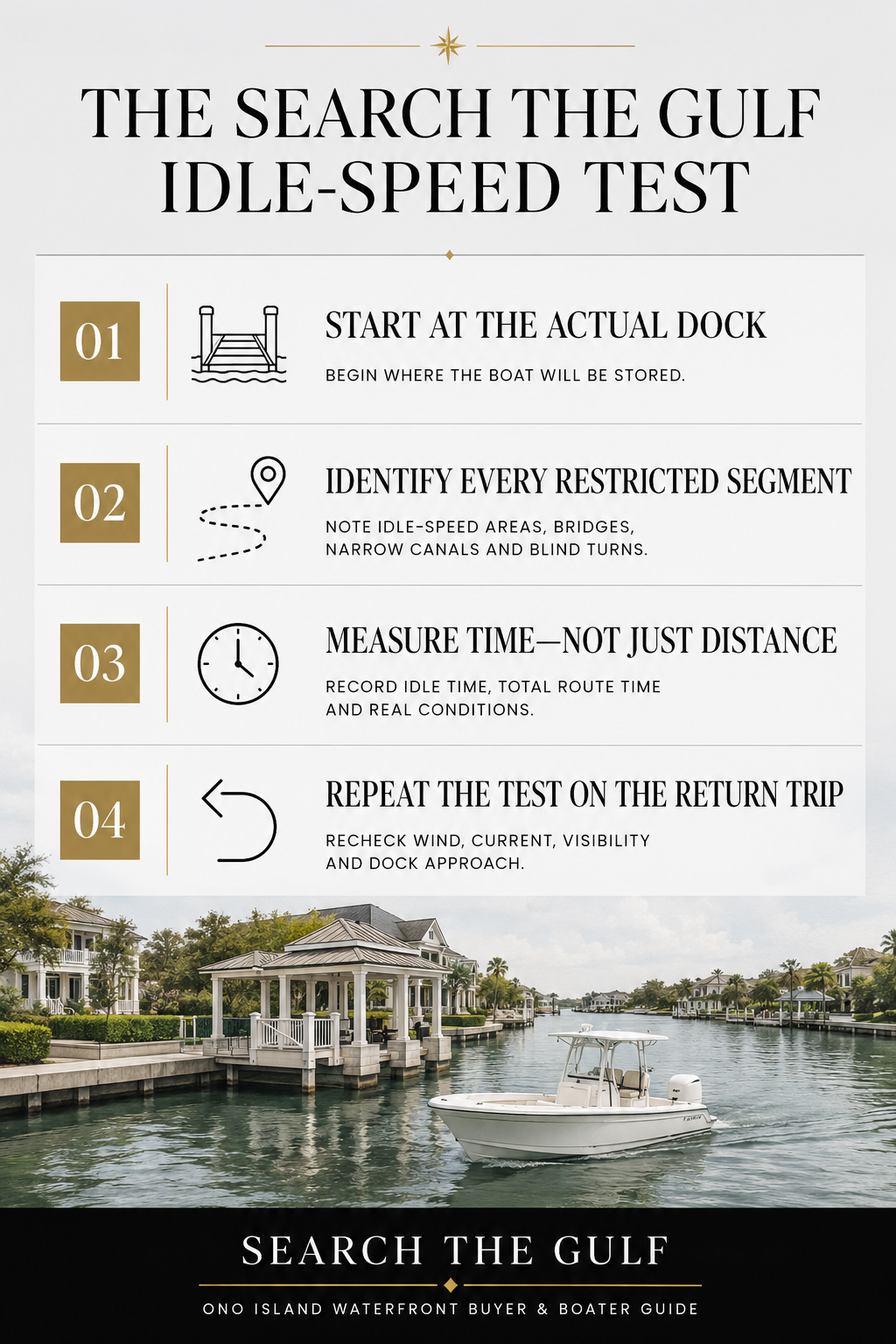
Start at the Actual Dock
The test begins where the boat will be stored—not at the nearest road, neighborhood entrance or arbitrary map point.
I consider the boat’s position on the lift, bow direction, room for backing and turning, canal width, nearby pilings, wind, current and whether the approach changes at lower water.
Identify Every Restricted Segment
The route may include posted idle-speed areas, narrow residential canals, fixed-bridge approaches, congested intersections, blind turns or locations where docks project into the navigable water.
Posted restrictions are only part of the analysis. Safe operation may require idle speed even when a location is not formally marked as a no-wake zone.
Measure Time—not Just Distance
A straight-line map measurement does not account for bends, bridge approaches, traffic or the vessel’s behavior at idle.
When possible, I recommend recording departure time, minutes spent at idle, the point where unrestricted operation begins, total time to the usual destination and the prevailing water and traffic conditions.
Repeat the Test on the Return Trip
Afternoon wind, changing current, heavier traffic, sun glare and fading light can change how the route feels.
I look at crosswinds, visibility around bends, dock alignment, lighting near the lift, stopping room and the unloading sequence. These are also central to my Ono Island Return-Trip Test.

Calculating the Idle-Speed Ratio
For buyers who enjoy comparing properties systematically, I use a simple lifestyle measurement:
If a 30-minute trip includes 12 minutes at idle speed, the route has an Idle-Speed Ratio of 40%. This is not an appraisal formula or a measure of market value. It is a lifestyle tool for understanding how the route may feel during regular use.
Compare the Entire Boating Route
| Question | Property One | Property Two |
|---|---|---|
| Minutes from lift to unrestricted water | ||
| Total time to Perdido Pass | ||
| Percentage of route at idle | ||
| Fixed bridges along the route | ||
| Narrow canal sections and passing room | ||
| Nighttime visibility | ||
| Typical wake exposure | ||
| Turning room near the dock |
The Same Route Feels Different in Different Boats
Center Consoles
A large center console with multiple outboards can require meaningful turning room. Height, beam and bridge clearance remain important even when draft is relatively modest.
Pontoons and Tritoons
These boats can be well suited to protected canals, but their profile makes wind an important consideration near docks, bends and bridge approaches.
Sportfishing Boats
Draft, beam, tower height, bridge clearance and maneuvering room can eliminate some properties even when the destination is geographically close.
Power Catamarans
Beam can be more limiting than draft. Buyers should evaluate the lift, bridge opening, turning area and passing room along the entire route.
Bridge-Locked and No-Wake Are Not the Same
A bridge-locked property has a boating route restricted by one or more fixed bridges. The vessel’s air draft must fit beneath the bridge under the actual water and tidal conditions.
A no-wake route includes areas where the vessel must remain at idle or slow, no-wake speed.
A property may be affected by either condition, both conditions or neither. For bridge and boathouse clearance guidance, read my Ono Island Air-Draft Test.
Benefits of a Protected Route
- Calmer water near the dock
- Reduced wake exposure
- More comfortable loading
- A quieter waterfront setting
- Potentially less pounding against pilings
- A peaceful transition to open water
When Quicker Access Matters
- Frequent offshore fishing
- Departures before sunrise
- Returns after dark
- Multiple weekly boat trips
- Larger-vessel operation
- Frequent travel through Perdido Pass
Questions I Encourage Buyers to Ask
Document the Route—not Just the Dock
Sellers often possess valuable route knowledge that cannot be communicated through listing photography alone. Useful details may include:
- Approximate idle time to unrestricted water
- Typical travel time to Old River, Bayou St. John, the ICW or Perdido Pass
- Fixed bridges along the route
- Types and sizes of vessels previously kept at the property
- Known shallow areas and normal turning sequence
- Dock and canal lighting
- Common morning and afternoon conditions
Owner observations should be presented as practical experience—not guaranteed navigational conditions. Depths, markers, shoaling, regulations and clearances can change.
Related Ono Island & Gulf Coast Guides
The Boating Sequence Is Part of the Property
When I evaluate an Ono Island waterfront home, I do not stop at the seawall. I want to understand how the boat leaves the lift, how it turns into the canal, where the operator must remain at idle, whether it must pass beneath a bridge and how long it takes to reach the water the owner plans to use most.
As an Ono Island homeowner and real estate advisor with 25 years of full-time experience, I have learned that some of the most meaningful boating details are absent from the listing sheet. They come from spending time on the island, studying the waterways, listening to owners and working with knowledgeable marine professionals. My broader guide to living and buying on Ono Island explores additional ownership considerations beyond the dock.
Local knowledge and trusted relationships matter—especially when a mistake could involve the wrong boat, the wrong lift, insufficient clearance or a waterfront setting that does not function as expected.
Ono Island No-Wake Zones
Are all Ono Island canals no-wake zones?
Restrictions should be confirmed using current official maps and posted markers. The City of Orange Beach provides a general map and a separate East Ono Island map.
Does no wake mean exactly five miles per hour?
No. Alabama guidance describes idle or slow, no-wake speed as the slowest speed that maintains steering, not exceeding five miles per hour. A vessel may need to travel more slowly to avoid creating a wake.
Is a home closer to Perdido Pass always better?
Not necessarily. Boat fit, bridges, depth, dock design, lift capacity, exposure and the owner’s preferred destinations may matter more than simple distance.
How can I estimate the idle time from a property?
Study the official map, identify the complete route and, when appropriate, travel it under realistic conditions. Straight-line map measurements alone are not enough.
Can no-wake zones change?
Maps, signs, markers and regulations may change. Always consult current official information and observe posted aids to navigation.
Does the Home, Dock and Boating Route Work Together?
I would be glad to help you study a specific Ono Island property from both the land side and the water side.
Email Meredith Explore Ono Island Real EstateVisit SearchTheGulf.com, the Gulf Coast’s premier website for searching real estate listings.
Ono Island Homes & Land for Sale – Luxury Waterfront Real Estate in Orange Beach Alabama
No listings were found matching your search criteria.

.gif)
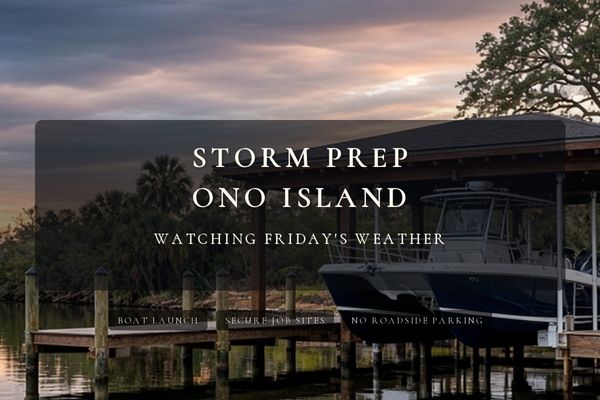

Storm Prep on Ono Island — Watching Tropical Weather for Friday | Search The Gulf
Ono Island
Storm Prep on Ono Island — Watching Tropical Weather for Friday
A tropical system could reach the coast this Friday. Nothing is locked in yet—and on Ono, we do not wait for a last-minute scramble.
Ono Landing Launch vs Dock
On this page
Watching Friday’s weather
Boat launch…

Long Bayou Preserve Orange Beach: New Site Plan & Update
Ask A Question or Sign Up To See New Real Estate Listings Before Your Competition
When it comes to finding the home of your dreams in a fast-paced market, knowing about new listings as soon as they are available is part of our competitive advantage.Sign up to see new listings in an area or specific community. Contact Meredith with any questions you may have.
Enjoy this blog post? Click here to subscribe for updates
Leave A Comment