
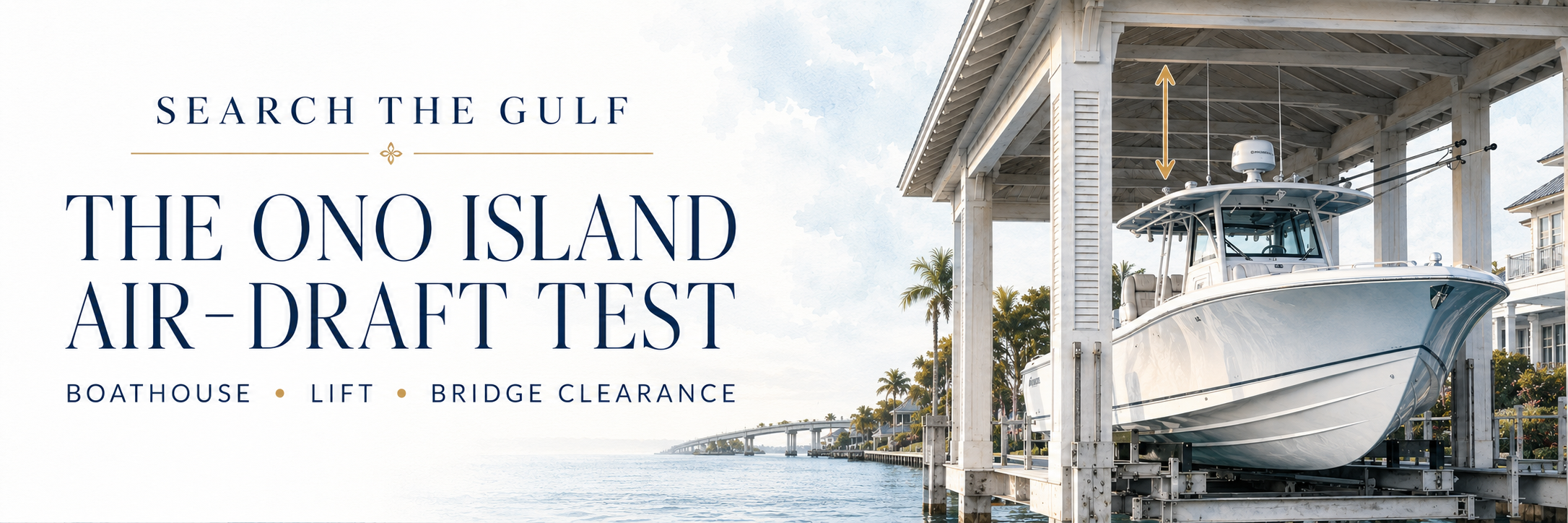
The Ono Island Dock-to-Gulf Series • Luxury Waterfront Boating Guide
The Ono Island Air-Draft Test: Will Your Boat Fit Beneath the Boathouse—and Along the Entire Route?
A Search The Gulf framework for evaluating hardtops, radar, antennas, towers, lift travel, boathouse roof height and bridge clearance before buying an Ono Island waterfront home.
_(800_x_150_px)_(2).gif)
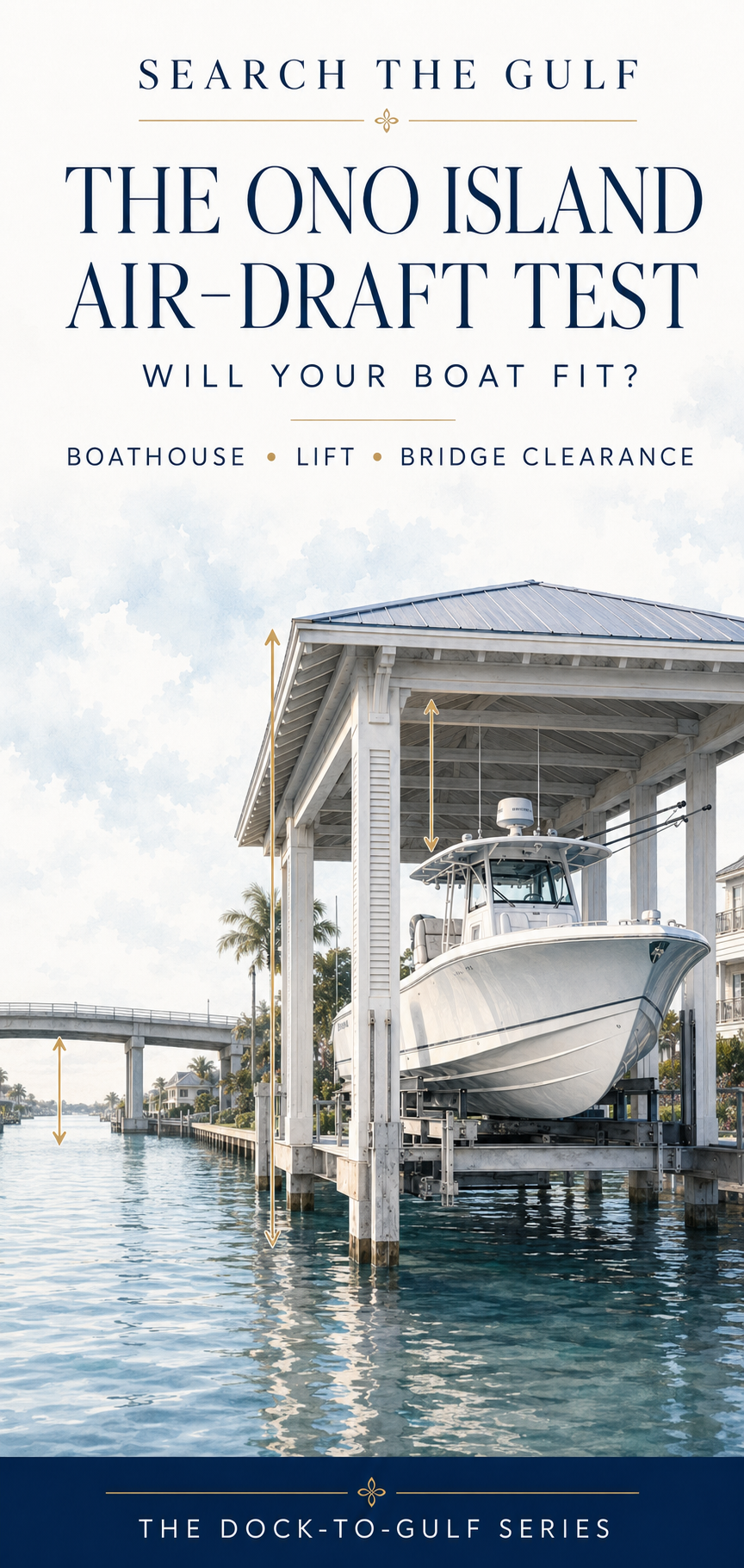
When buyers begin evaluating an Ono Island waterfront home for a particular boat, the first questions usually concern water depth, boat length, beam and lift capacity.
Those measurements are important, but they do not tell the entire story.
A vessel can have sufficient water beneath its hull, plenty of room between the pilings and a lift capable of carrying its fully loaded weight—and still be incompatible with the property.
The issue may be above the boat rather than below it.
Hardtops, radar, antennas, outriggers, light bars, upper stations and towers all contribute to a vessel’s height above the waterline. That measurement is known as air draft.
Air draft affects more than bridge passage. It can determine whether the boat fits beneath the boathouse roof, whether it can be raised fully on the lift and whether the complete route from the dock to open water is navigable.
As an Ono Island homeowner and Gulf Coast real estate advisor, I believe vertical clearance deserves its own waterfront evaluation. I call it the Ono Island Air-Draft Test.
“A boat must fit vertically while floating, while resting on the lift and while traveling along the entire route.”
The Air-Draft Test is a natural companion to my Ono Island Dock-to-Gulf Test, Ono Island Return-Trip Test and Ono Island Canals collection.
Together, these frameworks evaluate the complete relationship among the home, boat, lift, boathouse, waterway and route to the Gulf.
The Air-Draft Question
Does the vessel fit beneath the roof, rise safely on the lift and clear every fixed obstruction between the property and open water?
What Is Boat Air Draft?
Boat draft and boat air draft measure two very different things.
Below the Waterline
Boat Draft
The vertical distance between the waterline and the vessel’s lowest underwater point, including applicable running gear.
Above the Waterline
Boat Air Draft
The vertical distance between the waterline and the vessel’s highest fixed or operating point.
Depending upon the vessel, the highest point may be the hardtop, radar, anchor light, antenna, outrigger, upper helm, flybridge or tuna tower.
The measurement may also change depending upon whether antennas and outriggers are raised, lowered or folded.
Equipment That Can Affect Air Draft
- T-tops and hardtops
- Open-array radar and radar domes
- VHF and GPS antennas
- Satellite and communications equipment
- Anchor and navigation lights
- Light bars and spotlights
- Outriggers
- Upper stations and flybridges
- Tuna towers
- Canvas and enclosures
Why Air Draft Matters in Waterfront Real Estate
A waterfront property may offer excellent depth, a beautiful covered boathouse and a substantial lift. Those features do not necessarily establish compatibility with a specific vessel.
The vertical restriction may be:
- The lowest section of roof framing
- An overhead lift beam
- The height of the boat in its raised position
- A fixed bridge near the property
- The main route between the home and larger water
- A bridge that becomes restrictive during higher water
This is why I do not evaluate a luxury boating property by looking at the dock in isolation. I want to understand the complete vertical route—from the bottom of the lift cradle to the highest obstruction between the property and the intended boating destination.
“Deep water does not automatically mean unrestricted boating access. The route must work above the waterline as well as below it.”
The Three Vertical Measurements
I organize the Ono Island Air-Draft Test around three separate measurements. Each one answers a different part of the boat-to-property fit.
The Vessel’s True Air Draft
The first measurement is the vertical distance from the waterline to the highest point of the vessel.
I would identify both the vessel’s fixed air draft and its operating air draft. An antenna may fold for storage, but an upper station or hardtop may remain fixed.
The boat manufacturer’s specifications provide a useful starting point, but they may not include equipment added after delivery.
Confirm the Actual Boat
- Factory hardtop height
- Aftermarket radar installation
- Antenna mounting brackets
- Light bars and spotlights
- Raised and folded outrigger positions
- Upper-station controls and seating
- Any future equipment additions
The Boat’s Height in the Lifted Position
A boat may enter the boathouse comfortably while floating and become too tall as the lift raises it toward the roof.
The vessel’s stored height depends upon the lift’s cradle, bunk height, normal lifting position and the amount of clearance desired between the hull and water.
The critical measurement is not simply water to roof. It is the relationship among the water level, cradle, bunks, hull, hardtop and lowest roof framing when the boat is fully stored.
The Lifted-Height Relationship
Boat height + cradle and bunk position + lift travel + water-level variation + clearance allowance
The Route to Open Water
The third measurement extends beyond the property.
Every fixed bridge and overhead restriction along the intended boating route should be identified. The route should be evaluated using the boat’s actual operating height and appropriately conservative water-level assumptions.
This is particularly important for vessels with towers, flybridges, upper stations, tall radar equipment or fixed outriggers.
My guide to Ono Island waterfront homes on Ole River discusses why the Ono Island bridge is an important route consideration for certain vessels.

The Boathouse Roof-Clearance Test
A boathouse opening should provide comfortable working clearance rather than a narrowly measured fit.
The lowest structural point may not be the roof edge. Crossbeams, lift motors, cables, lighting, fans or other equipment may extend below the principal roof framing.
What I Would Measure
- Water surface to the lowest roof framing
- Water surface to lift beams and motors
- Waterline to the top of the boat’s hardtop
- Waterline to radar and fixed antennas
- Outrigger height in stored and operating positions
- Cradle and bunk height
- Maximum lift travel
- Normal storage position above the water
- Clearance during higher water
- Space needed to service roof-mounted equipment
Why Floating Clearance Is Not Enough
During a showing, the boat may be floating beneath the roof or resting unusually low on the lift. That single observation does not confirm adequate storage clearance.
I want to know how high the boat is normally raised, whether the hull remains above ordinary water exposure and how much space remains between the highest equipment and lowest structural obstruction.
Water-Level Variation Matters
Higher water reduces the space between the waterline and boathouse roof. Wind, weather and other conditions can affect local water levels beyond an ordinary tide prediction.
A comfortable fit under one set of conditions should not be assumed to establish year-round clearance.
How Air-Draft Concerns Change by Vessel Type
| Vessel Type | Vertical Features to Measure | Property Consideration |
|---|---|---|
| Bay boat | Console, windshield, Bimini and anchor light | May work in lower-profile boathouses and bridge-restricted routes |
| Center console | T-top, radar, antennas, outriggers and light bar | Confirm roof height in the fully lifted position |
| Power catamaran | Wide hardtop, antennas, radar and optional tower | Both vertical clearance and slip width become critical |
| Express cruiser | Radar arch, canvas and fixed superstructure | May require open dockage rather than a low covered lift |
| Sportfishing yacht | Flybridge, upper station, tower, antennas and outriggers | Bridge-free access and open deep-water dockage may be priorities |
| Sailboat | Mast, rigging and instruments | Fixed bridges may determine whether the property is viable |
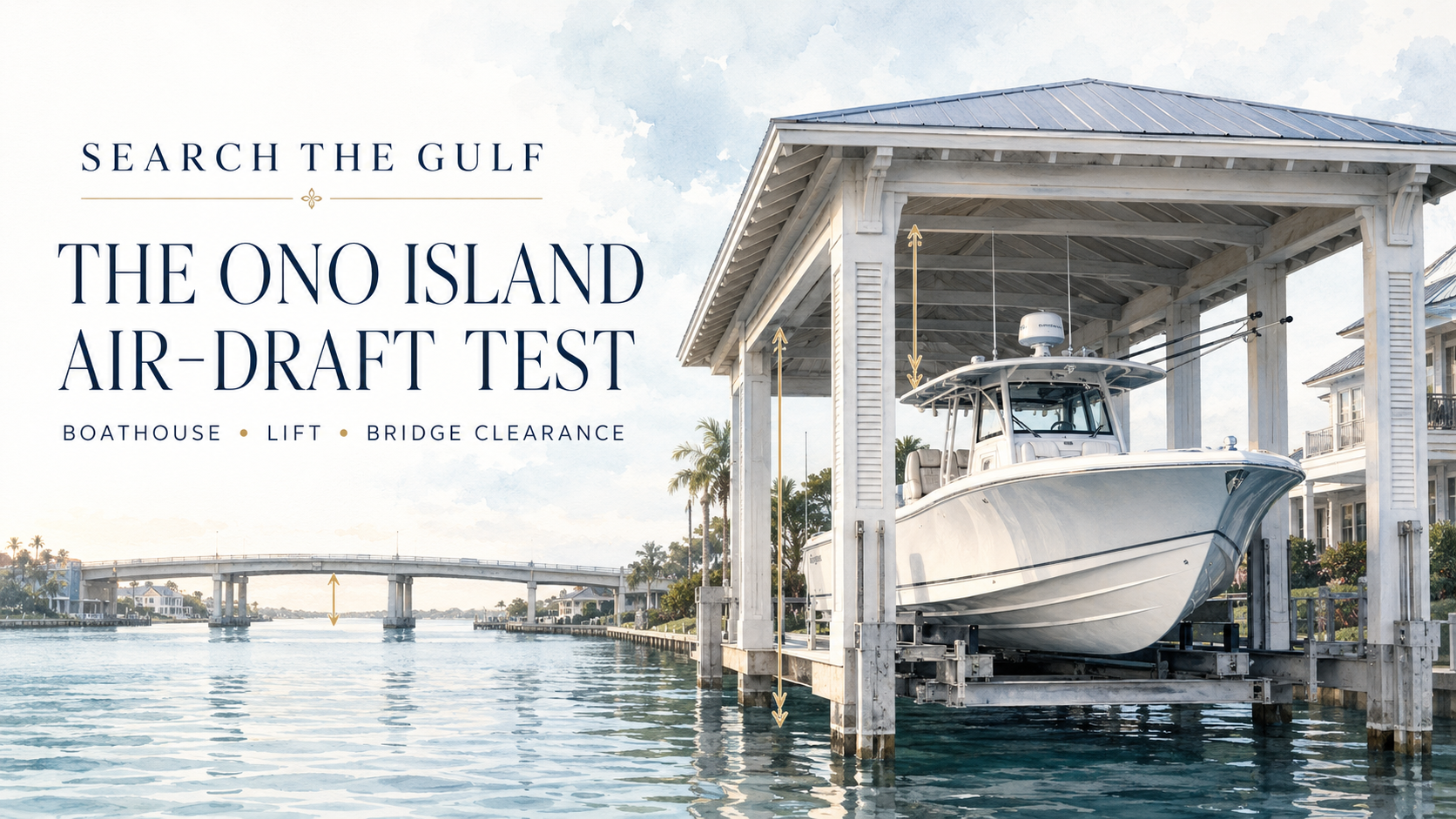
When a Tower Changes the Property Search
A tuna tower, upper station or enclosed flybridge can materially narrow the number of suitable waterfront properties.
The vessel may need a route that avoids fixed bridges entirely. Open dockage may be more practical than a covered boathouse, and deep water may need to extend through the entire approach rather than only at the dock.
For these vessels, I would pay particular attention to Bayou St. John homes and land, Intracoastal Waterway properties and Ono Island big-water homes.
A Route Issue Cannot Always Be Solved at the Dock
Raising a boathouse roof may solve storage clearance. It does not solve a fixed bridge located between the property and open water.
Designing a Boathouse for a Tall Center Console
When a new boathouse is being considered, vessel-specific planning should begin before roof height, lift position and piling placement are finalized.
A well-designed marine structure may incorporate:
- Higher clear-span roof framing
- Open gable ends
- Strategic lift-beam placement
- Adequate width for a large T-top or catamaran
- Folding antenna and outrigger systems
- Full-length side walkways
- Lift controls positioned for clear visibility
- Freshwater washdown and protected electrical service
- Capacity based upon the vessel’s fully loaded weight
- Space for future equipment additions
Marine-construction plans should also be evaluated for permitting, community approval, waterward projection, engineering and site-specific conditions.
My Four-Post vs. Elevator Boat Lifts guide explains how lift structure, water depth, vessel weight and dock configuration influence the marine-construction decision.
Air Draft on an Ono Island Canal
An Ono Island canal property may provide protected water, convenient private dockage and direct access to a larger waterway. The route still needs to be evaluated for vertical restrictions.
Some canal locations may allow a low-profile bay boat, skiff or center console to pass comfortably while restricting a taller vessel with fixed radar, a tower or upper station.
Canal suitability should be verified at the individual property. A street name or generalized description does not establish the clearance along every possible route.
Canal Air-Draft Questions
- Is there a fixed bridge between the property and larger water?
- What is the boat’s actual operating height?
- How does higher water affect available clearance?
- Can antennas and outriggers be lowered safely?
- Does the boat also fit the canal’s depth and turning room?
- Would future marine equipment change the fit?
Explore my Ono Island Canals collection and Ono Island canal-front property guide for additional information.
Air Draft on Big Water
A big-water property may provide a more direct route for a tall vessel, particularly when the dock connects to a navigation route without a restrictive fixed bridge.
Big-water suitability still requires more than vertical clearance. Depth, wind, wake exposure, piling strength, dock orientation, vessel movement and shore-power requirements may become more important.
Bayou St. John
Big-water dockage may suit larger vessels, subject to property-specific depth, approach and marine improvements.
Ole River
Beautiful southern waterfront settings require evaluation of bridge clearance, wake, depth and route.
Intracoastal Waterway
Direct connection to a major navigation corridor can be compelling for large vessels, with traffic and wake becoming part of the analysis.
The Ono Island Air-Draft Checklist
| Category | What I Would Verify |
|---|---|
| Vessel | Make, model, year, length, beam and actual equipment |
| Fixed air draft | Waterline to the highest non-folding point |
| Operating air draft | Height with antennas, outriggers and equipment deployed |
| Boathouse opening | Water surface to the lowest framing or equipment |
| Lifted height | Highest point of the vessel in its normal stored position |
| Lift configuration | Cradle, bunks, beams, motors and maximum travel |
| Water levels | Effect of tides, wind, weather and higher-water conditions |
| Route | Every fixed bridge and overhead restriction |
| Future equipment | Possible radar, antenna, light-bar or tower additions |
| Modification options | Engineering, permits, community approval and construction feasibility |
Conducting a Vertical Dock Trial
A sea trial explains how a boat performs. A dock trial explains whether it fits the property. A vertical dock trial adds the final dimension.
The Vertical Dock-Trial Sequence
- Bring the actual vessel—or one with identical dimensions—to the property when practical.
- Enter the slip while the boat is floating.
- Confirm side, engine and roof clearance.
- Lower antennas and outriggers as required.
- Position the hull correctly over the bunks.
- Raise the lift slowly while observing the hardtop and equipment.
- Confirm clearance in the normal storage position.
- Consider the effect of higher water.
- Verify the complete route to larger water.
- Document the measurements for future reference.
This type of practical evaluation can reveal conflicts that are difficult to identify from a listing description, survey or photograph.
Why the Air-Draft Story Matters to Sellers
Owners often know the property’s vertical fit better than anyone. They know how high the boat can be raised, which antennas must be lowered, how the roof relates to the hardtop and what vessels have used the route successfully.
Those details can become valuable marketing information when they are documented accurately.
Vertical-Clearance Details Worth Documenting
- Boathouse opening height
- Lowest roof-framing measurement
- Lift capacity and maximum travel
- Normal raised storage position
- Vessels that have used the setup
- Radar, antenna and outrigger clearance
- Fixed bridges along the route
- Recent roof, lift or marine-construction work
- Permits and construction records
- Potential modification options
A buyer may not recognize the value of a tall clear-span boathouse, unrestricted route or open deep-water dockage from photographs alone. The vertical-clearance story deserves to be explained as thoughtfully as the architecture and waterfront view.
Frequently Asked Questions
What is boat air draft?
Air draft is the vertical distance between the waterline and the highest point of a vessel. That point may be a hardtop, radar, antenna, tower, flybridge or other fixed equipment.
Why can a boat fit while floating but not fit on the lift?
As the cradle rises, the entire vessel moves closer to the boathouse roof. The hardtop, radar or antennas may contact roof framing before the hull reaches its intended storage height.
Do folding antennas solve the air-draft issue?
Folding antennas may reduce storage or bridge-passage height, but every fixed component should still be measured. Radar, hardtops, towers and upper stations may remain the controlling points.
Does bridge clearance remain the same?
Available vertical clearance can change with water level. Verify current bridge information, the applicable measuring reference, local conditions and the vessel’s actual air draft before relying upon a route.
Can a boathouse roof be raised?
It may be possible in some situations, but feasibility depends upon the existing structure, engineering, permits, community approvals, waterward dimensions and site conditions. A qualified marine contractor should evaluate the property.
Should I bring my boat to the property before buying?
When practical and appropriately arranged, a vessel-specific dock trial can provide valuable information about the approach, slip fit, water depth, lift compatibility and vertical clearance. Independent professional verification remains important.
Where can I search Ono Island waterfront homes?
Search The Gulf is the Gulf Coast’s premier website for searching coastal real estate listings, including Ono Island canal homes, big-water properties, homes with boat lifts and vacant waterfront land.
My Search The Gulf Take
The most valuable boathouse is not necessarily the largest or most elaborate. It is the one that works with the owner’s actual vessel and boating routine.
A sophisticated marine setup may include a tall clear-span roof, appropriately rated lift, full-length walkways, protected electrical service, freshwater washdown, thoughtful lighting and an unrestricted route to larger water.
When I evaluate a property, I want to know whether the vertical relationship works from beginning to end:
- Will the boat enter the slip?
- Can it be raised to the proper storage height?
- Will the highest equipment clear the roof?
- Can the vessel pass beneath every bridge?
- Will the setup continue to work if equipment is added?
“Luxury waterfront real estate is not defined only by the view. It is also defined by how intelligently the property connects the owner to the water.”
The Ono Island Air-Draft Test adds the vertical dimension to waterfront due diligence. It helps determine whether the home, boathouse, lift, route and vessel truly operate as one connected system.
Explore more local boating and real estate guidance through Ono Island Waterfront Architecture and Boating Access, Ono Island Canals and Ono Island Big-Water Homes and Land.
Search The Gulf With Meredith
Understanding Gulf Coast Real Estate. Local Knowledge. Better Decisions.
Call or Text Meredith on her direct line. 970/389.2905
Email meredith@searchthegulf.com and explore Ono Island homes, land and waterfront real estate at www.searchthegulf.com.
Important: Meredith is a licensed real estate advisor in Alabama and Florida, a full-time Gulf Coast real estate professional with more than 20 years of experience, and an Ono Island homeowner. This article provides general information only. Boat specifications, air draft, bridge clearance, water depth, water levels, navigation, lift capacity, boathouse dimensions, measurements, permits, regulations, marine structures and property suitability should be independently verified. Consult qualified captains, marine contractors, engineers, surveyors, manufacturers, permitting authorities and other appropriate professionals before purchasing, modifying or relying upon waterfront improvements. Conditions and requirements may change.
Ono Island
Storm Prep on Ono Island — Watching Tropical Weather for Friday
A tropical system could reach the coast this Friday. Nothing is locked in yet—and on Ono, we do not wait for a last-minute scramble.
When it comes to finding the home of your dreams in a fast-paced market, knowing about new listings as soon as they are available is part of our competitive advantage.Sign up to see new listings in an area or specific community. Contact Meredith with any questions you may have._(800_x_150_px).gif)

.gif)

Storm Prep on Ono Island — Watching Tropical Weather for Friday | Search The Gulf
Ono Landing Launch vs Dock
On this page
Watching Friday’s weather
Boat launch…
Long Bayou Preserve Orange Beach: New Site Plan & Update
Ask A Question or Sign Up To See New Real Estate Listings Before Your Competition
```
Posted by Meredith Folger Amon onEnjoy this blog post? Click here to subscribe for updates
Leave A Comment