Search The Gulf | Ono Island Waterfront Living
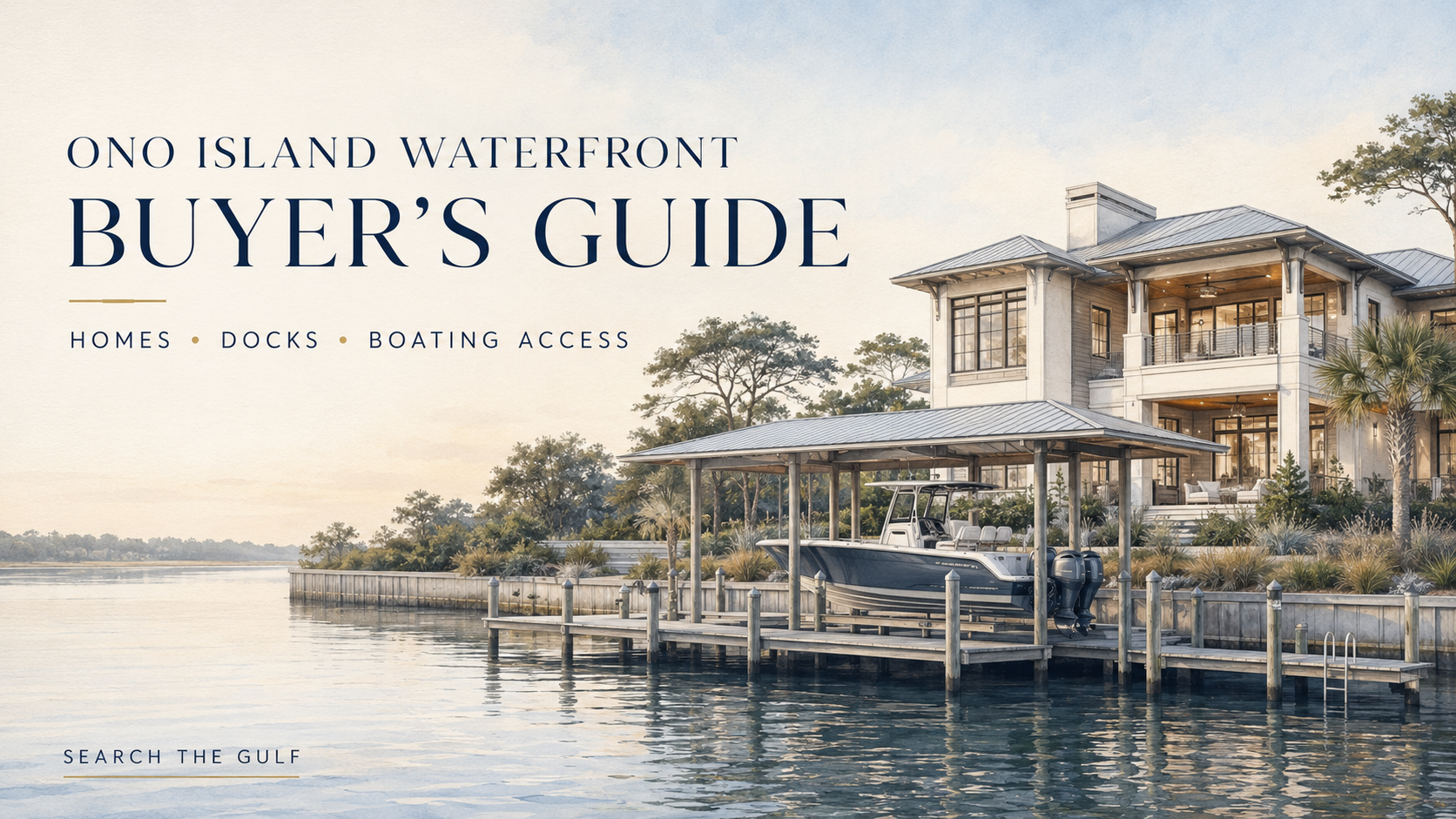
The Ono Island Waterfront Buyer’s Guide
How to evaluate the home, dock, boat lift, water depth, navigation route, flood considerations and long-term responsibilities before purchasing waterfront property on Ono Island.
_(800_x_150_px)_(2).gif)
Buying a waterfront home on Ono Island is about much more than selecting a beautiful house. The property must also support the way you plan to live on the water.
A home may have an impressive dock, wide canal view and inviting outdoor living area, but buyers still need to ask important questions. Is the water deep enough for the boat? Does the existing lift have sufficient capacity? Are there navigation or clearance concerns? What condition are the dock, pilings, electrical service and seawall in?
As an Ono Island homeowner and Gulf Coast real estate advisor, I believe these details should be evaluated early—not discovered after closing. My goal is to help buyers compare the property and its waterfront improvements as carefully as they compare the bedrooms, finishes and floor plan.
“The right waterfront property is not simply a home with a dock. It is a property where the house, shoreline, boating access and ownership responsibilities work together.”
Begin with the Way You Plan to Use the Water
Before evaluating individual homes, define your boating and waterfront priorities. Two buyers may admire the same property but need entirely different things from it.
Everyday Boating
Will you take short sunset cruises, visit waterfront restaurants, fish in the bays or travel regularly through Perdido Pass?
Your Boat
Consider its length, beam, draft, height, wet weight and the manufacturer’s recommended lift capacity.
Future Plans
If a larger boat may be in your future, evaluate the property for the boat you expect to own—not only the boat you have today.
Waterfront Lifestyle
Determine whether you want space for kayaks, paddleboards, Jet Skis, fishing equipment, a pool, outdoor entertaining or more than one vessel.
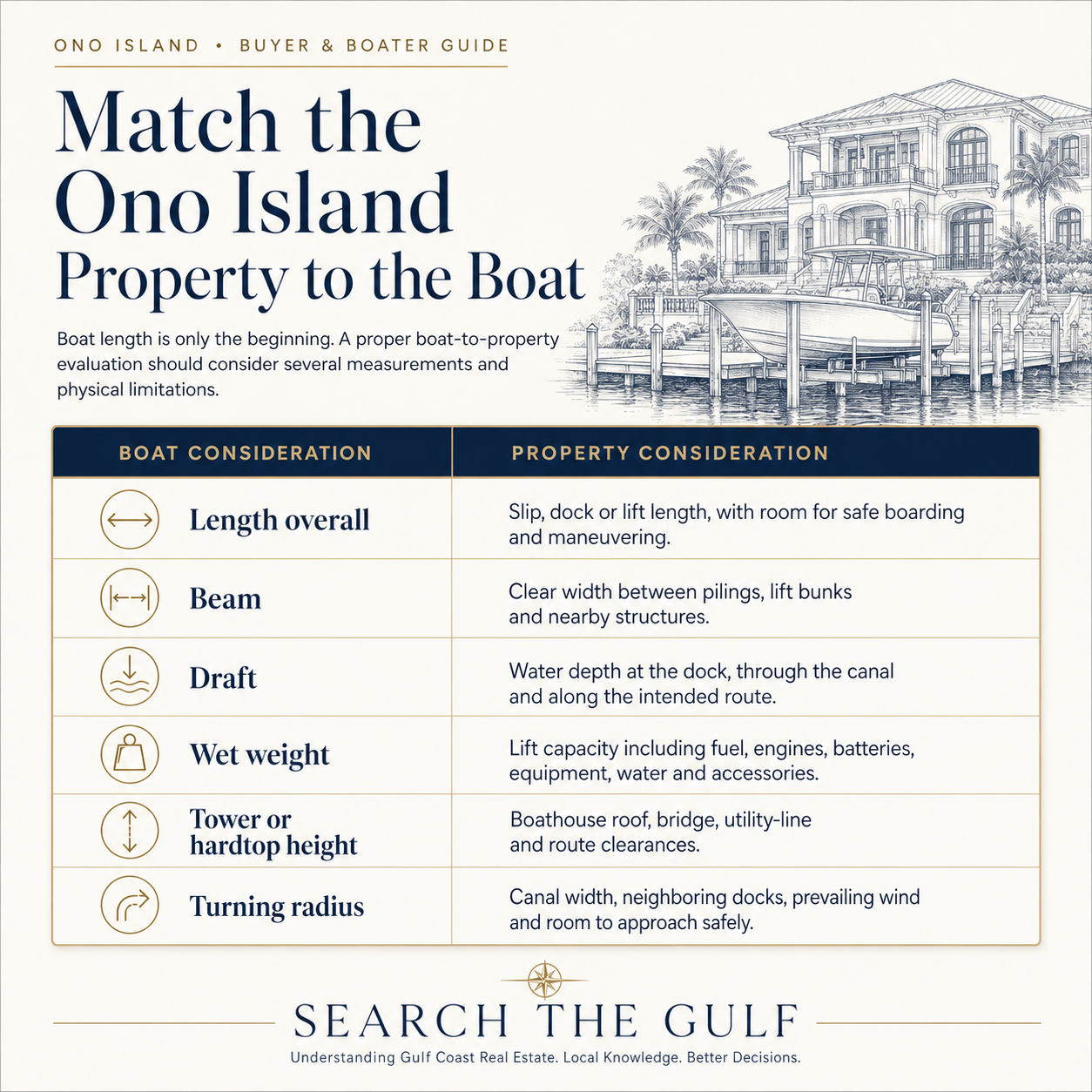
Match the Property to the Boat
Boat length is only the beginning. A proper boat-to-property evaluation should consider several measurements and physical limitations.
| Boat consideration | Property consideration |
|---|---|
| Length overall | Available slip, dock or lift length, including room for safe boarding and maneuvering. |
| Beam | Clear width between pilings, lift bunks and nearby structures. |
| Draft | Water depth at the dock, through the canal and along the intended navigation route. |
| Wet weight | Lift capacity after accounting for fuel, engines, batteries, equipment, water and accessories. |
| Tower or hardtop height | Roof, boathouse, bridge, utility-line and route clearances. |
| Turning radius | Canal width, neighboring docks, prevailing wind and room to approach the lift safely. |
My Practical Recommendation
Bring the exact boat make, model and specifications into the property search. If the boat is an essential part of the purchase, I recommend confirming the measurements rather than estimating from listing photographs or relying only on a stated lift capacity.
Understand the Different Waterfront Settings
Ono Island includes several waterfront environments. Conditions can differ from one property to another, even when two homes appear close together on a map.
Canal-Front Properties
Canal-front homes can provide protected water, convenient boat storage and a more intimate waterfront setting. Buyers should investigate canal width, water depth, turning room, shoaling, dredging history and the route from the property to larger water.
Bayou St. John and Larger-Water Settings
Larger-water properties may appeal to buyers seeking broader views and more direct boating access. They may also experience greater exposure to wind, waves, wakes and shoreline wear. Dock construction, lift design and seawall condition can be especially important.
Old River
Old River offers a distinctive setting along the south side of the island. Buyers should evaluate the precise navigation route required by their vessel. NOAA’s current Coast Pilot notes that local knowledge is advisable in this area and identifies a fixed bridge east of Perdido Pass. Published clearances and reported depths should never replace current, vessel-specific verification.
Ono Harbour and Protected Basins
Harbour and basin settings can feel sheltered, but depth and maneuverability should still be checked at the particular dock. A generalized depth shown on an electronic chart does not establish the usable depth beside an individual property.
Explore additional waterfront listings, land and community resources through Search The Gulf , the Gulf Coast’s premier website for searching real estate listings.
Water Depth Requires Property-Specific Investigation
Water depth is one of the most frequently asked—and most easily oversimplified—questions about waterfront real estate.
Depth can be affected by:
- Tide stage at the time of measurement
- Wind direction and recent weather
- Seasonal water-level changes
- Shoaling and sediment movement
- Dredging history
- Distance from the seawall
- The location of the lift or end of the dock
- The route between the property and marked channels
NOAA describes Perdido Bay as having varying depths and notes shoaling in portions of the local navigation system. It also advises caution near Perdido Pass, where conditions and submerged hazards require attention. These broader references are helpful for orientation, but they do not confirm the depth at an individual home.
How Buyers Can Investigate Water Depth
- Review current NOAA charts and Coast Pilot information.
- Check tide predictions for the relevant date and time.
- Ask when and how any stated depth was measured.
- Measure depth at several points around the dock or lift.
- Consider visiting at a lower-tide condition.
- Review the entire route, not merely the water beside the house.
- Consult an experienced local captain, marine contractor or other qualified professional when the vessel fit is critical.
Inspect the Dock, Boathouse and Boat Lift
Waterfront structures deserve specialized attention. A visually attractive dock can still have aging pilings, corroded hardware, outdated electrical components or lift equipment that is poorly matched to the buyer’s boat.
Dock and Boathouse Questions
- Are the pilings plumb, stable and free from significant deterioration?
- Are deck boards, joists, stringers and fasteners in good condition?
- Is there visible rust, movement, rot or storm damage?
- Does the structure appear consistent with available permits and surveys?
- Is the electrical system suitable for a wet marine environment?
- Are ladders, railings, lighting and walking surfaces safe?
- Does the roof provide adequate height for the boat and lift?
- Is there room for safe fueling, loading and boarding?
Boat-Lift Questions
- What is the manufacturer and rated lift capacity?
- Is the capacity appropriate for the boat’s fully loaded weight?
- How old are the motors, cables, pulleys, bunks and control system?
- Is the lift configured correctly for the hull?
- Is there corrosion or uneven movement?
- Are service records or installation documents available?
- Could the lift be modified, or would replacement be necessary?
Buyers should not assume that a lift advertised with a property will fit every boat within a particular length range. Hull design, beam, engine configuration, weight distribution and total operating weight all matter.
Evaluate the Seawall and Shoreline
The seawall or bulkhead protects one of the property’s most valuable boundaries. Warning signs do not automatically mean failure, but they deserve further investigation.
Conditions to look for include:
- Cracks, leaning or misaligned wall sections
- Soil loss or voids behind the wall
- Sinkholes or settling near the shoreline
- Rust staining or exposed reinforcement
- Failed joints, caps, anchors or tiebacks
- Erosion around the ends of the wall
- Drainage problems or standing water
- Recent patches without supporting repair documentation
When questions arise, a qualified marine contractor, engineer or other appropriate specialist can provide a more informed assessment. Obtain written proposals when possible so the condition can be considered during the inspection and negotiation period.
Review Surveys, Permits and Waterfront Rights
A dock, lift, boathouse or boat ramp already present at the property should not automatically be assumed to be permitted, transferable or replaceable in its current configuration.
Important questions include:
- Does the survey show the seawall and waterfront improvements?
- Are permits or approvals available for the dock and boathouse?
- Were later additions made after the original approval?
- Are encroachments or shared structures present?
- What maintenance obligations attach to the property?
- Could the existing improvement be repaired or reconstructed?
- Would a proposed new lift or boathouse require additional approval?
Current requirements should be confirmed with the relevant governmental authorities, property association and qualified professionals before a buyer relies on a proposed waterfront improvement.
Flood Zones, Elevation and Insurance
Flood-zone information is part of the evaluation, but the zone designation is not the only consideration. Buyers should also examine the home’s elevation, foundation, enclosure, mechanical equipment and prior documentation.
FEMA identifies its Flood Map Service Center as the official public source for National Flood Insurance Program flood hazard information. FEMA also explains that an Elevation Certificate may document elevation information used for floodplain compliance and insurance purposes.
Documents and Information to Request
- Current survey
- Elevation Certificate, if available
- Flood-zone information for the specific parcel
- Available flood-insurance information
- Wind-insurance information
- Roof age and Fortified designation documents
- Claims or loss information when legally available and applicable
- Details about enclosed areas below elevated living space
- Location and elevation of mechanical and electrical equipment
Insurance availability and cost can affect the ownership budget, so I recommend obtaining property-specific insurance guidance during the contingency period rather than relying on estimates from another home.
Consider the House Beyond the Waterfront
A waterfront purchase still needs to work as a home. I encourage buyers to consider how the property accommodates both everyday life and the equipment associated with coastal living.
- Garage depth and vehicle capacity
- Golf-cart parking and charging
- Boat-trailer storage options and applicable restrictions
- Fishing and boating-equipment storage
- Outdoor shower or cleanup areas
- Pool, spa and outdoor-kitchen condition
- Storm-shutter or impact-opening protection
- Roof, drainage and exterior material condition
- Guest accommodations and entertaining space
- Ability to monitor and maintain the property remotely
Understand Ono Island Community Considerations
Buyers should review current community documents, fees, architectural requirements and use restrictions before purchasing. Do not rely solely on an old listing description or a prior owner’s recollection.
Items to confirm include:
- Property-owner association dues and transfer-related charges
- Architectural and waterfront-improvement approval processes
- New-construction and renovation requirements
- Rental restrictions
- Gate access for owners, guests and contractors
- Vehicle, trailer and golf-cart rules
- Contractor access and working hours
- Optional recreation or neighborhood amenities
- Rules affecting fences, landscaping and accessory structures
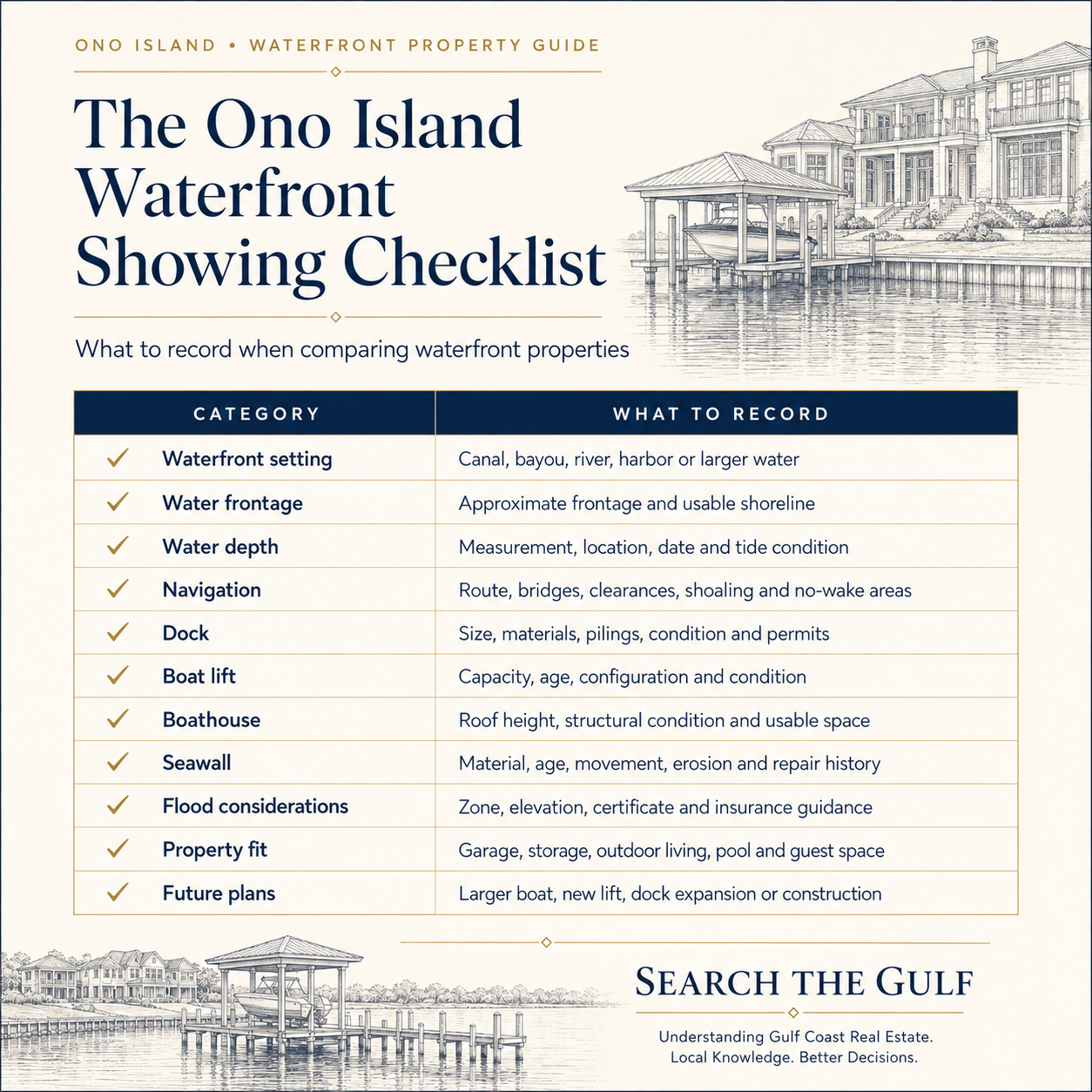
The Ono Island Waterfront Showing Checklist
This condensed checklist can be used when comparing properties:
| Category | What to record |
|---|---|
| Waterfront setting | Canal, bayou, river, harbour or larger water |
| Water frontage | Approximate frontage and usable shoreline |
| Water depth | Measurement, location, date and tide condition |
| Navigation | Route, bridges, clearances, shoaling and no-wake areas |
| Dock | Size, materials, pilings, condition and permits |
| Boat lift | Capacity, age, configuration and condition |
| Boathouse | Roof height, structural condition and usable space |
| Seawall | Material, age, movement, erosion and repair history |
| Flood considerations | Zone, elevation, certificate and insurance guidance |
| Property fit | Garage, storage, outdoor living, pool and guest space |
| Future plans | Larger boat, new lift, dock expansion or construction |
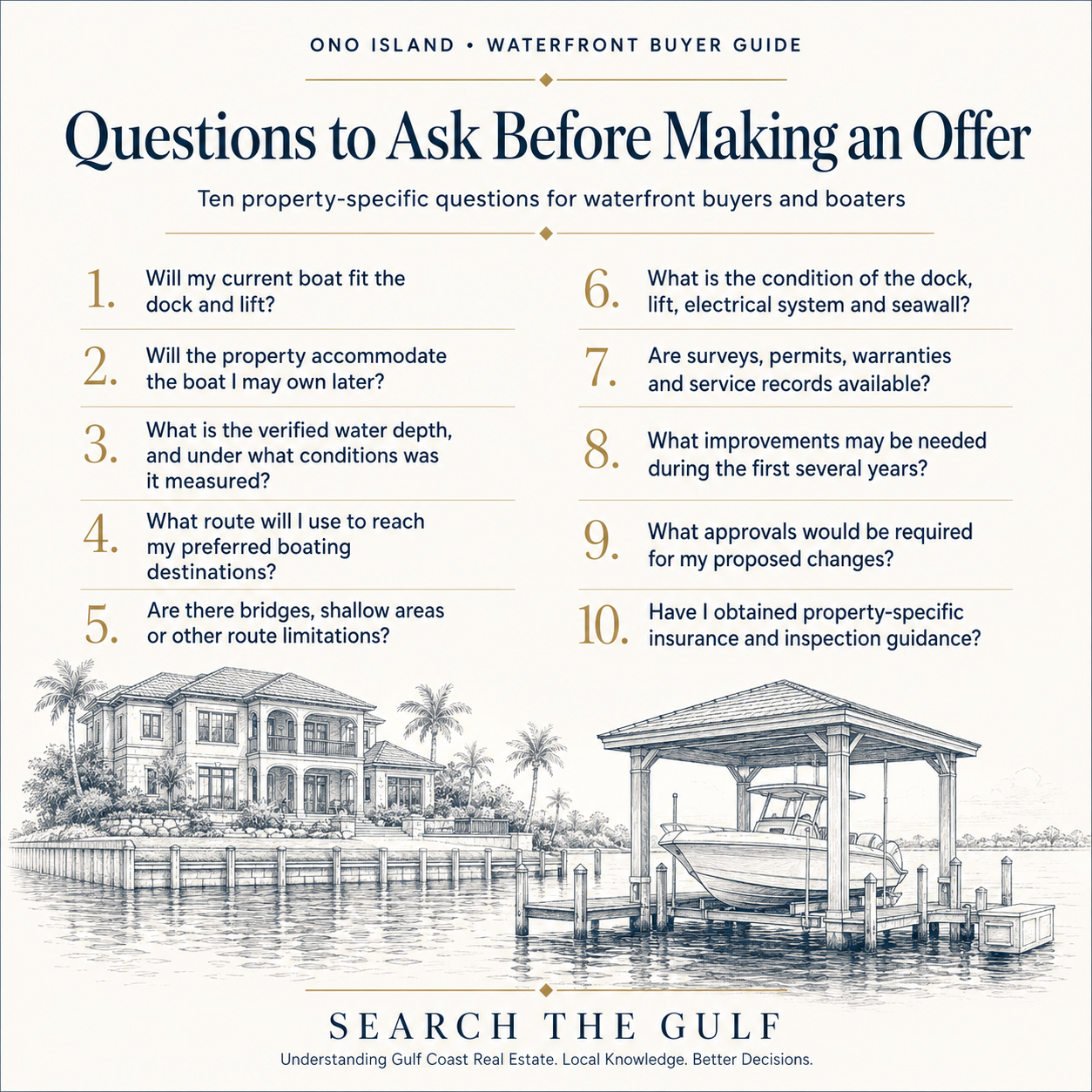
Questions to Ask Before Making an Offer
- Will my current boat fit the dock and lift?
- Will the property accommodate the boat I may own later?
- What is the verified water depth, and under what conditions was it measured?
- What route will I use to reach my preferred boating destinations?
- Are there bridges, shallow areas or other route limitations?
- What is the condition of the dock, lift, electrical system and seawall?
- Are surveys, permits, warranties and service records available?
- What improvements may be needed during the first several years?
- What approvals would be required for my proposed changes?
- Have I obtained property-specific insurance and inspection guidance?
My Search The Gulf Perspective
Some of the most important aspects of an Ono Island property are not obvious in listing photographs. The angle of the dock, the width between the pilings, the condition behind the seawall and the boating route beyond the canal may have a meaningful effect on how well the property fits a buyer.
I enjoy helping buyers examine those details. When possible, I like to begin with the boat specifications and lifestyle goals, then identify properties that deserve a closer look.
“My objective is not simply to help someone purchase a waterfront home. It is to help them understand what they are purchasing—from the front door to the end of the dock.”
Searching for an Ono Island Waterfront Property?
Send me the make, model, length, beam, draft and approximate loaded weight of your boat. I can help you identify the questions to ask as we evaluate potential Ono Island homes, docks and boating routes.
You can also explore Gulf Coast real estate through www.searchthegulf.com .
Search Ono Island Homes Request Personalized Guidance #searchthegulf #meredithamon #becausewelivehere





.gif)