
Orange Beach & Ono Island Marine Construction • Boat Lift Guide
Four-Post vs. Elevator Boat Lifts: A Marine Construction Guide for Orange Beach and Ono Island
A practical waterfront real estate guide to lift design, boat compatibility, water depth, canal width, capacity, costs, maintenance and big-water exposure.
_(800_x_150_px)_(2).gif)
Along the Orange Beach waterfront and throughout Ono Island, a properly designed boat lift can be just as important as the home itself. For a serious boater, the dock is not simply an amenity behind the property. It is where every boating day begins and where the complete return-trip sequence ends.
The right lift can make boat ownership feel effortless. The wrong lift—or one that is undersized, poorly positioned or incompatible with the vessel—can create daily frustration and expensive alterations.
Two of the most common choices for Gulf Coast waterfront properties are four-post lifts and elevator lifts. Both keep a vessel above the water when it is not in use, helping protect the hull and running gear from prolonged saltwater exposure. However, they differ significantly in structure, footprint, operation and ideal waterfront setting.
The better choice depends upon the boat, dock, water depth, canal width, bottom conditions, seawall, wind exposure and the way the owner intends to board and use the vessel.
“A boat lift should not simply hold the vessel. It should support the entire departure and return sequence.”
This guide is a natural companion to my Ono Island Dock-to-Gulf Test, Ono Island Return-Trip Test and Ono Island Canals collection. Together, these resources help buyers and owners evaluate the complete relationship among the vessel, lift, dock, waterway and property.
The Central Question
Should the boat be suspended within four pilings—or carried from the shoreline on an angled elevator system?
The Basic Difference
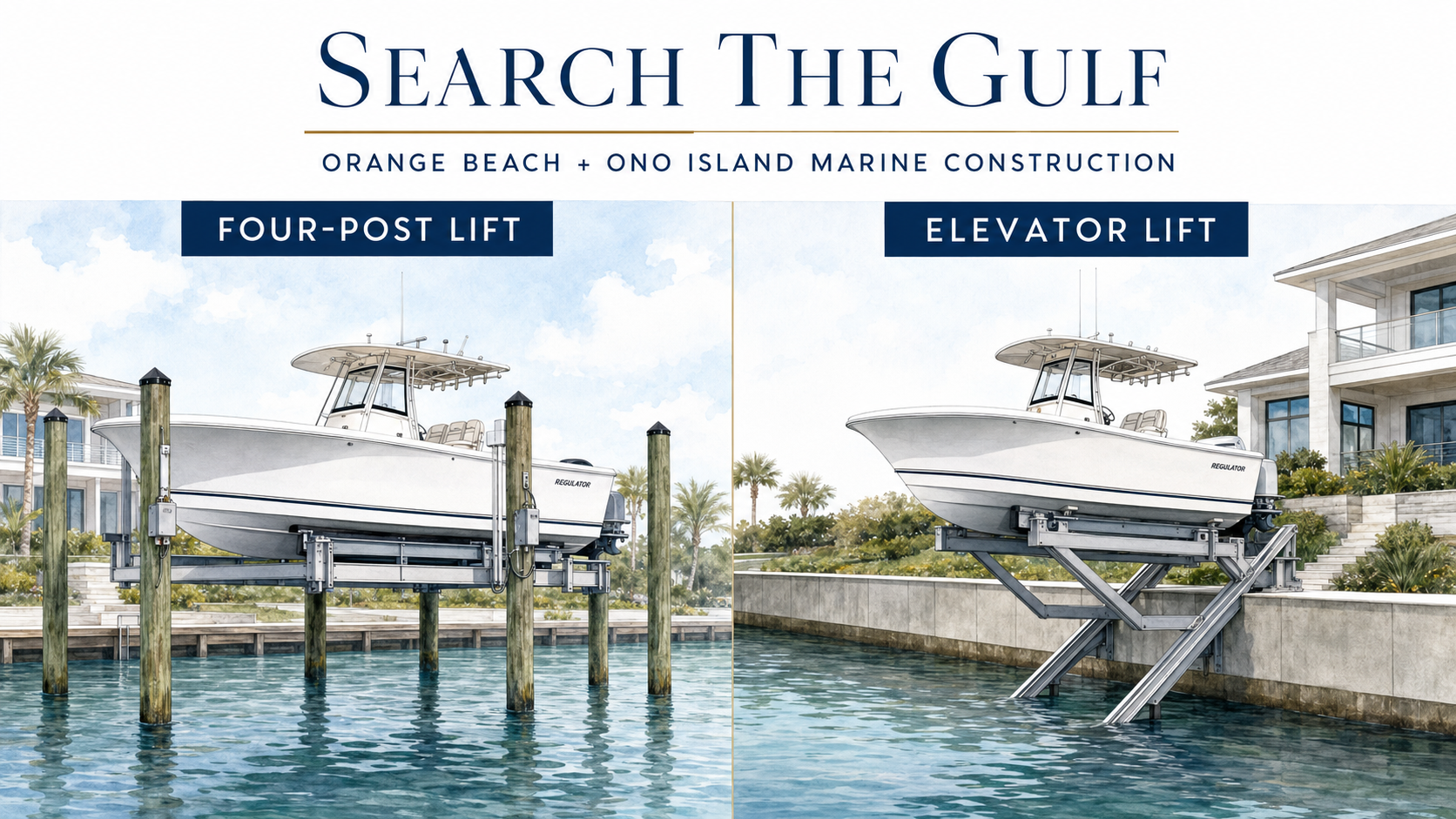
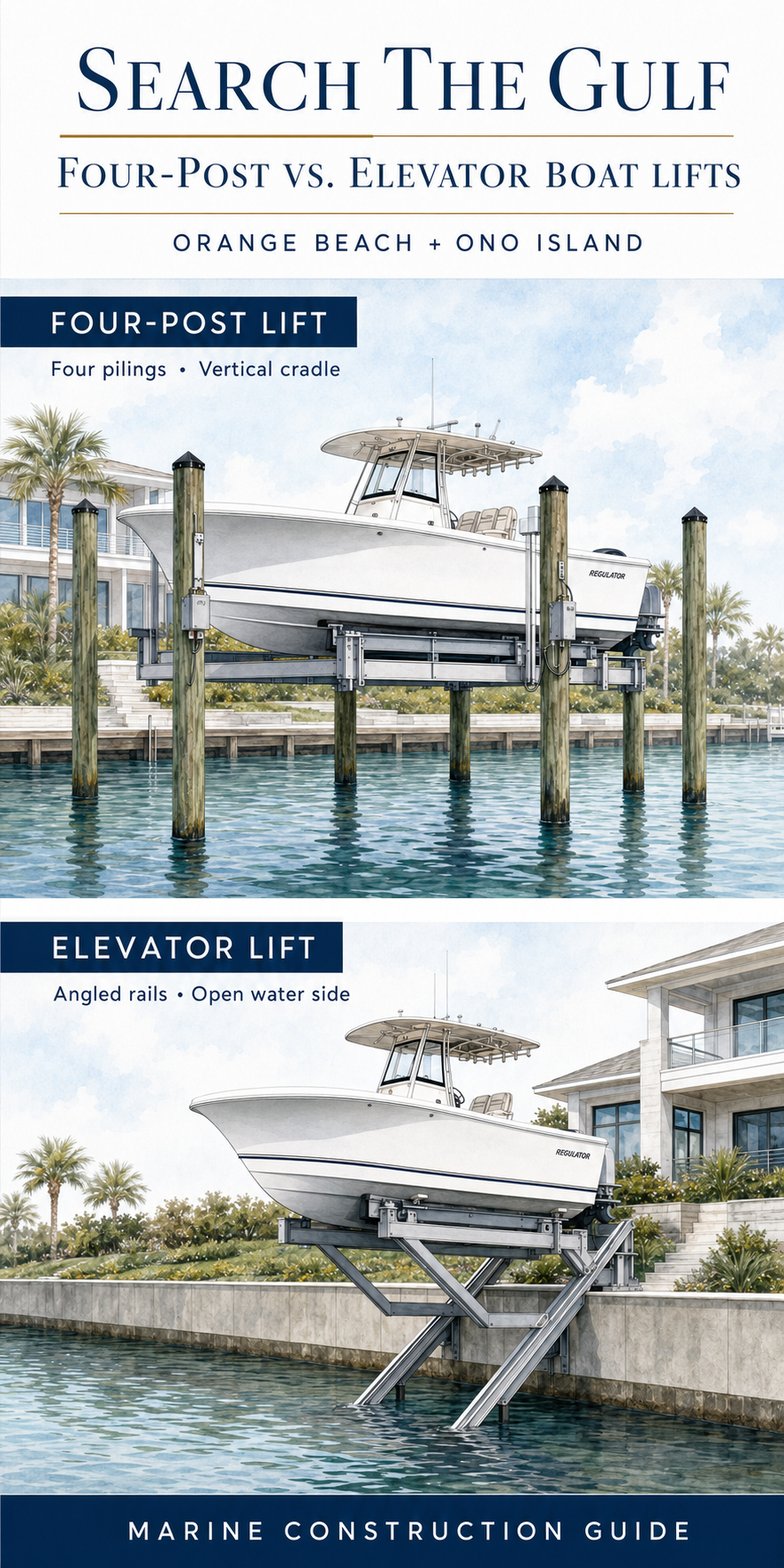
A four-post lift suspends the boat within a structural slip formed by four pilings. Cables raise and lower a cradle between those pilings.
An elevator lift carries the boat on cantilevered arms that travel along angled structural rails positioned near a seawall, shoreline or piling-supported structure.
| Feature | Four-Post Lift | Elevator Lift |
|---|---|---|
| Primary support | Four structural pilings | Angled rails and engineered shore-side support |
| Lift movement | Cradle moves primarily vertically | Cradle travels along inclined rails |
| Outside pilings | Normally required | Often eliminated |
| Water-side access | More enclosed | More open |
| Waterway footprint | Defined rectangular slip | Often more compact near the shoreline |
| Boathouse compatibility | Very common | Possible with custom planning |
| Primary structural concern | Pilings, beams, cables and alignment | Rails, foundations, tiebacks and lateral loads |
| Common application | Traditional slip or covered boathouse | Seawall or constrained waterfront |
Four-Post Lift
A Structural Slip Around the Boat
Four pilings create a defined lifting area. The vessel enters between the pilings and rests on bunks supported by a cable-driven cradle.
Elevator Lift
An Open-Sided Lift Along the Shore
Cantilevered arms carry the boat along angled rails, often preserving more open water beside and beyond the vessel.
How a Four-Post Boat Lift Works
A four-post lift uses four pilings positioned around the vessel. Structural beams, motors, cables and pulleys raise a cradle that supports the hull from below.
The pilings establish the boundaries of the slip and help guide the boat into position. Adjustable guideposts can assist with centering, particularly when wind or current affects the approach.
The cradle and bunks are configured for the hull. This makes a four-post system adaptable to center consoles, bay boats, dual consoles, catamarans, pontoons, tritoons, walkarounds, cruisers and many sportfishing boats.
Four-Post Lift Advantages
- Stable, clearly defined lifting area
- Natural compatibility with covered boathouses
- Flexible bunk configurations for different hulls
- Broad range of residential and heavy-duty capacities
- Can accommodate wide-beam and offshore vessels
- Common equipment that many Gulf Coast contractors service
- Can incorporate side walkways, storage, lighting and washdown
Stability and Structural Definition
Four pilings create a clearly defined lifting area. When properly engineered and installed, the system can provide substantial structural support for the cradle, motors and vessel.
This can be especially useful for larger center consoles, offshore boats and wide-beam catamarans that require carefully positioned hull support.
Excellent Boathouse Compatibility
Four-post lifts work naturally beneath covered boathouses. The roof can help protect upholstery, electronics and finishes from direct sun and weather while the lift keeps the hull and running gear above the water.
A thoughtfully designed boathouse may also include:
- Full-length side walkways
- Freshwater washdown
- Marine-grade electrical service
- Dock and under-roof lighting
- Secure equipment storage
- Line and fender organization
- Boarding and unloading platforms
Flexible Bunk Configuration
The cradle can be designed around the boat’s hull shape and center of gravity. This is particularly important for catamarans, pontoons and vessels with unusual strakes, steps, transducers, foils or other underwater equipment.
Four-Post Lift Disadvantages
- Requires a larger structural footprint in the water
- Exterior pilings may reduce maneuvering room
- A narrow piling opening can complicate a crosswind approach
- Upper beams and pilings may interrupt the view
- New piling installation can increase project cost
- The cradle must lower far enough for the vessel to float free
- The structure may project farther into a constrained canal
On a narrower canal, I look beyond the property’s waterfront width. I also consider the navigable channel, docks across the canal, neighboring lifts, stern swing and the space available to pause and realign before entering the slip.
How an Elevator Boat Lift Works
An elevator lift uses inclined structural rails positioned near a seawall, bulkhead, dock or piling-supported shoreline structure. Cantilevered arms travel along the rails, carrying the cradle and vessel down into the water or upward into storage.
Because the supporting structure is concentrated near the shoreline, an elevator lift can leave the outer side of the vessel comparatively open.
Elevator Lift Advantages
- May eliminate outside support pilings
- Preserves more open water beside the vessel
- Can be useful along a seawall or parallel dock
- Offers convenient side boarding and unloading
- May preserve cleaner water views
- Can work well where a traditional slip would project too far
- Operating equipment may be readily accessible from the dock
A Smaller Water-Side Footprint
An elevator system may eliminate the two outside pilings normally associated with a four-post lift. That can preserve valuable navigable space, particularly along a narrower canal.
Open Side Access
The water side of the vessel remains comparatively open, making it easier to approach, board, unload or service the boat from the dock side. This can be helpful when transferring coolers, fishing equipment, water toys or provisions.
Useful Along a Seawall
An elevator lift can work well where the dock runs parallel to a seawall and there is no natural location for a traditional four-piling slip.
Elevator Lift Disadvantages
- The shore-side structure must carry substantial loads
- A seawall may require engineering or reinforcement
- Rail length and angle are highly site-specific
- Installation may become complex on an irregular bottom
- Track and roller repairs may require specialized service
- Traditional covered-boathouse integration may be less direct
- Large or wide vessels can create significant cantilevered loads
A visually substantial seawall is not automatically strong enough to support an elevator lift. The rails, foundations, tiebacks, seawall and surrounding structure should be evaluated as one system.
“The question is not simply whether an elevator lift can raise the boat. The waterfront structure must also be able to carry the correctly engineered system.”

What Boats Work Best on Each Lift?
A four-post system is often the most versatile choice because its cradle can be configured for a broad range of vessels. Elevator systems can accommodate many of the same boats, but their suitability depends heavily upon rail design, shore-side support and site geometry.
Often Well Suited
Four-Post Lift
- Center consoles
- Bay boats
- Dual consoles
- Large offshore boats
- Catamarans
- Pontoons and tritoons
- Walkarounds and cruisers
Often Well Suited
Elevator Lift
- Flats boats
- Bay boats
- Runabouts
- Deck boats
- Dual consoles
- Smaller and mid-size center consoles
- Vessels loaded from a parallel dock
Large Center Consoles and Offshore Boats
Large center consoles may require lifts in the 20,000- to 30,000-pound class—or more—depending upon hull construction, engines, fuel capacity and installed options.
A properly engineered four-post lift is often a natural choice for a heavy offshore boat because it provides a defined piling-supported structure. A heavy-duty elevator system may also work, but its rails, foundations and shore-side structure must be designed for the vessel’s loaded weight and center of gravity.
Catamarans
Catamarans such as an Insetta, Freeman, Invincible or World Cat can work well on a properly designed four-post system. Their beam and twin hulls require:
- Adequate clear slip width
- Catamaran-specific bunk placement
- Support beneath both sponsons
- Tunnel, foil and underwater-hardware clearance
- Correct center-of-gravity positioning
- Capacity for fuel, engines and offshore equipment
An elevator system may also be designed for a catamaran, but the vessel’s beam and cantilevered load make engineering especially important.
Pontoons and Tritoons
Pontoons and tritoons require bunks or support structures designed for their tubes. Their beam may require greater piling separation than a monohull of similar length.
Understanding Boat-Lift Capacity
Lift capacity should never be selected using the boat’s dry weight alone. The complete lifting weight may include the hull, engines, fuel, water, batteries, electronics, anchors, chain, hardtop, tower, trolling motor, outriggers, safety equipment and items normally stored aboard.
Gasoline weighs approximately six pounds per gallon. A boat carrying 300 gallons can have roughly 1,800 pounds of fuel aboard. A vessel carrying more than 500 gallons may add over 3,000 pounds before water and equipment are considered.
Weight distribution matters as much as total weight. Engines, fuel tanks, towers and equipment can shift the center of gravity toward one end or side. A boat can create an uneven load even when its total weight appears to be within the lift’s nominal rating.
| Lift Class | Potential Boat Applications | Important Consideration |
|---|---|---|
| 4,500–6,000 lb. | Skiffs, flats boats and smaller bay boats | Confirm engine, fuel and equipment weight |
| 8,000–10,000 lb. | Many mid-size bay boats, runabouts and center consoles | Twin engines can change the calculation quickly |
| 12,000–16,000 lb. | Many twin-engine center consoles and larger recreational boats | Calculate maximum operating weight |
| 20,000–24,000 lb. | Large center consoles, some catamarans and offshore boats | Hull support and center of gravity become critical |
| 30,000 lb. and above | Heavy offshore boats, large catamarans and custom vessels | Custom engineering may be required |
Capacity Is Not a Boat-Length Guarantee
Two vessels of identical length can differ by thousands of pounds. The actual hull, engines, fuel, options, equipment and normal loading should be evaluated before selecting a lift.
Water-Depth Requirements
Neither lift type eliminates the need for sufficient water beneath the boat. The vessel must be able to float clear of the bunks and cradle before entering or leaving the lift.
The water-depth calculation may need to include:
- Boat draft
- Propeller and lower-unit clearance
- Cradle-beam depth
- Bunk height
- Clearance required for the vessel to float free
- Normal water-level changes
- Wind-driven low water
- Sediment, shoaling and bottom slope
- Future accumulation beneath the lift
Four-Post Water Depth
The cradle lowers vertically. If it reaches the bottom before the vessel can float free, the lift may not function properly for that boat. Shallow-water cradle designs can help in some settings.
Elevator Water Depth
The cradle travels down angled rails and may reach deeper water away from shore. Suitability depends upon rail length, angle, bottom profile and available waterward space.
An elevator lift is not automatically better in shallow water. In some settings, its cradle or rails may reach the bottom before the vessel can float. Each site should be evaluated individually.
Canal Width, Slip Width and Turning Room
A lift may fit inside the property’s permitted waterfront footprint and still be difficult to use. Canal width, neighboring structures and the vessel’s turning characteristics are part of the practical fit.
Four-Post Slip Width
A four-post system needs adequate separation between the pilings for the boat’s beam, rub rails, guideposts, lift hardware, fenders and normal side movement.
A 10-foot-wide vessel should not be placed in a 10-foot-wide opening. The captain needs practical working clearance—not a theoretical fit.
For a catamaran with a beam near 11 feet, a clear slip width of approximately 14 to 15 feet may be a reasonable starting point, subject to the exact vessel, lift design and marine contractor’s recommendations.
Elevator Lift Width
An elevator lift may preserve more open canal space because exterior support pilings can often be eliminated. The boat still needs clearance around the cradle and lifting arms, but the approach may feel less enclosed.
This can be valuable where the distance between opposing docks is already limited.
“Lift fit is not a two-dimensional measurement. It is the relationship among the vessel, the structure, the water and the approach.”
Which Lift Is Better on an Ono Island Canal?
For a larger Ono Island canal with sufficient width, depth and turning room, a four-post lift can be an excellent choice. It works naturally with a covered boathouse and can support many vessel types.
On a smaller or more constrained canal, an elevator lift may preserve navigable width by reducing exterior pilings. It can be especially useful when a vessel is stored parallel to a seawall or when a conventional slip would project too far into the waterway.
However, choosing a compact lift does not make an oversized vessel suitable for a narrow canal. The canal itself must still accommodate the boat.
My Ono Island Canal Evaluation
- Clear navigable canal width
- Distance between opposing docks
- Turning room in front of the property
- Water depth along the approach
- Slip-entry angle
- Afternoon crosswinds
- Neighboring pilings and vessels
- Boat length, beam and stern swing
- Waterward projection of the lift
- The complete return-trip sequence
Explore my Ono Island Canals collection and Ono Island Canal Owners Association guide for additional local information.
Which Lift Is Better on Big Water?
Big-water properties along Bayou St. John, Ole River or the Intracoastal Waterway introduce more wind, wake and wave exposure.
A four-post lift provides a defined piling-supported structure around the vessel. This can make it a natural choice for a heavy boat on an exposed site, provided the pilings, beams and cradle are properly engineered.
An elevator lift can also perform on exposed water, but its rail foundations, cantilevered arms, shore-side connections and seawall must be designed to accept the applicable loads.
Big-Water Engineering Considerations
- Wind exposure
- Wave and reflected-wake action
- Piling or rail embedment
- Bottom and soil conditions
- Seawall and tieback condition
- Cradle stabilization
- Cable and motor configuration
- Maximum lifting height
- Boat weight and wind profile
- Hardtop, tower and enclosure height
A large T-top, tower or enclosed helm adds wind area. That can become important when the vessel is elevated above the water.
Neither lift style should be considered hurricane protection simply because the boat is raised. Owners should follow the boat, lift, marine contractor and insurance provider’s storm-preparation requirements.
Compare waterfront settings through my guides to Ono Island big-water homes and land, Ono Island homes on Ole River, Bayou St. John properties and Ono Island Intracoastal Waterway real estate.
Approximate Boat-Lift Costs on the Gulf Coast
Boat-lift costs vary widely. The lift mechanism may represent only part of the total marine-construction project.
A complete estimate may include:
- Lift equipment
- Pilings or rail foundations
- Installation labor
- Barges and marine equipment
- Engineering and permit preparation
- Electrical service
- Dock alterations and walkways
- Roof or boathouse modifications
- Seawall reinforcement
- Custom bunks and guide systems
- Remote controls and limit switches
- Removal and disposal of an existing lift
| Lift or Project | Approximate Installed Planning Range |
|---|---|
| PWC or Jet Ski lift | $3,000–$7,500 |
| 4,000–6,000 lb. cradle lift | $8,000–$16,000 |
| 8,000–10,000 lb. cradle lift | $14,000–$26,000 |
| 12,000–16,000 lb. cradle lift | $20,000–$38,000 |
| 20,000 lb. and larger lift | $35,000–$70,000+ |
| Elevator or platform lift | $12,000–$40,000+ |
| Pier with a lift | Approximately $30,000–$60,000+ |
| Large boathouse with lift and electrical | Approximately $70,000–$150,000+ |
Planning Ranges, Not Contractor Quotes
Two properties on the same canal can produce very different estimates. Piling condition, seawall integrity, equipment access, water depth, electrical requirements and distance from shore can all affect the final price.
Read more in my Gulf Coast boat-lift cost guide and guide to building piers, docks and boathouses on Ono Island and in Orange Beach.
Boat-Lift Maintenance in Saltwater
Saltwater, humidity, sun and electrical exposure make regular maintenance essential. A lift on protected canal water may experience different loading than one located along the Intracoastal Waterway, but both require ongoing attention.
Cables & Winders
Watch for fraying, broken strands, flattening, corrosion, uneven winding and misalignment.
Bunks & Cradle
Confirm that the bunks remain secure and continue supporting the hull at the intended locations.
Motors & Gears
Listen for unusual noise, hesitation, jerky movement or uneven lifting.
Electrical System
Have waterfront controls, wiring, grounding and protective devices inspected by qualified professionals.
Pilings & Rails
Look for movement, settling, misalignment, corrosion and changes around structural connections.
Professional Service
Follow the manufacturer’s schedule and increase attention as the system ages or exposure becomes more severe.
Cable replacement should be treated as preventive maintenance—not postponed until a cable fails. Catamaran bunks also deserve particular attention because both hulls must remain correctly supported.
Permits and Approvals
Marine construction along the Alabama Gulf Coast can involve local, state, federal and community approvals.
Depending upon the property and scope of work, a project may require coordination with:
- City of Orange Beach
- Baldwin County
- U.S. Army Corps of Engineers
- Alabama Department of Environmental Management
- Alabama State Lands Division
- Ono Island Property Owners Association
- Applicable architectural or marine-review authorities
- Floodplain administrators
- Utility and electrical inspectors
An owner should not assume an existing dock footprint can automatically be enlarged or that a previous lift can be replaced with any desired configuration. Waterward projection, neighboring navigation, floodplain requirements and community restrictions may affect what can be approved.
Four-Post or Elevator: Which Is Better?
Consider a Four-Post Lift When
- The property has sufficient slip and canal width
- A covered boathouse is planned
- The boat is large, heavy or wide
- Custom catamaran or pontoon bunks are needed
- Walkways along both sides are preferred
- The approach is straight and unobstructed
- The bottom can support engineered pilings
Consider an Elevator Lift When
- Waterward space is limited
- Exterior pilings could interfere with navigation
- The dock runs parallel to the shoreline
- Open side access is important
- The site has suitable shore-side support
- Preserving sightlines is a priority
- The bottom profile suits an angled-rail system
Neither system is universally better. The correct choice is the one that has been designed around the boat, property and waterway.
My Search The Gulf Boat-Lift Checklist
| Category | What I Evaluate |
|---|---|
| Capacity | Rated capacity, loaded vessel weight and operating margin |
| Weight distribution | Engines, tanks, tower, equipment and center of gravity |
| Hull support | Bunks, sponsons, tubes, steps and underwater equipment |
| Slip fit | Beam, piling width, guides, fenders and movement |
| Water depth | Draft, cradle depth, low-water conditions and bottom profile |
| Vertical clearance | Hardtop, tower, radar, antennas and boathouse roof |
| Approach | Turning radius, wind, current, wake and neighboring structures |
| Structure | Pilings, beams, rails, seawall, tiebacks and connections |
| Return-trip support | Walkways, lighting, washdown, electrical and storage |
| Future use | Whether the system could accommodate the owner’s next vessel |
Frequently Asked Questions
Is a four-post lift better than an elevator lift?
Not universally. A four-post lift often works well for a traditional slip, covered boathouse or heavy vessel. An elevator lift may be preferable where exterior pilings would occupy valuable water space or where the boat is stored along a seawall.
Can an elevator lift support a large center console?
It may be possible with a properly engineered heavy-duty system. The rails, lifting arms, foundations, seawall or shore-side structure, vessel weight and center of gravity must all be evaluated.
Is a four-post lift better for a catamaran?
A four-post system is often a natural choice because it can provide a wide, stable structure with bunks configured beneath both sponsons. The clear piling width, tunnel clearance and fully loaded vessel weight still need to be verified.
Which lift works better in shallow water?
It depends upon the bottom profile and vessel. A shallow-water four-post cradle may help in some settings. An elevator may carry the cradle toward deeper water if the bottom slopes away, but rail length and available space must support that configuration.
Can I use the boat’s dry weight to select a lift?
No. Fuel, engines, batteries, water, electronics, anchors, hardtop, tower, equipment and items stored aboard should be included. Weight distribution and center of gravity also matter.
Does an existing boat lift guarantee that my boat will fit?
No. Verify rated capacity, clear width, bunk arrangement, water depth, engine clearance, roof height, electrical condition and the vessel’s actual operating weight. The approach and turning room matter as much as the stationary dimensions.
How much does a boat lift cost in Orange Beach or on Ono Island?
Installed costs can range from several thousand dollars for a smaller lift to $70,000 or more for a heavy-duty system. A complete boathouse, electrical work, pilings, seawall reinforcement and difficult equipment access can increase the overall project substantially.
Where can I search Orange Beach and Ono Island waterfront homes?
Search The Gulf is the Gulf Coast’s premier website for searching coastal real estate listings, including canal homes, big-water properties, homes with boat lifts and vacant waterfront land.
Why Lift Details Matter to Sellers
Owners often know more about the dock and lift than anyone else. They know where the afternoon wind arrives, how the boat enters the slip, which guide receives the hull first and what maintenance has been completed.
Those details can become valuable marketing information when they are documented accurately.
Marine Details Worth Documenting
- Lift type, capacity and manufacturer
- Installation date and service history
- Clear piling and slip measurements
- Bunk arrangement and hull compatibility
- Boats that have used the lift
- Water depth near the lift
- Roof and equipment clearance
- Dock lighting, electrical service and freshwater
- Recent piling, seawall or shoreline work
- Permits and marine-construction records
A buyer may not recognize the value of a correctly positioned heavy-duty lift, protected approach or properly supported catamaran cradle from photographs alone. Those features deserve to be explained as thoughtfully as the home’s architecture and water views.
My Search The Gulf Take
When I evaluate a waterfront property, I do not begin with the question, “Does it have a boat lift?”
I want to know:
- What is the lift’s rated capacity?
- What vessel was it designed to carry?
- What is the boat’s fully loaded weight?
- How are the bunks configured?
- What is the clear width between the pilings?
- How deep is the water beneath the cradle?
- Is the roof high enough for the hardtop and radar?
- How does the captain approach the lift?
- What happens when the afternoon wind arrives?
- Can the boat be unloaded and washed comfortably?
- What maintenance or structural work may be approaching?
- Will the system accommodate the owner’s next vessel?
“The best boat lift is not merely strong enough to raise the vessel. It should also make the departure and return sequence feel natural.”
That is why I evaluate the home, canal, dock, lift, boathouse and vessel as one connected system. It is an important part of my Ono Island Dock-to-Gulf Test and one of the most valuable pieces of waterfront due diligence a buyer can complete.
Search The Gulf With Meredith
Understanding Gulf Coast Real Estate. Local Knowledge. Better Decisions.
Call or Text Meredith on her direct line. 970/389.2905
Email meredith@searchthegulf.com and explore Ono Island homes, land and waterfront real estate, Orange Beach real estate and all Gulf Coast listings at www.searchthegulf.com.
Important: Meredith is a licensed real estate advisor in Alabama and Florida, a full-time Gulf Coast real estate professional with more than 20 years of experience, and an Ono Island homeowner. This article provides general information only. Boat specifications, lift capacities, loaded vessel weights, water depth, navigation, costs, measurements, permits, regulations, electrical systems, seawalls, marine structures and property suitability should be independently verified. Consult qualified marine contractors, engineers, electricians, manufacturers, permitting authorities and other appropriate professionals before purchasing, modifying or installing marine improvements. Conditions, prices and requirements may change.
Ono Island
Storm Prep on Ono Island — Watching Tropical Weather for Friday
A tropical system could reach the coast this Friday. Nothing is locked in yet—and on Ono, we do not wait for a last-minute scramble.
When it comes to finding the home of your dreams in a fast-paced market, knowing about new listings as soon as they are available is part of our competitive advantage.Sign up to see new listings in an area or specific community. Contact Meredith with any questions you may have._(800_x_150_px).gif)

.gif)

Storm Prep on Ono Island — Watching Tropical Weather for Friday | Search The Gulf
Ono Landing Launch vs Dock
On this page
Watching Friday’s weather
Boat launch…
Long Bayou Preserve Orange Beach: New Site Plan & Update
Ask A Question or Sign Up To See New Real Estate Listings Before Your Competition
```
Posted by Meredith Folger Amon onEnjoy this blog post? Click here to subscribe for updates
Leave A Comment